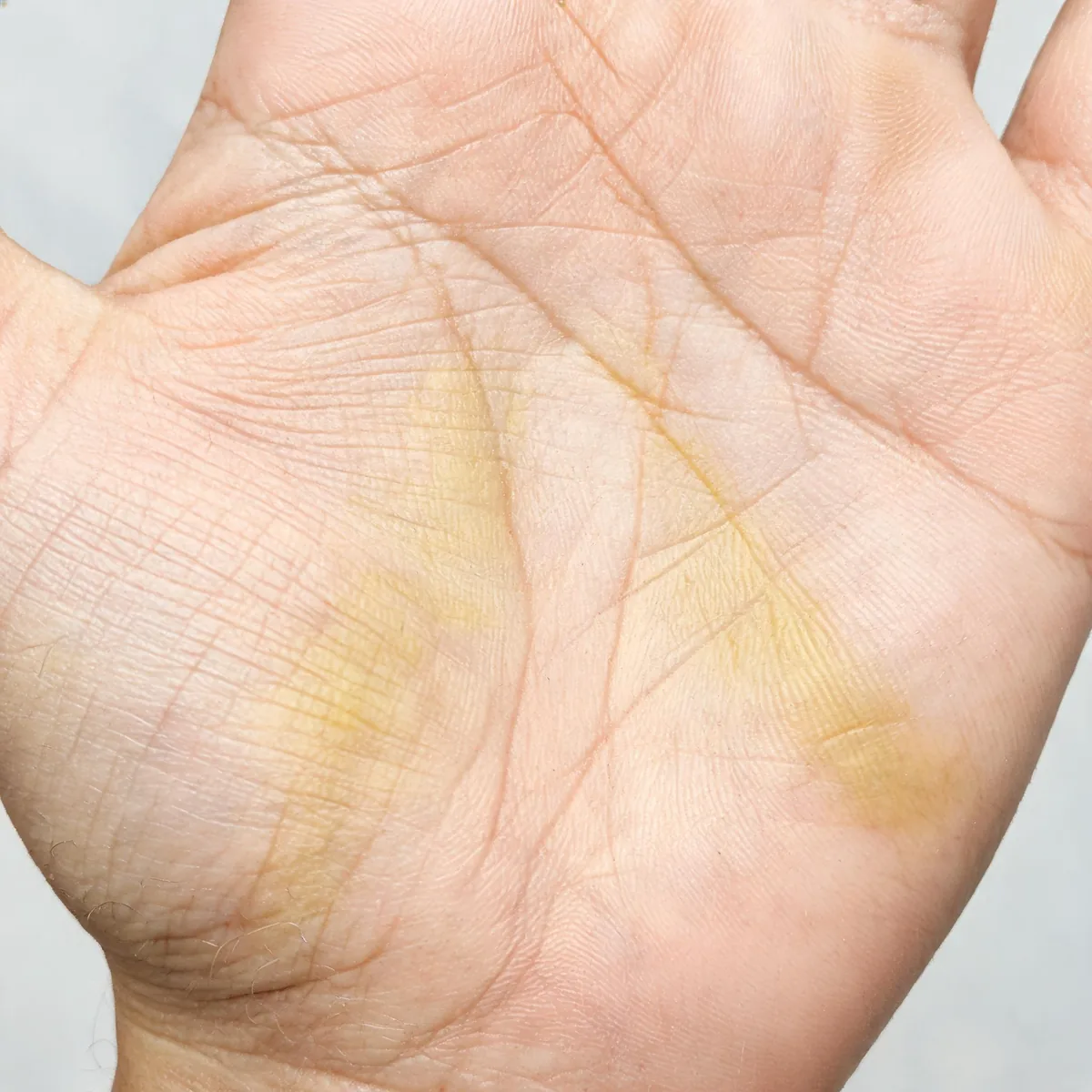
Understanding Dark yellow skin
The classical literature separates yang jaundice, bright and orange from damp heat, from yin jaundice, which is dark, dull and smoky.
This page is about the dark type. It almost always involves the Spleen, the organ that transforms food and fluids, and it develops more slowly than the bright type.
Cold-Damp invading the Spleen gives dull dark yellow skin like a smoke stain, with upper abdominal fullness, heaviness in the limbs, loose or watery stools and poor appetite. The yellow is described as unpolished rather than bright.
Blood Stagnation gives a different picture again: fixed stabbing pain under the ribs, a dark purple or dusky tongue with stasis spots, a dark sallow complexion and lips, possible hard lumps or masses in the abdomen, and pain worse at night. This is the pattern where the jaundice is a sign of obstruction, not just dampness.
The distinction that matters is not how yellow the skin looks but how it behaves. Bright, glossy, almost orange colouring that arrives over days belongs to damp heat and is treated by cooling and draining. The dull, smoky, unpolished shade described here develops over months, feels cold to the patient and points to a Spleen that has lost its warming power.
Two mechanisms are recorded, and they often occur in sequence rather than as alternatives. Cold and dampness first weaken the Spleen so that fluids are no longer transported; the resulting dampness obstructs the Liver and Gallbladder, and bile, unable to follow its usual path, colours the skin. If that obstruction lasts for years the movement of Blood slows as well, and the second mechanism, stasis, darkens the complexion further and may produce a lump that can be felt. This is why the tradition describes yin jaundice as a slow condition needing warmth applied patiently rather than one strong remedy.
Conventional view
In Western medicine dark yellow skin is usually jaundice, the yellowing of skin and the whites of the eyes caused by a raised bilirubin level. Bilirubin is a yellow pigment made when red blood cells break down; the liver processes it and excretes it in bile, so jaundice appears when the liver is damaged, the bile ducts are blocked, or red cells are destroyed faster than the liver can cope. Doctors investigate with blood tests for bilirubin and liver enzymes, ultrasound or CT imaging, and sometimes a liver biopsy to find the cause, which ranges from hepatitis and gallstones to cirrhosis or pancreatic cancer.
Treatment follows the cause: acute viral hepatitis may need only rest and supportive care, gallstones or tumours may need surgery, chronic liver disease may be managed with drugs such as ursodeoxycholic acid or antivirals, and dangerously high bilirubin in newborns is treated with phototherapy. In many adult cases the focus is on managing the underlying condition, because no medicine directly clears jaundice.
Conventional medicine is strong at identifying the structural or infectious cause, but once the acute problem is addressed patients are often left with fatigue, poor appetite and a dull yellow complexion that will not lift, and liver enzymes can normalise while the person still feels unwell. It does not rebuild the digestive and circulatory function that allowed the jaundice to settle, which is the gap TCM addresses.
Selected PubMed records
Real PubMed records for the conventional discussion above, selected by condition name and title relevance. They are references, not a claim that any treatment is proven for this condition.
- Guideline for the Evaluation of Cholestatic Jaundice in Infants: Joint Recommendations of the North American Society for Pediatric Gastroenterology, Hepatology, and Nutrition and the European Society for Pediatric Gastroenterology, Hepatology, and Nutrition.. Journal of pediatric gastroenterology and nutrition, 2017. PMID: 27429428.
How it connects
The classical literature groups this complexion with abdominal distension and fullness, a cold sensation in the abdomen, aversion to cold and loss of appetite. The link is mechanical rather than coincidental: the same dampness that stains the skin also sits in the middle burner, so appetite falls, the belly feels tight and cold, and the limbs stay chilly because the Spleen's warmth is not reaching them. Warming and Spleen-strengthening treatment is described as relieving the complexion and the digestive complaints at the same time.
How it is assessed
The practitioner distinguishes the two kinds of jaundice by colour and associated signs.
What a practitioner looks for
- Colour: bright orange-yellow suggests yang jaundice from damp heat; dull smoky dark yellow suggests yin jaundice.
- Digestion: loose stools, bloating and heaviness accompany cold-damp.
- Pain: fixed stabbing rib pain with dark tongue suggests Blood stagnation.
- Red flags: sudden yellowing, confusion, fever or abdominal pain need urgent medical care.
Jaundice is a sign that always needs medical investigation first, so a TCM consultation usually runs alongside blood tests and imaging rather than replacing them. Within the pattern reading, the practitioner begins with how the yellow looks: a smoky greyish tone with cold limbs and a feeling of heaviness indicates cold-damp, while a deeper sallow colour in someone with long-standing liver trouble suggests that stasis has been added.
The abdomen and the tongue carry much of the evidence. A soft distended upper abdomen with a thick white greasy coat and a slow, soggy or slippery pulse supports cold-damp, while stabbing pain that stays under the ribs, a lump that can be felt, a dusky purple tongue with distended veins beneath it and a choppy or wiry pulse point to Blood Stagnation. Questions about dark stools, nosebleeds and pain that wakes the patient at night are asked because bleeding and fixed pain change both the urgency and the formula.
TCM patterns in Dark yellow skin
Two patterns are recorded, best understood as stages of one process rather than rivals. In the first, cold and dampness overwhelm the Spleen's warming function, so fluids gather, the middle of the body feels full and cold, and bile is pushed out into the skin to leave a dull smoky stain. In the second, years of that obstruction slow the movement of Blood, and the complexion deepens towards a sallow olive tone that warmth alone will not shift. Asking which pattern leads is practical: heaviness, cold limbs, loose stools and a thick greasy coat put cold-damp first, while fixed rib pain, a mass in the abdomen, a purple tongue and pain worse at night put stasis first. Many patients show both, and the classical literature is explicit that this is normal. What changes is emphasis, since warming and drying lead in one case and moving Blood and softening masses in the other, always within a warming frame.
| Pattern | Key signs | The itch | Tongue | Main formula |
|---|---|---|---|---|
| Cold-Damp invading the Spleen | Dull dark yellow skin like a smoke stain | Not specified | Body: Pale and swollen with teeth marksCoat: Thick white greasy, and excessively wet | Not specified |
| Blood Stagnation | Fixed stabbing pain under the ribs; Pain worse at night | Not specified | Body: Purple, dusky or with dark stasis spots; sublingual veins dark and distendedCoat: Often thin white; a yellow coat would suggest Heat as the cause | Not specified |
Cold-Damp invading the Spleen
Dull smoky yellow skin with heaviness and loose stools.
The Spleen is described as the organ that transforms food and moves fluids, and it needs warmth for that work. When cold and dampness arrive together, from cold raw food, damp weather or a constitution that was never strong, the transforming function slows, fluids gather as dampness, and that dampness sits in the middle of the body and blocks the free passage of Liver and Gallbladder Qi. Bile is then forced out of its channel and stains the skin, but because the underlying state is cold the colour has no shine to it. The result is described as a complexion like smoke, and it comes with a body that feels heavy, bloated and easily chilled.
Tongue and pulse agree with that picture: a pale swollen tongue with teeth marks and a thick white greasy coat, and a pulse that is slow and either soggy or slippery. Cold weather, damp rooms, heavy meals and long hours sitting still all make the complexion duller, while warmth, ginger and cinnamon tea, moxibustion over the abdomen and gentle daily movement make it clearer. Yin Chen is the herb the classical literature treats as central for any jaundice, supported by Gan Jiang to warm the middle and Bai Zhu to strengthen the Spleen and dry dampness. Points recorded for the pattern are Zusanli (ST-36), Yinlingquan (SP-9), Zhongwan (REN-12) and Pishu (BL-20), with moxibustion used where cold dominates.
Signs
- Dull dark yellow skin like a smoke stain
- Bloating and upper abdominal fullness
- Heavy feeling in body and limbs
- Loose or watery stools
- Poor appetite
Diet and lifestyle for this pattern: Eat warm cooked food such as soups, stews and congee, with warming spices such as ginger, cinnamon and pepper. Avoid raw, cold and greasy food that burdens the Spleen, keep the abdomen warm, and consider moxibustion at the navel to support Yang.
Blood Stagnation
Dark sallow complexion with fixed rib pain and abdominal masses.
When cold-damp has blocked the Spleen for years, the Qi that should move Blood loses its push, and the blood itself becomes sluggish. Bile that is already seeping into the skin is joined by stagnant blood, and the complexion deepens from a smoky yellow to a darker sallow tone that looks fixed rather than changing. Stasis explains the rest of the picture: pain that stays in one place under the ribs, worse at night, a lump that can be felt in the abdomen, and dark lips. In the classical literature this is the pattern of long-standing liver and spleen enlargement rather than of a recent illness.
The tongue is the clearest guide: a dusky or purple body, stasis spots, dark distended veins beneath the tongue and a thin white coat, with a choppy pulse compared to a knife scraping bamboo, or a wiry one. Cold, inactivity and emotional stress congeal Blood further, while warmth, gentle exercise and light warm meals help it move. Bie Jia Jian Wan is the formula recorded for this presentation, softening hardness and moving Blood with Bie Jia, Chi Shao, Tao Ren and wine-fried Da Huang. Points are Xuehai (SP-10), Geshu (BL-17), Taichong (LR-3) and Yanglingquan (GB-34).
Signs
- Fixed stabbing pain under the ribs
- Dark purple or dusky tongue with stasis spots
- Dark sallow complexion and lips
- Hard lumps or masses in the abdomen
- Pain worse at night
Diet and lifestyle for this pattern: Eat warm cooked food and avoid raw, cold or greasy items that promote Dampness. Gentle daily movement such as walking or tai chi keeps Blood flowing, and long periods of sitting or lying down work against it.
Treatment approach
How the tradition treats dark yellow skin, with the herbs, formulas and points used for it.
Principles
- Establish the medical cause: jaundice always needs investigation of the liver and bile ducts.
- Warm the Spleen and drain cold-damp in the cold-damp pattern.
- Move Blood and resolve stasis where the pattern is stagnation with masses.
- Avoid alcohol and hepatotoxic substances entirely during any liver-related illness.
- The root in both patterns is a loss of warmth and movement in the middle, so treatment warms and dries before it does anything else, and clearing heat would be the opposite of what is needed. Within that frame the branch changes: cold-damp calls for warming aromatic herbs and moxibustion, while stasis calls for moving Blood and softening masses, usually with a warming herb kept in the formula.
Herbs used
Formulas
Acupoints
- ST-36 (Zusanli)
- SP-9 (Yinlingquan)
- zhongwan-ren-12
- BL-20 (Pishu)
- SP-10 (Xuehai)
- BL-17 (Geshu)
- LR-3 (Taichong)
- GB-34 (Yanglingquan)
What to expect
- The tradition describes gradual improvement in the cold-damp pattern over weeks.
- Blood stagnation with masses needs both herbal and medical assessment.
- Jaundice that worsens or appears suddenly needs urgent care, not a waiting approach.
- The classical literature gives two timelines. In cold-damp, digestion and a little colour usually improve within three to four weeks when herbs are taken daily and acupuncture weekly, with the full course running six to eight weeks. Where stasis or an enlarged liver and spleen is present, three to six months of steady treatment is expected, and pain often eases before the colour changes.
Safety and when to get help
Seek medical help urgently for
- Sudden or severe yellowing of the skin or eyes.
- Confusion, drowsiness, vomiting blood or black stools.
- Yellowing with fever, severe abdominal pain or a rapidly shrinking liver.
For anything severe, sudden or spreading quickly, read when a skin problem needs urgent care.
Cautions
- Jaundice always needs medical investigation.
- Do not take unregulated herbal products during liver disease.
- Alcohol must be avoided completely.
Using this alongside conventional care
- This page is educational only: jaundice requires medical diagnosis, and herbs must be supervised where liver function is impaired.
- Herbs are described as compatible with the usual medical management of liver disease, including antiviral treatment, ursodeoxycholic acid and care for autoimmune liver conditions, provided both teams know what is being taken. Da Huang, used in stasis formulas, can affect potassium and needs watching in anyone on diuretics or heart medicine. Give the hepatologist or family doctor an ingredient list, and never change or stop a prescribed medicine in order to take herbs.
Diet and lifestyle
- Eat warm cooked easily digestible food, and avoid alcohol, greasy and raw food.
- Food is treated as part of the treatment here rather than as background advice. Warm cooked and easily digested meals, congee, soups, stews and steamed vegetables, with warming spices such as ginger, cardamom, cinnamon and a pinch of black pepper, are the base, and small amounts of lean protein with well-cooked rice or millet help rebuild strength. Raw salads, iced drinks, ice cream, dairy, fried food and sweets all add dampness or chill the digestive fire, and alcohol is described as damaging enough to be left out entirely.
If you're pregnant
Jaundice in pregnancy is serious and needs immediate medical evaluation. The standard Cold-Damp formula Yin Chen Shu Fu Tang contains Fu Zi, which is strictly contraindicated in pregnancy because of its toxicity and risk of miscarriage, and even external use of aconite is avoided.
Treatment is modified: warming herbs such as Gan Jiang and Rou Gui can replace Fu Zi under experienced guidance, while Yin Chen and Bai Zhu are traditionally used for reducing jaundice, with limited trial evidence, and jaundice in pregnancy needs medical assessment so herbal treatment should not delay it. Acupuncture and moxibustion are preferred in the first trimester, using points such as Zusanli (ST-36) and Zhongwan (REN-12) to strengthen the Spleen.
If you're breastfeeding
Fu Zi passes into breast milk and can be toxic to the infant, so it must be avoided while nursing. The blood-moving herbs in Bie Jia Jian Wan, including Tao Ren and Chi Shao, are also best avoided because they may cause loose stools or digestive upset in the baby.
Safer choices include Yin Chen, Bai Zhu and Fu Ling, which are gentle and unlikely to affect the infant, and moxibustion on the abdomen and lower back is a drug-free way to warm the Spleen and dispel Dampness while the formula is adjusted.
If treating a child
In children jaundice of this kind usually reflects a constitutionally weak Spleen combined with cold exposure or improper feeding, with dull yellow skin, poor appetite, abdominal distension and loose stools. Children's organs are delicate, so treatment is gentle and doses are a quarter to a half of the adult dose by age and weight.
Fu Zi is used only with extreme caution and rarely; milder warming herbs such as Gan Jiang and Bai Zhu are preferred. Moxibustion on Shenque (REN-8) and Zusanli (ST-36) is traditionally used, with limited trial evidence, and acupuncture is given very shallowly or replaced by acupressure.
If treating an elderly patient
Older patients with dark yellow skin usually have underlying Spleen and Kidney Yang deficiency, so the Cold-Damp pattern is more entrenched, and chronic illness often adds Blood Stagnation. Treatment takes longer and tolerance for strong warming or blood-moving herbs is lower, so doses are about two-thirds of the adult dose.
Fu Zi carries a higher toxicity risk where kidney function is reduced, so mild warming herbs such as Gan Jiang and Rou Gui are used instead. Moxibustion gives deep warmth without taxing digestion, and herb-drug interactions need screening because many older patients take multiple medicines.
Urgent-sign guidance is based on standard sources: NHS anaphylaxis, NHS cellulitis, NHS Stevens-Johnson syndrome, NHS melanoma.
Evidence
Evidence status
Compiled for this page from the classical and modern literature; not a systematic review, so treat it as a pointer to sources rather than clinical guidance.
Evidence draws on Chinese-language randomised trials and case series. The 2023 Chinese Expert Consensus on TCM Diagnosis and Treatment of Jaundice synthesised it and gave moderate-quality recommendations for Yin Chen Shu Fu Tang in Cold-Damp invading the Spleen and Bie Jia Jian Wan in Blood Stagnation, with reductions in serum bilirubin and improved symptoms in chronic hepatitis B and other liver disease. High-quality placebo-controlled trials remain lacking.
The evidence recorded here comes mostly from Chinese-language trials and case series rather than from placebo-controlled work published in English. A 2023 expert consensus reviewed that material and supported both formulas at moderate quality, reporting falls in bilirubin and better symptoms in other liver disease as well as chronic hepatitis B, while noting small samples and methodological weaknesses throughout. Moxibustion and acupuncture for yin jaundice appear only in pilot work, which looks promising but cannot support firm conclusions.
Studies often cited
Recommended at moderate quality for the Cold-Damp invading the Spleen pattern, with reduced bilirubin and improved symptoms in chronic hepatitis B. 2023 Chinese Expert Consensus on TCM Diagnosis and Treatment of Jaundice (as recorded in the source)
Recommended at moderate quality for the Blood Stagnation pattern, used in chronic liver disease. Same consensus (as recorded in the source)
Classical record
Jaundice arising from cold-dampness is called yin jaundice. Treatment should warm the middle burner and transform dampness.
- Sheng Ji Zong Lu (Comprehensive Recording of Divine Assistance), chapter on jaundice. The Chinese original is not reproduced here: it could not be recovered reliably from the source record, and is not guessed.
Common questions
What is yin jaundice?
The dark, dull type of jaundice, described as coming from cold-damp or Blood stagnation, as opposed to the bright orange type from damp heat.
Is this different from hepatitis?
The framework describes a pattern, not a diagnosis. Jaundice needs medical assessment for liver, bile duct and blood causes.
Can herbs treat jaundice?
Only with medical supervision. Jaundice is a sign of disease that must be diagnosed and monitored.
When is it urgent?
Sudden yellowing, confusion, fever, severe abdominal pain or bleeding.
What is the difference between bright and dark yellow jaundice?
Bright orange-yellow colouring that arrives quickly alongside fever, thirst and a fast pulse is read as damp heat and needs cooling, draining treatment. The dark smoky shade described on this page is more chronic, brings chilliness and heaviness with a thick coat on the tongue, and needs warming and moving instead.
Can herbs alone clear up my dark yellow skin?
Herbs are the core of treatment because they work directly on the Spleen's warmth, on dampness and on Blood that has stopped moving. Acupuncture and moxibustion support that work by warming the channels that govern digestion and circulation, and the classical literature suggests most people do best with herbs, acupuncture and diet together, since herbs alone are slower.
Is it safe to take Chinese herbs if I am already on liver medication?
Many of the herbs used here are considered safe, but some, prepared Da Huang among them, can interact with medicines or shift electrolyte balance. Bring the full medication list to the practitioner, who can adjust the formula, and do not stop or reduce a prescribed drug without the prescriber's agreement.
Can TCM help if my jaundice comes from cirrhosis or a tumour?
It is described as a support rather than a replacement. Herbs and acupuncture may ease fatigue, improve daily comfort and sometimes lighten the colour, but they do not substitute for cancer treatment or for the medical management of advanced liver disease, and treatment is best planned alongside the liver team.
How soon will my skin colour improve?
Most people notice the complexion beginning to brighten within three to four weeks, while the whites of the eyes clear more slowly. Where the yellowing has lasted many months, or a lump can be felt, three to six months is a more realistic horizon, and sticking with herbs and diet is what the classical literature credits for the change.