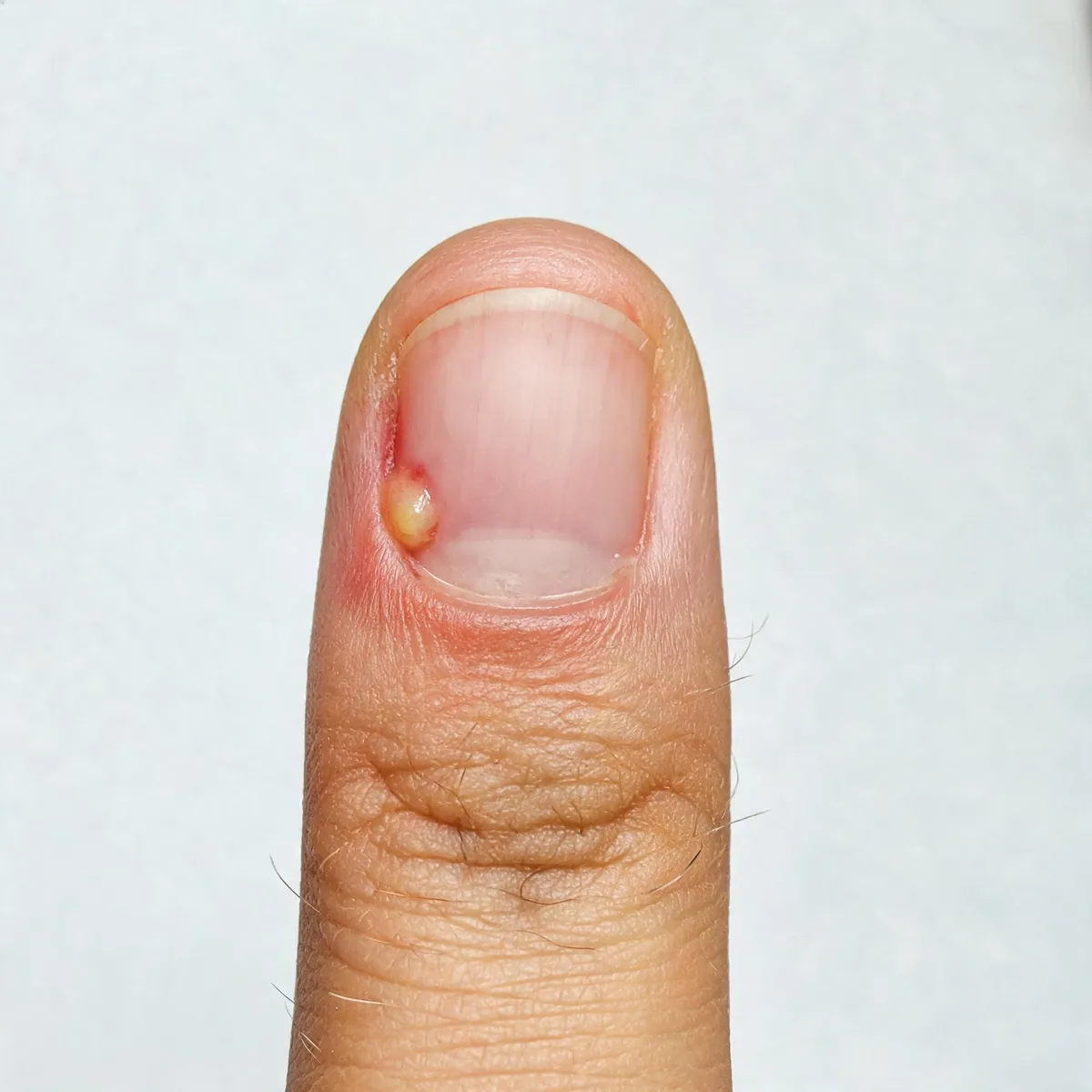
Understanding Paronychia
The tradition describes paronychia as an invasion of external pathogens, usually heat or damp heat, entering through a small break in the skin around the nail.
Toxic-Heat stagnation gives intense local heat and throbbing pain with bright redness and swelling around the nail, a hard pus head, fever, intense thirst and dark scanty urine. That is an abscess forming and needs drainage.
Damp-Heat gives a boggy heavy-feeling swelling rather than tight dry redness, with weeping or oozing from the lesion and worsening in damp humid weather.
Blood Stagnation with Heat gives dark purplish-red swelling around the nail with stabbing fixed pain rather than simple throbbing, worse at night and with pressure, plus a sensation of heat.
Paronychia begins where the nail meets the skin fold, a narrow seam that a hangnail, a manicure tool, or a bitten cuticle can open. Once that seam is breached, the outcome depends on the strength of the body's defensive Qi: a sturdy surface pushes the invader out within days, while a weakened one lets Heat and Dampness settle into the tissue and build towards an abscess.
The fingertips are the end point of the Spleen and Stomach channels, so what happens at the nail reflects how digestion is working. Rich, sweet, fried, and spicy food breeds internal Dampness and Heat, and that turbid mixture travels out to the extremities, priming the nail fold for infection. Frustration and unexpressed anger can add Liver Fire, which rises and joins with external toxin to create a swelling that throbs angrily.
Once infection takes hold, local Qi and blood stop moving freely, and that stagnation produces the swelling, the pain, and eventually the pus. Heat left to smoulder damages the fluids and the blood in the area, which is how an acute red boil turns into the dusky, hard, poorly healing lesion that the classical literature treats as a separate pattern. The tongue, the pulse, and the exact feel of the swelling tell a practitioner which stage is dominant.
Conventional view
Paronychia, in conventional terms, means infection of the fold of skin that runs along the side of the nail. The acute form usually follows a small injury such as a torn cuticle, a rough manicure, or bitten nails, and bacteria, most often Staphylococcus aureus, are responsible. The fold becomes red, warm, swollen, and painful, and pus may collect. The chronic form comes on gradually in hands that are often wet, and bacteria and yeast may both be involved. Appearance is usually enough to make the diagnosis, and treatment aims to drain pus, keep the area dry, and clear the organism.
For an acute infection, standard care is a course of warm soaks, incision and drainage once pus has collected, and oral antibiotics if the infection is spreading, with ordinary painkillers for comfort. Chronic paronychia is handled by keeping hands out of water, avoiding irritants, and applying topical steroid or antifungal preparations; where the disease is stubborn or keeps returning, part of the nail can be removed to let the area drain and heal.
Antibiotics and drainage deal well with the acute episode but say nothing about why the tissue gave way, so recurrence is common, particularly in chronic paronychia and in people whose hands are repeatedly wet. Conventional care also treats every paronychia alike, whereas the patient whose lesions flare with stress and rich food and the patient whose lesions fester in humid weather are not the same, which is where a pattern-based approach adds something.
Selected PubMed records
Real PubMed records for the conventional discussion above, selected by condition name and title relevance. They are references, not a claim that any treatment is proven for this condition.
- Acute and Chronic Paronychia.. American family physician, 2017. PMID: 28671378.
How it connects
Paronychia frequently appears alongside other skin infections such as boils and abscesses because they share a root in TCM: invasion of Toxic-Heat or accumulation of Damp-Heat. When defensive Qi is weak or the skin barrier is broken, the same pathogenic factors that trigger a boil elsewhere can settle around the nail fold, and this clustering signals an internal environment that is overheated and toxic rather than a series of isolated local problems. Where Damp-Heat predominates, paronychia on the toes often coexists with athlete's foot, since heavy turbid Dampness sinks downward and creates a moist warm habitat that breeds both fungal and bacterial infection; draining Dampness and clearing Heat often resolves both at once. Recurrent crops of paronychia and boils can also point to a deeper deficiency rather than a series of unlucky local events. The usual suspects are a Spleen too weak to transform dampness, or a Yin deficiency that generates empty heat. In these people the infection is a surface expression of an internal imbalance, so treatment after the acute phase turns to the constitution, and a practitioner looks well beyond the nail before deciding what to prescribe.
How it is assessed
The practitioner examines the nail fold and the extent of spread.
What a practitioner looks for
- Pus: a hard pus head with throbbing suggests Toxic-Heat stagnation.
- Swelling quality: boggy oozing suggests Damp-Heat.
- Colour: dark purplish with stabbing pain suggests Blood stagnation with heat.
- Red flags: red streaks up the arm, fever, or spreading swelling.
A practitioner starts at the nail fold and asks how the trouble began, because the speed and the texture of the swelling carry most of the diagnostic weight. A bright, tense, throbbing boil that appeared within a day of a small cut reads differently from a boggy swelling that crept in over a week of sweaty work. Reading the tongue and the pulse comes afterwards, to confirm what the tissue has already suggested.
When Toxic-Heat Stagnation dominates, the tissue beside the nail is a vivid angry red, hot to the touch, and exquisitely tender, with a yellow pus head usually visible or forming. The pulse is rapid and forceful, as though the body were throwing everything at a strong local invasion, and the tongue looks red under a yellow coat that is thick and dry.
If Damp-Heat is behind it, the swelling feels spongy and heavy rather than tightly hard; there may be a greasy film or some oozing, and the discomfort is a dull ache rather than a sharp throb. The pulse is slippery and rapid and the coating thick, yellow, and greasy, and the picture is commoner on the toes and in people whose hands or feet are often wet. In Blood Stagnation with Heat the nail area is dusky or purplish, the pain is stabbing and fixed, and the history usually runs through several failed attempts to clear it. The tongue body looks dark, speckled with tiny stasis spots; the pulse is choppy or wiry, the sign of heat congealing blood in the small vessels.
TCM patterns in Paronychia
Three patterns are described for an inflamed nail fold, and telling them apart begins with what the swelling is doing. A tight, bright, hot lesion with a hard pus head that came up fast belongs to Toxic-Heat Stagnation, where an external pathogen has met internal fire. A boggy, heavy, weeping swelling that lingers and flares in humid weather belongs to Damp-Heat, where turbidity thickens the picture. A dusky, purplish, hard swelling with stabbing pain that has dragged on for weeks belongs to Blood Stagnation with Heat, where unresolved toxin has obstructed the small vessels around the nail. These are less separate diseases than stages that follow one another, since a boil that is not fully cleared may turn boggy, and a boggy lesion left alone may turn dusky. Practitioners weigh the tongue, the pulse, and the discharge to decide what to address first.
| Pattern | Key signs | The itch | Tongue | Main formula |
|---|---|---|---|---|
| Toxic-Heat Stagnation | Intense local heat and throbbing pain; Bright redness and swelling around the nail with a hard pus head | Not specified | Body: Deep red or crimson with raised red pointsCoat: Thick, dry and yellow | Not specified |
| Damp-Heat | Boggy heavy-feeling swelling rather than tight dry redness; Weeping or oozing fluid from the lesion | Not specified | Body: Red, often swollen with teeth marksCoat: Yellow, greasy and thick, usually in the middle and at the root | Not specified |
| Blood Stagnation with Heat | Dark purplish-red swelling around the nail; Stabbing fixed pain rather than throbbing | Not specified | Body: Reddish-purple, with stasis spots and dark sublingual veinsCoat: Thin, dry and yellow | Not specified |
Toxic-Heat Stagnation
Throbbing nail-fold abscess with bright redness and fever.
This is the classic acute paronychia of the textbooks: heat or toxin enters through a small break beside the nail, or internal fire from spicy food and stress surges up to the fingertips. The heat congeals in the local tissue and blocks the movement of Qi and blood, so the fold becomes red, swollen, hot, and throbbing, and a hard pus head forms as the stagnation deepens.
The pulse is rapid and forceful, sometimes overflowing, and the tongue is deep red under a coating that is thick, dry, and yellow, often with prickly papillae showing. Spicy, fried, and greasy food, alcohol, humid heat, anger, and squeezing or picking at the lesion all make it worse, whereas cool compresses, light cooling food, and resting the hand ease it. Huang Lian Jie Du Tang is the internal formula, with Pu Gong Ying and Jin Yin Hua supporting it, and the points used to clear the heat are Quchi (LI-11), Dazhui (DU-14), and Hegu (LI-4).
Signs
- Intense local heat and throbbing pain
- Bright redness and swelling around the nail with a hard pus head
- Fever with intense thirst
- Dark scanty urine
Diet and lifestyle for this pattern: Eat plenty of cooling, light food such as cucumber, watermelon, mung beans and leafy greens, and strictly avoid spicy, greasy and fried food as well as alcohol and coffee, which add Heat. Keep the affected finger clean and dry, never squeeze or pick at the pus-head, and a cool compress can soothe the throbbing while protecting the area from irritation.
Damp-Heat
Boggy oozing swelling in damp weather.
Dampness is heavy and turbid. Once Heat joins it and the mixture settles around the nail bed, the result is a swelling that feels boggy rather than tight, that may weep fluid, and that refuses to settle. The wet sluggish environment suits the pathogen, which is why this form lingers where pure Toxic-Heat would resolve, and why it flares when the weather turns humid or when digestion is already producing dampness.
The tongue is red with a thick yellow greasy coating, and the pulse is slippery and rapid. Humid weather, heavy greasy sweet food, long hours of sitting, alcohol, rich meals, and stress that stagnates Qi all worsen it, while a cool dry room, light digestible meals, keeping the area clean and dry, and gentle exercise help. Wu Wei Xiao Du Yin, often with Fu Ling and Yi Yi Ren added to drain dampness, is the formula; Pu Gong Ying, Yi Yi Ren, and Huang Qin are the herbs, and Yinlingquan (SP-9), Quchi (LI-11), and Hegu (LI-4) are the points.
Signs
- Boggy heavy-feeling swelling rather than tight dry redness
- Weeping or oozing fluid from the lesion
- Worse in damp humid weather
- Heavy body sensation
Diet and lifestyle for this pattern: Avoid heavy, greasy, sweet and dairy-rich food that creates internal Dampness. Eat light, easy meals such as congee with barley or lightly steamed vegetables, keep the affected area clean and dry, avoid long exposure to humid environments, and keep moving gently so the Spleen transforms Dampness.
Blood Stagnation with Heat
Dark purplish nail fold with stabbing night pain.
When an infection never quite resolves, the original heat and toxin remain in the small vessels around the nail. The trapped heat keeps smouldering and the obstructed flow leaves a dark, purplish, hard swelling with a stabbing quality rather than a simple throb. Because blood is literally stuck, the pain is sharper and more fixed, and it deepens overnight, when stillness lets circulation slow.
The tongue body is reddish-purple, marked with stasis spots or patches, its sublingual veins distended, under a thin yellow coat that has dried. The pulse is choppy and rapid, often wiry at the left Guan position. Spicy, greasy, and fried food, alcohol, direct pressure, anger, and humid heat aggravate it, while cool compresses, elevation of the hand, and cooling light food relieve it. Xue Fu Zhu Yu Tang invigorates the blood and clears the lingering heat, with Dan Shen, Chi Shao, and Hong Hua, and the points are Xuehai (SP-10), Sanyinjiao (SP-6), Quchi (LI-11), and Hegu (LI-4).
Signs
- Dark purplish-red swelling around the nail
- Stabbing fixed pain rather than throbbing
- Pain worse at night and with pressure
- Sensation of heat
Diet and lifestyle for this pattern: Keep the affected finger clean and dry and avoid squeezing or pressing the swelling. Eat cooling, blood-moving food such as celery, hawthorn berries and mung beans, strictly avoid alcohol, spicy dishes and greasy fried food that add Heat, and a short cool compress can ease the burning without putting ice directly on the skin.
Treatment approach
How the tradition treats paronychia, with the herbs, formulas and points used for it.
Principles
- Seek medical drainage and antibiotics where indicated; this is an infection.
- Clear heat and resolve toxicity in the acute abscess picture.
- Drain dampness where the swelling is boggy and oozing.
- Move Blood where the nail fold is dark and pain is fixed.
- The root and branch strategy is to clear Heat and toxin at the nail fold while strengthening the body's capacity to finish the job, which is why internal formulas and external washes or pastes are almost always prescribed together. Points on the Yangming channels, Quchi (LI-11) and Hegu (LI-4), draw Heat away from the extremity, and the formula is changed as the lesion moves from fiery to boggy to dusky.
Herbs used
Formulas
Acupoints
What to expect
- Treated paronychia usually improves within days.
- Abscesses resolve faster after drainage.
- Spreading infection up the finger or hand needs urgent care.
- Acute cases usually settle within days of daily decoctions and acupuncture every two or three days, with the swelling softening and draining before the skin closes. Once the pain eases the sessions are spaced out and the formula shifts towards healing the skin and preventing a recurrence, while chronic cases often need weekly treatment for three or four weeks plus a change in diet. Normal activity can continue, though resting the finger speeds things up.
Safety and when to get help
Seek medical help urgently for
- Red streaks spreading from the finger toward the hand or arm.
- Fever or chills.
- Rapidly spreading swelling, severe pain, or a collection of pus that needs drainage.
For anything severe, sudden or spreading quickly, read when a skin problem needs urgent care.
Cautions
- Do not cut or squeeze the nail fold at home.
- People with diabetes need prompt care for hand infections.
- Avoid nail biting and cuticle picking, which create the entry point.
Using this alongside conventional care
- This page is complementary: drainage and antibiotics where needed come first, and herbs support the pattern alongside.
- Keep taking any prescribed antibiotic exactly as directed; the herbs and the needles work alongside it rather than against it, and may shorten the course by helping the body clear the infection completely. Anyone taking warfarin, aspirin, clopidogrel, or with a bleeding disorder must tell the practitioner, because blood-invigorating herbs such as Dan Shen, Chi Shao, and Hong Hua can add to the bleeding risk. Give both your doctor and your practitioner a full list of medicines and supplements, and never stop a prescribed drug without medical advice.
Diet and lifestyle
- Avoid spicy, greasy and fried food and alcohol while the infection is active.
- While the infection is active, keep food cooling and easy to digest, with plenty of water alongside fresh vegetables and light soups, and mung bean soup or chrysanthemum tea as traditional helpers. Spicy chillies, curries, excess garlic, fried food, sugar, dairy, and alcohol all generate Heat or Dampness and should be left out. For the boggy Damp-Heat form, choose lightly steamed vegetables or a barley congee and avoid heavy sweet dairy-rich food; for the dusky stagnation form, add cooling blood-moving foods such as celery, hawthorn berries, and mung beans. Once the lesion has healed these foods can return as occasional treats rather than daily staples.
If you're pregnant
Pregnancy rules out the stronger formulas used here. Huang Lian Jie Du Tang contains bitter-cold herbs such as Huang Lian and Huang Qin, used with caution in pregnancy, and Xue Fu Zhu Yu Tang contains Tao Ren and Hong Hua, contraindicated because they can move blood strongly enough to threaten the pregnancy. Mild topical soaks or compresses of Pu Gong Ying or Jin Yin Hua clear Heat and toxin with little systemic absorption. Distal needling at Quchi (LI-11) is preferred to needling near the infected nail, which risks pushing infection deeper, and Hegu (LI-4) is used cautiously because strong needling there can encourage labour. Work with a practitioner experienced in pregnancy care.
If you're breastfeeding
The concern here is transfer through breast milk. Bitter-cold herbs such as Huang Lian and Huang Bai can cause loose stools or digestive upset in a baby, so for the acute Toxic-Heat form the gentler route is a topical wash, or mild Heat-clearing herbs such as Pu Gong Ying and Jin Yin Hua rather than an oral formula. Acupuncture carries no risk of transfer and works well, with Dazhui (DU-14) and Quchi (LI-11) clearing Heat without affecting the infant. If an oral formula is needed, use the smallest dose that works, for as short a time as possible, and watch the baby's stools and mood.
If treating a child
Paronychia is common in children, usually after nail-biting, finger-sucking, or a small cut during play, and the Toxic-Heat form is what is most often seen, with bright redness, swelling, and throbbing pain coming on quickly. Because children's Qi and blood move readily they can worsen fast but also recover fast. Doses are scaled by age and weight, typically a quarter to a half of the adult amount for the young, and bitter decoctions are often refused, so soaks with Pu Gong Ying and Jin Yin Hua are more practical. Acupuncture may be replaced by acupressure or a single quick needle at Hegu (LI-4). A fever or redness spreading up the finger needs medical review.
If treating an elderly patient
In older patients the infection often sits on Qi and Yin deficiency, so it looks less fiery than in the young yet lingers and heals slowly. The Blood Stagnation with Heat form is commoner here, giving a dusky, stubborn swelling on a background of poor circulation. Harsh cold herbs can upset an already weak Spleen and Stomach, so Wu Wei Xiao Du Yin modified with extra Huang Qi is often preferred, and needling is gentle, with moxibustion at Zusanli (ST-36) to support energy. Blood sugar should be checked, since unrecognised diabetes is a frequent reason these infections keep returning.
Urgent-sign guidance is based on standard sources: NHS anaphylaxis, NHS cellulitis, NHS Stevens-Johnson syndrome, NHS melanoma.
Evidence
Evidence status
Compiled for this page from the classical and modern literature; not a systematic review, so treat it as a pointer to sources rather than clinical guidance.
Evidence consists mainly of small Chinese studies and case series. Topical heat-clearing decoctions, such as modified Wu Wei Xiao Du Yin or Huang Lian Jie Du Tang used as soaks or compresses, are the most studied interventions, reporting high rates of symptom resolution and shorter healing than antiseptic care alone. Quality is limited by small samples, absent blinding and inconsistent outcomes, and acupuncture has been described in only a few reports.
The published base is made up mainly of small Chinese-language clinical studies and case series rather than rigorous trials. Topical decoctions and soaks, including modified Wu Wei Xiao Du Yin and Huang Lian Jie Du Tang, are the most studied intervention, and they generally report high rates of resolution and shorter healing times than antiseptic care alone. Acupuncture appears in observational reports, usually at distal points such as Quchi (LI-11) and Hegu (LI-4), with or without local needling. Small samples, absent blinding, and inconsistent outcome measures limit all of it, and no properly randomised trial has been done, so TCM is best regarded as an adjunct for uncomplicated cases while spreading infection goes to conventional care.
Studies often cited
Soaks and compresses report high symptom resolution rates and shorter healing than conventional antiseptic care alone. Small Chinese studies and case series (as recorded in the source)
Described in only a few reports, with limited evidence. Case reports (as recorded in the source)
PubMed records for the TCM evidence
Real PubMed records for the TCM clinical evidence discussed above, selected by condition name and title relevance. They are references, not proof of benefit.
- Cervical spine infection arising from chronic paronychia: A case report and review of literature.. World journal of orthopedics, 2024. PMID: 39744732.
Classical record
沿爪疔者,生于指甲旁,初起如粟米,痒痛相兼,根深坚硬,形如钉丁之状。
In paronychia, which forms beside the nail, the lesion starts the size of a grain of millet, with itch and pain appearing together; the root lies deep and feels hard, and the shape resembles a nail.
Wai Ke Zheng Zong (Orthodox Manual of External Medicine) - Classical citation: Volume 2, chapter on sores and ulcers.
Common questions
Will it drain on its own?
Sometimes, but an abscess usually needs professional drainage. Do not squeeze it at home.
When is it urgent?
Red streaks up the finger, fever, or rapidly spreading swelling.
Can herbs treat it?
Only as support. Paronychia is a bacterial infection and may need drainage and antibiotics.
How do I prevent it?
Avoid nail biting and cuticle picking, keep hands dry, and treat breaks around the nail early.
How quickly can TCM help my paronychia?
Most people notice less pain and redness within one to two days of starting herbs, particularly in the acute Toxic-Heat form, and the swelling then softens and drains. The skin itself may take about a week to close, while chronic or recurrent cases improve steadily over a longer period.
Can I use TCM alongside antibiotics?
Yes. Herbs and acupuncture work through different mechanisms, supporting the body's own ability to clear infection and settle inflammation, and they do not replace a prescribed course. Tell both practitioners about everything you are taking, especially blood-thinning medication, because blood-invigorating herbs such as Dan Shen and Hong Hua can add a mild anticoagulant effect.
Is acupuncture safe for an infected finger?
Needles are not placed into the infected swelling itself. Points are chosen further along the same channel, on the hand, the arm, or even the opposite limb, so that Heat and toxin are cleared at a distance, and a sterile prick near the nail may occasionally be used to release Heat. Both approaches are safe in trained hands.
Can TCM prevent recurrent paronychia?
Recurrence usually points to an underlying tendency, often Damp-Heat or Spleen Qi deficiency, that keeps the terrain favourable to infection. After the acute episode settles, a practitioner may prescribe herbs and dietary change to clear lingering Dampness, strengthen the Spleen, and reduce how often the problem returns.