Understanding Sunburn
The tradition describes sunburn as an invasion of light toxin, carried by the sun rays, that the skin can normally resist through defensive Qi and its moisture layer.
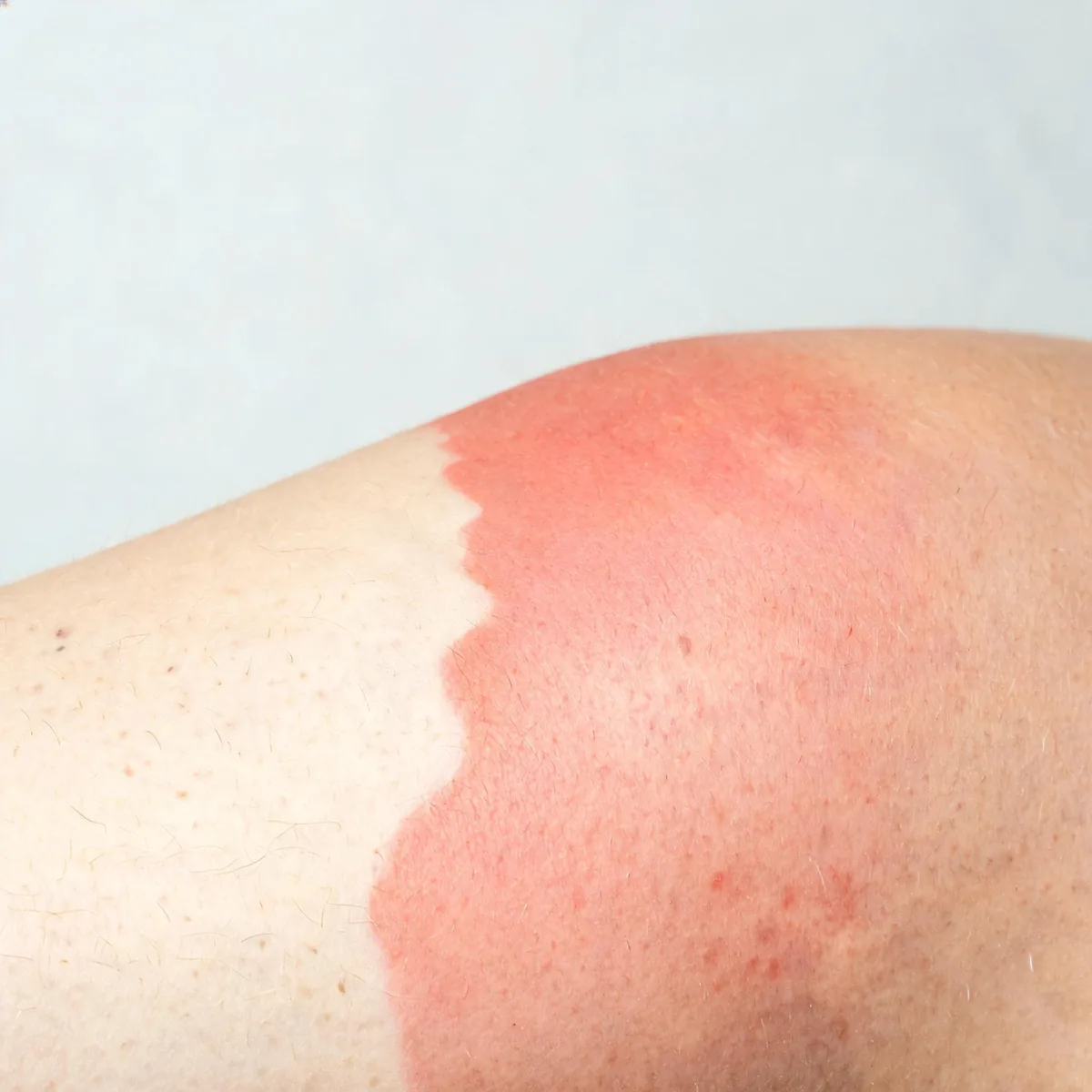
When exposure is too strong, or the defence is already weak, that heat penetrates and burns the surface. The acute picture is Toxic-Heat: intense redness and swelling, burning pain, blisters filled with clear or yellowish fluid, fever and severe thirst.
Heat in the Blood gives deepening redness that worsens in the evening, with restlessness and a furnace-like feeling inside. Damp-Heat gives weeping blisters or yellow crusts with heaviness and a sticky taste, rather than dry peeling.
The later picture is Empty-Heat from Yin deficiency: dry red skin with a lingering burning sensation, worse in the evening, with night sweats and thirst for small sips. Where the skin has been damaged deeper, Blood stagnation with heat gives purplish-red patches with fixed stabbing pain.
The tradition describes the event as a collision at the surface. Fire toxin carried by the sun meets the defensive Qi and the moisture film that normally keep heat out, and where exposure outruns that defence the toxin lodges in the skin. The Lung has charge of the skin and of the pores that open and close, so once that function is disturbed heat cannot be regulated, and redness, swelling and heat follow. Blistering is read as the body containing, then trying to expel, what has entered.
Depth is what the practitioner is judging. Heat that stays near the surface burns and peels; heat that reaches the Blood gives the deep, furnace-like sensation that is worse at night, at the hour when Yin ought to be governing. Dampness changes the picture again, because a body already carrying it produces weeping blisters and crusts instead of dry peeling. Constitutional dryness explains the burn that returns after modest exposure and lingers as a tight red rash.
Conventional view
Conventional medicine treats sunburn as an acute inflammatory injury from ultraviolet radiation, mostly UVB. Within hours the skin reddens, warms, tenderises and hurts, with swelling and blistering in more severe burns, and peeling follows after a few days. The diagnosis rests on the history of exposure and the appearance, and most burns are mild and settle on their own.
First aid is to get out of the sun, cool the skin with compresses or a cool bath, and apply a moisturiser or aloe vera gel. Ibuprofen or aspirin reduce pain and inflammation. Extensive blistering may be treated with a topical corticosteroid and, rarely, oral steroids, and fluids matter because sunburn draws fluid to the surface.
The gap the classical literature identifies is that this relieves the symptom without asking why one person burns so much more easily than another, or why a burn weeps or lingers in one person and peels cleanly in the next. Repeated use of anti-inflammatory drugs and steroids has its own costs, and nothing in the conventional plan strengthens the skin's tolerance over time.
Selected PubMed records
Real PubMed records for the conventional discussion above, selected by condition name and title relevance. They are references, not a claim that any treatment is proven for this condition.
- The terminology of skin disorders. Primary Care, 2000. PMID: 10815043.
How it connects
These pictures are stages more often than separate conditions, which is why they appear together in one person. A severe burn that starts as surface heat can reach the blood within a day, so bright redness and a furnace-like inner heat show at once. Where dampness was already present, weeping and crusting join the picture and change the formula from cooling to draining. A burn that never quite settles usually has Yin deficiency underneath, and one that leaves purple patches has left blood stagnation behind. Reading the stage keeps treatment accurate, and the reading is revised as the skin changes over the following days.
How it is assessed
The practitioner assesses depth, moisture and the constitutional response.
What a practitioner looks for
- Depth: redness alone is superficial; blistering suggests deeper injury.
- Moisture: dry peeling suggests heat in the Blood; weeping and crusting suggests Damp-Heat.
- Systemic signs: fever, severe thirst and restlessness indicate a stronger heat reaction.
- Red flags: extensive blistering, or signs of infection such as pus and increasing pain.
The assessment reads depth and moisture together. Bright red, swollen skin that is hot to the touch, with clear or yellow blisters and a strong thirst for cold drinks, is placed at the surface, where fire toxin has struck directly; the tongue reddens and takes a yellow coat, and the pulse is rapid and forceful. Darker redness with a heat that seems to come from inside, a dry mouth and a rapid thin pulse means the heat has gone past the surface into the blood.
Where clear or yellow fluid weeps out and honey-coloured crusts form, dampness has joined the heat, and the tongue coating turns thick, yellow and greasy while the pulse rolls under the fingers. The two remaining pictures are read from the constitution. A dry red rash with little swelling, worse in the evening, on someone already dry, is empty heat from Yin deficiency, with a red tongue that has almost no coating and a thin rapid pulse. Purple patches and a fixed stabbing pain that does not fade mean the heat has injured small vessels and left blood stagnant, and the tongue may show dark spots with a wiry or rough pulse.
TCM patterns in Sunburn
These five pictures follow one burn rather than standing beside it. The same afternoon in the sun can land as surface heat, as heat inside the blood, as damp heat where the skin weeps, as empty heat where no cooling fluid is left, or as stagnation where damaged vessels leave purple patches that go on hurting. What separates them is depth, moisture, and what the body was already carrying. Blisters with fever and fierce thirst stay at the surface. Redness that deepens in the evening has gone deeper. Weeping and crusting mean dampness has joined. Dryness with hardly any swelling means Yin was low before the sun did anything. Purple with fixed stabbing pain means the blood itself has been injured. The tongue and pulse are read before a choice is made between cooling, draining, moistening and moving blood.
| Pattern | Key signs | The itch | Tongue | Main formula |
|---|---|---|---|---|
| Toxic-Heat | Intense redness and swelling; Burning skin pain | Not specified | Body: Red, often with raised red pointsCoat: Yellow, dry, sometimes thick | Not specified |
| Heat in the Blood | Burning skin pain; Redness that deepens in the evening | Not specified | Body: Deep red, often with red points or pricklesCoat: Thin, yellow and dry | Not specified |
| Damp-Heat | Weeping oozing blisters or yellow crusts; Red swollen skin with exudate | Not specified | Body: Red, often swollen with teeth marksCoat: Yellow, greasy and thick, usually in the middle and at the root | Not specified |
| Empty-Heat caused by Yin Deficiency | Dry red skin with lingering burning; Dry mouth and throat with thirst for small sips | Not specified | Body: Red, thin and dry, often crackedCoat: Little or none; the tongue may look peeled | Not specified |
| Blood Stagnation with Heat | Purplish-red patches or bruising; Fixed stabbing pain worse at night | Not specified | Body: Reddish-purple, with stasis spots and dark sublingual veinsCoat: Thin, dry and yellow | Not specified |
Toxic-Heat
The acute burn: intense redness, blistering, burning pain and fever.
The classical literature treats the acute burn as a direct hit rather than an internal imbalance. Fire toxin arrives with the sun, and when exposure is long enough it overpowers the defensive Qi that would normally turn it away. What follows is a rapid excess state: heat flares upward and outward, the skin reddens and swells, and the pain is sharp because the surface is where the struggle is happening. The blisters are read as the body walling off and then trying to push out what it could not keep out, which is why they can fill with clear or yellowish fluid and why the whole picture comes on within hours of exposure.
The tongue is red and thorny, its coating dry and yellow, and the pulse is rapid and forceful, often full or overflowing. Sun exposure is the obvious trigger, and alcohol, hot showers and saunas, fried or spicy dishes and emotional stress all add to it, since each brings more heat to a body already fighting it. Cool compresses, cold water or a cooled herbal tea, rest out of the light in a shaded room and aloe vera gel are the reliefs the classical literature lists. Huang Lian Jie Du Tang is the formula named, with Jin Yin Hua, Lian Qiao and Huang Qin, and the points are DU-14 Dazhui, LI-11 Quchi and LI-4 Hegu, used here to release heat and cool the whole body.
Signs
- Intense redness and swelling
- Burning skin pain
- Blisters with clear or yellowish fluid
- High fever with severe thirst
- Restlessness and irritability
Diet and lifestyle for this pattern: Drink plenty of cooling fluids such as chrysanthemum tea or plain water, and eat water-rich, cooling food such as cucumber, watermelon and mung bean soup. Avoid spicy, fried or greasy meals as well as alcohol, which add internal Heat, apply cool rather than icy compresses and pure aloe vera gel to the skin, and stay out of the sun, resting in a cool dark room until the acute Heat subsides.
Heat in the Blood
Deepening redness with internal heat and restlessness.
This pattern describes what happens when the burn is not stopped at the surface. The heat passes the skin and reaches the blood, and once there it agitates what should be calm and contained. The tradition describes a burning that feels internal rather than raw, and it is worse at night, when Yin ought to be governing and the heat is left unopposed. Because the blood carries the disturbance outward, bright redness appears over a wider area than the exposure alone would explain, and thirst and restlessness arrive with it.
The tongue is red with red spots or prickles and a thin yellow dry coating, and the pulse is rapid, often wiry and forceful. Sun exposure stirs it, and so do alcohol, hot showers, emotional stress and fried, greasy or spicy dishes. The reliefs given are cold drinks and cooling dishes, a cool compress or aloe vera gel, peppermint or chrysanthemum tea, a gentle cooling bath, and rest out of the light. Qing Ying Tang is the formula named, with Mu Dan Pi and Chi Shao, and the points are SP-10 Xuehai, LI-11 Quchi and DU-14 Dazhui, chosen to cool the blood and bring the heat back down.
Signs
- Burning skin pain
- Redness that deepens in the evening
- Restlessness and irritability
- Intense thirst for cold drinks
- Feeling of internal heat
Diet and lifestyle for this pattern: Stay out of the sun, especially at midday. Apply cool compresses and drink plenty of cooling fluids such as chrysanthemum tea or watermelon juice, and avoid spicy, fried and greasy food as well as alcohol, which add Heat to the Blood.
Damp-Heat
Weeping blisters or yellow crusts with heaviness.
Most sunburn is dry heat, so when the skin begins to weep the classical literature reads a second factor at work. Dampness is heavy, sticky and slow, and it changes how fluid behaves: instead of evaporating from the surface, it seeps. Where a body is already carrying dampness from food, from humid weather or from sluggish digestion, the heat of the sun is driven into it and the two combine. The result is described as blisters that weep yellow fluid and then crust, with swelling and redness but no clean dry peeling, and the healing is slower because there is something for the body to clear as well as heat.
The tongue is red, its coating thick, yellow and greasy and hard to scrape away, and the pulse is slippery and rapid, rolling under the fingers. Weather that is hot and humid, greasy or fried or spicy dishes, and alcohol all worsen it. A cool dry environment, light bland food such as barley and mung beans, and cool compresses help. Long Dan Xie Gan Tang is the formula named, with Long Dan Cao, Huang Qin and Fu Ling, and the points are SP-9 Yinlingquan, LI-11 Quchi and ST-40 Fenglong, used to dry the dampness and clear the heat that is holding it in place.
Signs
- Weeping oozing blisters or yellow crusts
- Heaviness in body and head
- Sticky or greasy taste in the mouth
- Red swollen skin with exudate
Diet and lifestyle for this pattern: Avoid greasy, fried and spicy food, dairy and alcohol, which all create more internal Dampness and Heat. Focus on light, plain, cooling food that drains Dampness such as mung beans, barley, cucumber and celery, drink plenty of room-temperature water while avoiding iced drinks that trap Dampness, and keep the skin cool and dry, patting it dry gently after a cool shower rather than rubbing.
Empty-Heat caused by Yin Deficiency
The drying aftermath: lingering burning with night sweats.
This is the burn that keeps coming back. Where the Yin is already low, the skin has lost the moistening layer that would normally blunt heat, so modest exposure is enough to stir up a low-grade fire. The tradition describes the result as a dry red burn that feels hot but does not blister in the way a fresh external burn does, and it lingers rather than fading, worsening in the evening when there is too little Yin to balance the body's warmth. The person is often someone who has been running hot and dry for months before the sun became involved.
The tongue is red, thin and dry with cracks and little or no coating, and the pulse is fine and rapid. Sunny hot weather, fried or spicy dishes, late nights and stress, and sweating heavily through vigorous exercise all draw down what is left. The reliefs the classical literature gives are a cooled room away from the light, small sips of cool water, aloe vera or a cool compress, and rest that does not make the body sweat. Zhi Bai Di Huang Wan is the formula named, with Zhi Mu among its herbs, and the points are KI-3 Taixi and SP-6 Sanyinjiao, which strengthen the cooling foundation rather than driving heat outwards.
Signs
- Dry red skin with lingering burning
- Worse in the evening or at night
- Night sweats
- Dry mouth and throat with thirst for small sips
Diet and lifestyle for this pattern: Avoid spicy, fried or drying food and alcohol, and eat cooling, moistening food such as cucumber, watermelon, pear and tofu. Sip water frequently through the day rather than drinking a lot at once, protect the skin from direct sun, and avoid workouts that cause heavy sweating, since that depletes Yin further, with gentle movement such as tai chi or a short walk instead.
Blood Stagnation with Heat
Purplish-red patches with fixed stabbing pain.
When a burn is severe or repeated, the tradition describes the heat going deeper than the blood level and damaging the small vessels themselves. Blood that should circulate thickens and congeals, and where it stops moving the skin turns purple and the pain becomes fixed rather than diffuse. The classical literature notes that this can persist long after the surface has apparently healed, because the problem is no longer heat alone but heat plus something stuck, which is why cooling by itself does not resolve it.
The tongue is reddish-purple with stasis spots and a thin dry yellow coat, and the pulse is choppy and rapid. Alcohol and hot spicy dishes, anger or emotional stress, further sun exposure, sitting too much and hot weather all keep it going. Cool compresses, light movement, cooling foods such as cucumber and celery, and avoiding the sun are the reliefs given. Xue Fu Zhu Yu Tang is the formula named, with Chi Shao and Dan Shen, and the points are SP-10 Xuehai, BL-17 Geshu and LR-3 Taichong, which move the blood and clear the heat trapped with it.
Signs
- Purplish-red patches or bruising
- Fixed stabbing pain worse at night
- Internal heat at night
- Thirst with desire to rinse but not swallow
Diet and lifestyle for this pattern: Eat plenty of cooling, blood-moving food such as celery, cucumber, hawthorn and radish, and avoid spicy, greasy and fried food that adds Heat. Gentle movement such as walking helps blood circulation, apply cool compresses to the affected area, and strictly avoid further sun exposure until healed.
Treatment approach
How the tradition treats sunburn, with the herbs, formulas and points used for it.
Principles
- Cool the skin and clear heat in the acute phase, and replace fluids.
- Drain dampness where blisters weep rather than peel.
- Nourish Yin and moisten where the skin has dried out afterwards.
- Protect from further sun while the skin heals.
- Two threads run through every plan here. The first is the branch: clear the heat and resolve the toxin where the burn is, since the classical literature treats cooled washes, compresses and ointments as a mainstay rather than a supporting measure. The second is the root: what allowed this burn to take hold in this way. Once the acute heat is down, the method follows the depth reached, cooling the blood where heat went inward, draining where dampness weeps, moistening where Yin was short, and moving blood where stasis has settled. The aim is skin that tolerates sun, not only a burn that has faded.
Herbs used
Formulas
- Huang Lian Jie Du Tang
- Qing Ying Tang
- Long Dan Xie Gan Tang
- Zhi Bai Di Huang Wan
- Xue Fu Zhu Yu Tang
Acupoints
- DU-14 (Dazhui)
- LI-11 (Quchi)
- LI-4 (Hegu)
- SP-10 (Xuehai)
- SP-9 (Yinlingquan)
- ST-40 (Fenglong)
- KI-3 (Taixi)
- SP-6 (Sanyinjiao)
- BL-17 (Geshu)
- LR-3 (Taichong)
What to expect
- Superficial sunburn is described as settling over several days to a week.
- Blisters take longer and need protection from infection.
- Extensive blistering needs medical assessment for fluid loss and infection.
- The classical literature gives an order to expect. An acute burn eases within hours to a day once cooling treatment begins, and heals with less peeling than it otherwise would. Excess pictures settle quickly; burns that recur because of Yin deficiency, or that leave blood stagnation behind, take weeks to months of constitutional work even though each flare is managed promptly. Improvement is measured by how well the skin tolerates sun, not only by how fast one burn fades.
Safety and when to get help
Seek medical help urgently for
- Severe blistering over a large area of the body.
- Signs of infection: pus, increasing pain, swelling or fever.
- Sunburn with dizziness, confusion or fainting, which may indicate heat exhaustion or dehydration.
For anything severe, sudden or spreading quickly, read when a skin problem needs urgent care.
Cautions
- Do not burst blisters.
- Avoid further sun exposure and use shade and cover.
- Some medications increase photosensitivity; check with a pharmacist.
Using this alongside conventional care
- TCM is described as complementary to conventional care: cooling, rehydration and analgesia continue alongside herbs, and severe burns need medical care.
- Conventional first aid continues throughout: cool compresses, aloe vera gel and ordinary pain relief are compatible with treatment and are not replaced by it. The caution the classical literature raises concerns internal formulas, because cooling herbs that also move blood, Dan Shen and Chi Shao among them, may add a mild anticoagulant effect, so anyone on warfarin or another blood thinner should tell both practitioners. Medicated creams should be disclosed as well, so that topical herbal applications do not overlap with them. Extensive blistering, pus, spreading redness or fever belongs to medical care first, with herbs supporting recovery afterwards.
Diet and lifestyle
- Favour cooling moistening foods and plenty of fluids during recovery, and avoid alcohol and spicy food.
- One rule holds whatever the pattern: cool and moisten, and add nothing that heats. The classical literature names cucumber, watermelon, cantaloupe, pear, mung beans and leafy greens, with water and teas of chrysanthemum, peppermint or dandelion, and asks for spicy, fried and greasy food, alcohol and excess coffee to be dropped, since each of these generates internal heat. Where the skin weeps, dairy, sugar and rich food are reduced too, because they add dampness. In the Yin deficient picture the emphasis shifts to moistening foods and frequent small sips rather than large amounts at once.
If you're pregnant
Sunburn in pregnancy is treated with extra caution. Clearing heat remains the principle, but strongly bitter-cold herbs such as Huang Lian and Phellodendron are avoided as too cooling for pregnancy, and milder herbs such as Jin Yin Hua and Lian Qiao are used instead. Cooling herbal washes with chrysanthemum or peppermint, and aloe vera, are the preferred approach. Acupuncture is safe away from LI-4 and SP-6. Because pregnancy itself runs hot, Heat in the Blood may be seen more often, but treatment still has to be gentle.
If you're breastfeeding
Bitter-cold heat-clearing herbs can pass into milk and loosen an infant's stools, so Huang Lian, Huang Qin and Da Huang are avoided, or prescribed only under supervision. Topical applications and simple dietary measures such as mung bean soup and cucumber juice come first. Where internal herbs are needed, gentle choices such as Jin Yin Hua are preferred, and acupuncture does not affect milk supply. Keeping hydrated matters while the body is dealing with the heat.
If treating a child
A child's skin is thinner, so a burn can develop quickly and severely, and the classical literature finds the Toxic-Heat picture most common, with rapid redness, blistering and fever. Doses are reduced to roughly a third to a half of the adult amount. Bitter herbs are poorly tolerated at this age, so cooled compresses of chrysanthemum or honeysuckle and aloe vera gel do most of the work, with gentle acupressure rather than needles. Prevention and immediate cooling matter most.
If treating an elderly patient
In older adults a burn often sits on Yin deficiency with empty heat: the skin is dry, thin and red rather than blistered, and it lingers. Bitter-cold herbs used alone can upset the Spleen and Stomach, so formulas that nourish Yin while clearing heat, such as Zhi Bai Di Huang Wan, are more suitable. Doses are lower, around two thirds of the adult amount, and treatment takes longer. Cooling emollients help locally, and points such as KI-3 Taixi and SP-6 Sanyinjiao support Yin.
Urgent-sign guidance is based on standard sources: NHS anaphylaxis, NHS cellulitis, NHS Stevens-Johnson syndrome, NHS melanoma.
Evidence
Evidence status
Compiled for this page from the classical and modern literature; not a systematic review, so treat it as a pointer to sources rather than clinical guidance.
There are no clinical studies recorded for this condition, so the evidence is classical and practical rather than trial-based. The traditional texts treat heat sores by clearing heat and resolving toxin, with cooling external washes. For sunburn the practical measures are shade, cooling and fluids; anything herbal is supportive and should not delay treatment of extensive blistering or sunstroke.
The evidence the classical records is thin. Aloe vera, used in the same cooling and moistening role, has some support from studies of burn wounds. A few Chinese-language trials of herbal decoctions for acute sunburn report faster pain relief and faster healing, but they are small and their methods are not rigorous. Acupuncture for sunburn has not been studied systematically. What carries the most weight here is long traditional use, and the practical measures of shade, cooling and fluids remain the foundation of care.
PubMed records for the TCM evidence
Real PubMed records for the TCM clinical evidence discussed above, selected by condition name and title relevance. They are references, not proof of benefit.
- Diosmetin attenuates the ubiquitination of epidermal hypoxia-inducible factor 1 alpha by diminishing the formation of RhoBTB3/PHD2 complex in ultraviolet radiation-induced sunburn in mice.. Phytomedicine : international journal of phytotherapy and phytopharmacology, 2025. PMID: 40311591.
Classical record
Treatment should clear heat and resolve toxins, and externally wash with cooling preparations.
- Yi Zong Jin Jian (Golden Mirror of Medicine), External Medicine, chapter on heat sores.
日晒疮者,乃酷日曝晒,熱毒侵膚所致。其證皮膚焮紅,灼熱疼痛,甚則起疱。
Sores from sun exposure come from fierce burning sun, when heat toxin invades the skin. The affected skin is red and hot, burning and painful, and in severe cases blisters rise.
Wai Ke Zheng Zong, chapter on sun and heat sores - Classical citation: for this condition, where the quotation appears in the understanding section.
Common questions
Can herbs treat sunburn?
The tradition describes cooling and moistening treatment for the burnt skin. Extensive blistering or infection needs medical care first.
Why is my sunburn worse in the evening?
Heat in the Blood is described as deepening in the evening, with a feeling of internal heat.
Should I pop the blisters?
No. Bursting them removes the natural protection and invites infection.
When should I see a doctor?
Extensive blistering, infection signs, or dizziness and confusion with the burn.
Can TCM help a fresh sunburn?
Yes. A wash or compress of cooled herbs, Jin Yin Hua or chrysanthemum among them, draws heat out of the skin and reduces redness and pain, and internal formulas that clear heat and resolve toxin can speed healing. The classical literature stresses starting as soon as possible after exposure.
Which herbs are safe to apply at home?
For a mild burn, brew Jin Yin Hua, Ju Hua or Bo He strongly, let it cool, then apply it with a cloth several times daily; aloe vera gel is used for cooling and moistening. Oily or heavy creams are avoided because they trap heat. A severe or blistered burn needs a practitioner rather than a home remedy.
How quickly should the pain settle?
With cooling herbs the stinging usually eases within hours, and redness fades over a day or two. Pain that persists or worsens suggests the heat has gone deeper and needs stronger treatment, so it should be assessed by a practitioner or doctor.
Can acupuncture help a sunburn?
Acupuncture clears heat and calms inflammation, particularly for widespread or painful burns, with points such as DU-14 Dazhui and LI-11 Quchi. For a localised burn, external herbal applications come first and acupuncture supports the body's cooling response.
Can TCM prevent future sunburns?
It cannot replace sunscreen, but treating an underlying Yin deficiency or Damp-Heat picture makes the skin less reactive. The tradition describes people burning less easily, and recovering faster once a course of constitutional work is done.