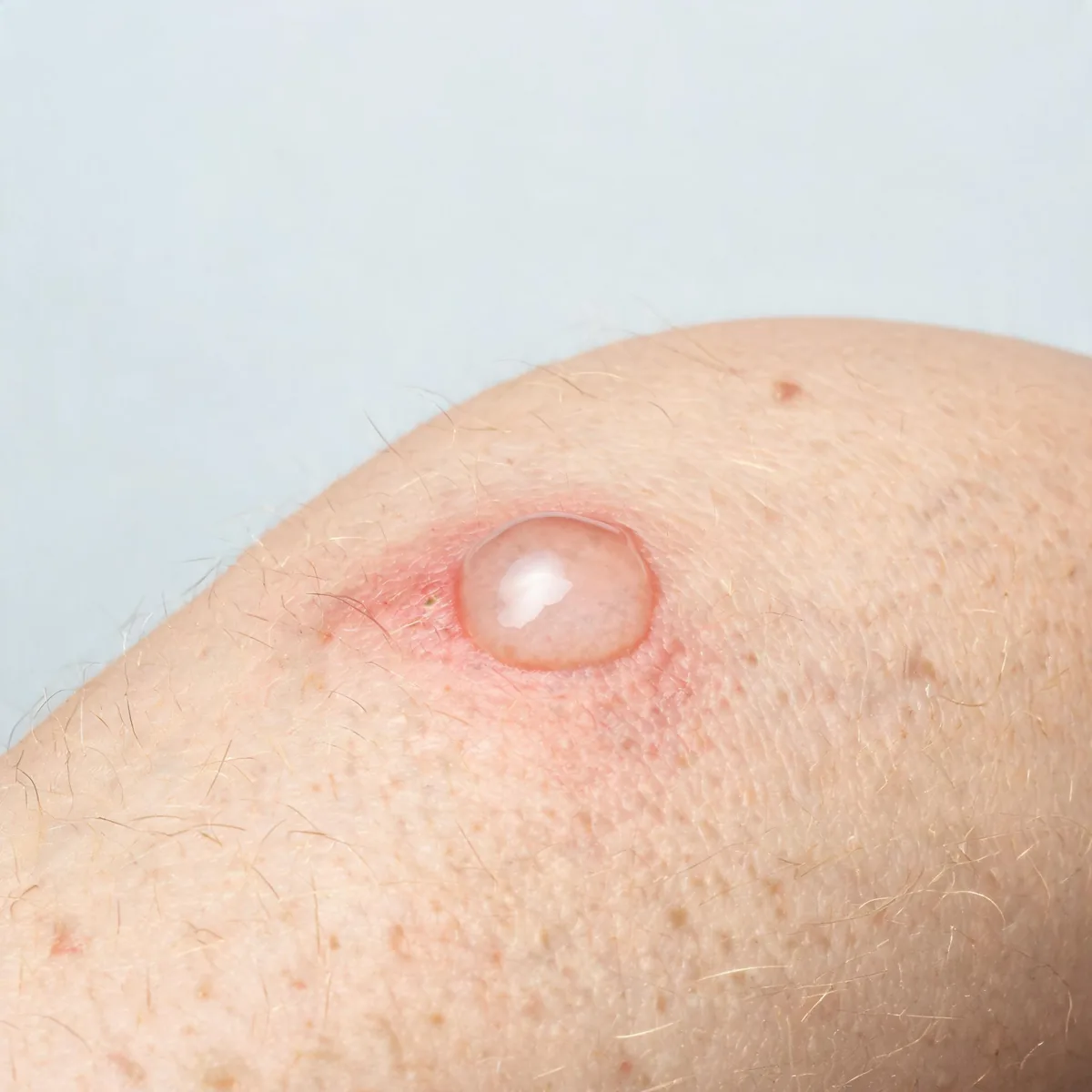
Understanding Skin blisters
The tradition describes blisters as a sign of internal disharmony rather than a surface problem. The two main factors are Heat, which agitates the Blood and causes redness and burning, and Dampness, which settles and forms fluid.
Damp-Heat in the Liver channel gives red tense blisters with clear fluid, burning stabbing pain along the ribs or flank, a bitter taste, a dry throat and irritability. That is the pattern shared with shingles-type eruptions.
Spleen deficiency with dampness gives pale loose blisters with easily broken roofs and clear watery fluid rather than yellow pus, with heaviness, poor appetite and bloating. That is a deficiency pattern where clearing alone would weaken the person.
Toxic-Heat gives widespread fragile blisters with pus, high fever, malaise, intense thirst, dark scanty urine and red swollen hot painful skin around the blisters. The classical literature treats this as the severe picture, and so does conventional medicine.
The three patterns differ in where the trouble sits. Liver Qi held in place by frustration turns into fire, and when that fire meets dampness from rich food or a tired Spleen it travels the channel that crosses the ribs, so the blisters follow a band across the side of the body. When the Spleen itself is the weak point, fluid is not transformed and instead pools beneath the skin, so the blisters look pale and slack. Toxic-Heat is the pattern in which the whole system is involved and the skin reaction is only the most visible part of it.
Two features do most of the sorting at the bedside. Clear fluid in a tense blister sitting on red, hot skin points to Heat and Dampness together, while watery fluid in a slack blister points to Dampness on a background of depletion. The second feature is pace: a rash that appears over hours with fever and malaise moves Toxic-Heat to the front of the queue and makes medical assessment the first step, before any formula is chosen.
Conventional view
In Western medicine a blister is a pocket of fluid where the upper layer of skin has lifted away from the layer beneath. Friction, burns, contact allergy, viral infection such as herpes zoster, and autoimmune disease such as pemphigus are the usual causes, and the history together with the appearance and distribution of the lesions usually identifies which one. A skin biopsy or a blood test is sometimes needed to confirm it.
Treatment follows the cause. Antivirals with pain relief cover shingles, corticosteroids or immunosuppressants are used for autoimmune blistering, and antibiotics are given for bacterial infection. Small blisters are protected and left to heal, while large or painful ones may be drained under sterile conditions.
What conventional care does not do is change whatever made the skin vulnerable in the first place. Suppressing the immune attack or killing the virus ends the acute episode, but the underlying terrain is untouched, and long courses of immunosuppressants carry real risks. TCM is used alongside that care, aimed at the internal pattern that allows blisters to form, and it does not replace urgent medical treatment.
Selected PubMed records
Real PubMed records for the conventional discussion above, selected by condition name and title relevance. They are references, not a claim that any treatment is proven for this condition.
- [Bullous pemphigoid].. Presse medicale (Paris, France : 1983), 2010. PMID: 20832237.
- Bullous Dermatoses and Depression: A Systematic Review.. JAMA dermatology, 2021. PMID: 34668929.
How it is assessed
The practitioner assesses the fluid, the blister roof and the systemic response.
What a practitioner looks for
- Fluid: clear fluid in tense blisters suggests Damp-Heat; watery fluid in pale loose blisters suggests Spleen deficiency; pus suggests Toxic-Heat.
- Distribution: a band along the ribs suggests the Liver channel pattern.
- Systemic signs: high fever and malaise indicate toxicity and urgency.
- Red flags: mucosal blisters, rapid spread, or skin peeling.
Colour, tension and site are read together. Tense blisters on a red base, with burning pain that wraps the ribs, a bitter taste and a dry throat, suggest Damp-Heat in the Liver Channel; the tongue is red with a yellow greasy coat and the pulse is wiry, slippery and rapid. Slack pale blisters that weep clear fluid, with a poor appetite, a bloated abdomen and loose stools, suggest Spleen Deficiency with Dampness, where the tongue is pale and swollen with teeth marks and a white greasy coating, and the pulse is slow and slippery.
The practitioner also asks what came first: a new medicine, a febrile illness, a burn or a diagnosis of autoimmune disease. Rapid spread, blisters on mucous membranes, dark or bloody fluid and general systemic upset all point away from an ordinary eruption and towards something that needs urgent medical care, so the examination is as much about excluding those as about naming a pattern.
TCM patterns in Skin blisters
Four observations separate the three patterns: the fluid, the roof, the base and the pace. Tense blisters of clear fluid on red, burning skin, especially in a band across the ribs, point to Damp-Heat in the Liver Channel, where stagnant Liver Qi has turned to fire and joined with dampness. Slack blisters with thin roofs that tear easily and weep watery fluid point to Spleen Deficiency with Dampness, where fluid is no longer transformed and gathers under the skin. Widespread fragile blisters holding pus, on swollen hot painful skin, with fever and malaise, point to Toxic-Heat. Tongue and pulse confirm it: red with a yellow greasy coat and a wiry rapid pulse for the Liver channel, pale and swollen with a white greasy coat and a soft slow pulse for the Spleen, deep red with a dry yellow coat and a forceful pulse for toxicity. Mixed pictures are common.
| Pattern | Key signs | The itch | Tongue | Main formula |
|---|---|---|---|---|
| Damp-Heat in the Liver Channel | Burning stabbing pain along the ribs or flank; Red tense blisters with clear fluid | Not specified | Body: Red, with redder sides and edgesCoat: Yellow and greasy, thicker at the centre and root | Not specified |
| Spleen Deficiency with Dampness | Pale loose blisters with easily broken roofs | Not specified | Body: Pale and swollen, often with teeth marks along the edgesCoat: White, greasy and moist, thick in the middle | Not specified |
| Toxic-Heat | Widespread fragile blisters with pus; Red swollen hot painful surrounding skin | Not specified | Body: Red, often with raised red pointsCoat: Yellow, dry, sometimes thick | Not specified |
Damp-Heat in the Liver Channel
Red tense clear-fluid blisters with burning rib-side pain.
The Liver channel crosses the ribs and flanks, and when frustration or unexpressed anger holds Liver Qi in place, that held Qi heats up. If dampness is present as well, from rich or greasy food, alcohol, or a Spleen that cannot keep pace, the two combine into a heavy, burning mixture that is pushed along the channel and out through the skin. The blisters are tight and filled with clear fluid, they sit on skin that is red and hot, and the pain is burning or stabbing rather than dull.
The tongue is red with redder sides and a yellow greasy coat that is thickest in the centre and at the root, and the pulse is wiry, slippery and rapid. Flares follow anger, spicy or greasy meals, alcohol and coffee, and hot humid weather, and they ease with cool compresses, stress reduction, cooling food and gentle movement. Long Dan Xie Gan Tang is the formula named for this presentation, with Zhi Zi and Huang Qin among its key herbs, and the points are Taichong (LR-3), Xiaxi (GB-43), Waiguan (SJ-5) and Xuehai (SP-10).
Signs
- Burning stabbing pain along the ribs or flank
- Red tense blisters with clear fluid
- Bitter taste with dry throat
- Irritability and restlessness
Diet and lifestyle for this pattern: Eat cooling, Dampness-resolving food such as mung beans, watermelon, cucumber and pear, and avoid alcohol, coffee, spicy and greasy food, which fuel Heat and Dampness. Manage emotional stress with gentle exercise such as walking or tai chi, and ensure adequate rest.
Spleen Deficiency with Dampness
Pale loose blisters with watery fluid and fatigue.
The Spleen turns food and fluid into something the body can use, and a Spleen worn down by irregular meals, overwork or long illness loses that ability, so fluid stays where it is and becomes dampness. That dampness moves outward and settles beneath the skin, producing blisters with thin roofs that break easily and leak a clear, watery fluid rather than pus. Because the problem is depletion rather than fire, the surrounding skin is not vividly red and the pain is mild and burning at most.
The tongue is pale and swollen with teeth marks at the edges and a white, greasy, moist coat, and the pulse is soggy (Ru) and slow (Huan), or slippery, and weakest at the right wrist where the Spleen is read. Heavy or fried food, damp weather, skipped or oversized meals, dairy, iced drinks and long sitting all worsen it, while warm dry weather, light cooked meals, steady exercise and ginger help. Wei Ling Tang and Shen Ling Bai Zhu San are the formulas named, with Fu Ling, Bai Zhu and Yi Yi Ren as key herbs, and the points are Yinlingquan (SP-9), Sanyinjiao (SP-6), Zusanli (ST-36) and Xuehai (SP-10).
Signs
- Pale loose blisters with easily broken roofs
- Clear watery fluid rather than yellow pus
- Heaviness in body and limbs
- Poor appetite with bloating
Diet and lifestyle for this pattern: Focus on warm, cooked, easy food such as congee, steamed vegetables and soups, with Spleen-friendly ingredients such as yam, Job's tears, lentils and lightly cooked ginger. Avoid raw, cold, greasy and dairy-heavy food that creates more Dampness, and keep moving gently such as walking or qigong so Qi flows and internal Dampness dries.
Toxic-Heat
Widespread fragile blisters with pus and high fever.
Toxic-Heat is what happens when heat is not merely present but overwhelming, arriving with a severe infection, an autoimmune flare or a blast of environmental heat. It reaches deeper than the surface, so the skin is damaged quickly and fluid collects in blisters that are fragile, widespread and often cloudy with pus. The whole body registers it: fever, malaise, intense thirst, scanty dark urine and restlessness, with the surrounding skin red, swollen, hot and painful.
The tongue is red with raised prickles and a dry yellow coat, and the pulse is rapid and forceful, full or overflowing on pressure. Spicy and fried food, alcohol and coffee, hot humid weather, anger and lost sleep all add fuel, while cooling food, rest, a cool ventilated room and steady hydration help. Huang Lian Jie Du Tang is the formula named here, with Huang Lian and Jin Yin Hua as key herbs, and Dazhui (DU-14), Quchi (LI-11) and Xuehai (SP-10) are chosen to clear heat and cool the blood.
Signs
- Widespread fragile blisters with pus
- High fever and malaise
- Intense thirst with dark scanty urine
- Red swollen hot painful surrounding skin
Diet and lifestyle for this pattern: Eat plenty of cooling, hydrating food such as watermelon, cucumber, mung beans and pear, and sip chrysanthemum or dandelion tea. Avoid alcohol, coffee, spicy dishes, fried food and lamb, which all add Heat, and rest as much as possible, since overexertion and emotional stress can fan the flames of Toxic-Heat.
Treatment approach
How the tradition treats skin blisters, with the herbs, formulas and points used for it.
Principles
- Assess medically first: blisters can signal infection, drug reaction or autoimmune disease.
- Clear heat and drain dampness where blisters are tense with clear fluid.
- Support the Spleen where blisters are pale and loose with fatigue.
- Clear toxicity and involve medical care where blisters are widespread, pustular or febrile.
- Root and branch are treated together. Where dampness and heat are full, the branch is cleared and drained first; where the Spleen is weak, the root is supported and the clearing is kept light, because a cold drying formula would leave the person weaker and the blisters quicker to return. Formula choice follows the pattern: Long Dan Xie Gan Tang for the Liver channel, Wei Ling Tang or Shen Ling Bai Zhu San for the Spleen, and Huang Lian Jie Du Tang where toxicity dominates.
Herbs used
Formulas
Acupoints
- LR-3 (Taichong)
- GB-43 (Xiaxi)
- SJ-5 (Waiguan)
- SP-10 (Xuehai)
- SP-9 (Yinlingquan)
- SP-6 (Sanyinjiao)
- ST-36 (Zusanli)
- DU-14 (Dazhui)
- LI-11 (Quchi)
What to expect
- Simple blisters from heat or dampness are described as settling within one to two weeks.
- Deficiency patterns heal more slowly.
- Mucosal or spreading blisters need urgent medical care.
- Most people see fewer new blisters and existing ones drying within one to two weeks, with pain and itch easing more slowly, especially where a nerve has been involved. Sessions are usually weekly or twice weekly at first, and recurrent or autoimmune cases are managed over two to three months with the aim of longer remissions rather than a single cure.
Safety and when to get help
Seek medical help urgently for
- Blisters spreading rapidly with high fever.
- Blisters inside the mouth, eyes or genitals.
- Skin peeling or detachment over large areas, or blisters with severe pain.
For anything severe, sudden or spreading quickly, read when a skin problem needs urgent care.
Cautions
- Do not burst blisters; the roof protects the healing skin.
- Keep the area clean and covered.
- New blisters with a new medication should prompt immediate medical advice.
Using this alongside conventional care
- TCM is described as complementary to conventional care: medical assessment and prescribed treatment come first where infection or drug reaction is possible.
- Herbal treatment and acupuncture can run alongside conventional care for most blistering conditions. Antivirals such as aciclovir for shingles do not conflict directly with herbs, but both practitioners should know what is being taken; corticosteroids and immunosuppressants for autoimmune blistering must never be stopped or reduced abruptly, and any taper is arranged with the prescribing doctor once the condition is stable. Some heat-clearing herbs have mild blood-thinning effects, so anticoagulants deserve a conversation, and a full medication list should come to the first consultation.
Diet and lifestyle
- Avoid spicy dishes, deep-fried food, excess sugar, alcohol and rich dairy.
- The general rule is to avoid what feeds heat and dampness, meaning spicy dishes, deep-fried food, excess sugar, alcohol and rich dairy, and to favour light meals such as congee, steamed vegetables and lean protein, with cooling foods such as cucumber, watermelon and mung bean soup, and cooked grains and squash for the Spleen. Water is better taken warm than iced, because cold drinks slow digestion. For the Liver channel pattern add mung beans, watermelon, cucumber and pear; for the Spleen pattern, warm congee, yam, Job's tears, lentils and a little cooked ginger; for Toxic-Heat, cooling hydrating food and chrysanthemum or dandelion tea.
If you're pregnant
Strong heat-clearing and blood-moving herbs such as Da Huang and Tao Ren are avoided in pregnancy because they can stimulate the uterus, and milder options such as Huang Qin and Jin Yin Hua are preferred. Points traditionally avoided in pregnancy, including Hegu (LI-4) and Sanyinjiao (SP-6), are left out. Spleen Deficiency with Dampness is common in pregnancy because fluid retention is normal, so food therapy with Yi Yi Ren and Bai Zhu is often the first step, alongside cool compresses that limit systemic exposure.
If you're breastfeeding
The main concern is transfer into milk. Bitter-cold herbs such as Huang Lian and Long Dan Cao can cause loose stools and digestive upset in the infant, so they are avoided or used only briefly under supervision, while Fu Ling and Yi Yi Ren are gentler choices for dampness. Acupuncture carries no risk to the infant, a topical wash with Ku Shen can settle localised blisters with little absorption, and if internal herbs are needed the infant's stools and mood are watched and the dose timed to limit the peak in milk.
If treating a child
Blisters in children most often arrive with viral illnesses such as chickenpox or hand-foot-and-mouth disease, and the patterns seen are Wind-Heat in the Lung or Damp-Heat in the Spleen. A child's Spleen is immature, so dampness forms easily, while abundant yang makes high fever likely. Observation of the rash and the child's behaviour replaces verbal reports, doses are reduced to a third to a half of the adult amount, and gentle sweet-cooling herbs such as Jin Yin Hua and Bo He are preferred, with topical lotions, diet and tui na rather than needles.
If treating an elderly patient
In older adults blisters are most often herpes zoster, and the pain that follows, postherpetic neuralgia, usually reflects Qi and Blood stasis on a background of deficiency. Treatment shifts from draining fire towards nourishing Blood, moving Qi and opening the channels, with formulas such as Xue Fu Zhu Yu Tang modified with tonics such as Huang Qi. Doses are lower, needling is gentler, timelines are longer, and a long medication list is checked carefully for interaction.
Urgent-sign guidance is based on standard sources: NHS anaphylaxis, NHS cellulitis, NHS Stevens-Johnson syndrome, NHS melanoma.
Evidence
Evidence status
Compiled for this page from the classical and modern literature; not a systematic review, so treat it as a pointer to sources rather than clinical guidance.
The evidence comes from herpes zoster, the blistering condition most studied with these treatments. A meta-analysis found acupuncture significantly reduced pain in postherpetic neuralgia with improved quality of life, and a review of herbal medicine for acute zoster found that combined oral and topical treatment shortened time to crusting and reduced pain more than conventional therapy alone, though methodological flaws limit the conclusions. Blisters from other causes have different implications and need diagnosis.
The evidence on the herbal side is thinner than the acupuncture evidence. Reviews of Chinese herbal medicine for shingles suggest formulas such as Long Dan Xie Gan Tang can improve healing rates and reduce pain, but most of the trials are Chinese-language, unblinded and at high risk of bias, and for autoimmune blistering such as pemphigus the support is largely case series. That is why herbs are used as an adjunct to immunosuppressive treatment rather than instead of it, and why the acupuncture findings in postherpetic neuralgia are the strongest part of the picture.
Studies often cited
Pooled randomised trials showed acupuncture significantly reduced pain intensity and improved quality of life in postherpetic neuralgia compared with conventional medication, with the authors calling for larger high-quality trials. Liu Y, et al. Pain Physician. 2017;20(3):E425-E435.
The review found that combining oral and topical herbal treatment with conventional therapy shortened the time to crust formation and reduced pain more effectively than conventional therapy alone, with the evidence described as promising but methodologically limited. Wang J, et al. Complement Ther Med. 2018;41:277-284.
Classical record
Wind-heat often generates blistering sores, which appear like water bubbles, with unbearable itching and pain.
- Zhu Bing Yuan Hou Lun (Treatise on the Origins and Symptoms of Diseases), Volume 35.
天疱疮者,乃心火妄动,脾湿内蕴,外受风热,以致火邪侵肺,热邪蒸渗皮肤而成。
When heart fire stirs restlessly and dampness gathers in the Spleen, and wind-heat attacks from outside as well, fire reaches the Lung and heat steams through the skin, and blisters form.
Heart fire and spleen dampness form blisters - Classical citation: Wai Ke Zheng Zong (Orthodox Manual of External Medicine), chapter on sores and ulcers.
Common questions
Should I pop a blister?
No. The blister roof protects the raw skin beneath and reduces infection risk.
When are blisters an emergency?
Blisters in the mouth, eyes or genitals, rapid spread with fever, or skin peeling over large areas.
Can herbs dry up blisters?
The tradition describes clearing damp heat or supporting the Spleen, with improvement over one to two weeks for simple cases.
Could it be a drug reaction?
Yes, and that needs immediate medical advice rather than herbal treatment.
Can TCM help shingles blisters?
The pattern that fits shingles most often is Damp-Heat in the Liver Channel, which matches red burning blisters in a band across the ribs. Long Dan Xie Gan Tang is used to clear Liver fire and drain dampness, and needling Taichong (LR-3) and Xiaxi (GB-43) is used to ease the pain. Herbs are used alongside antivirals, which should not be delayed.
How long until the blisters dry up?
Blisters driven by heat often begin to dry and crust within five to ten days of treatment, while dampness-dominant blisters on a background of Spleen weakness take longer, often three to six weeks, because the digestion has to be strengthened as well as the skin cleared.