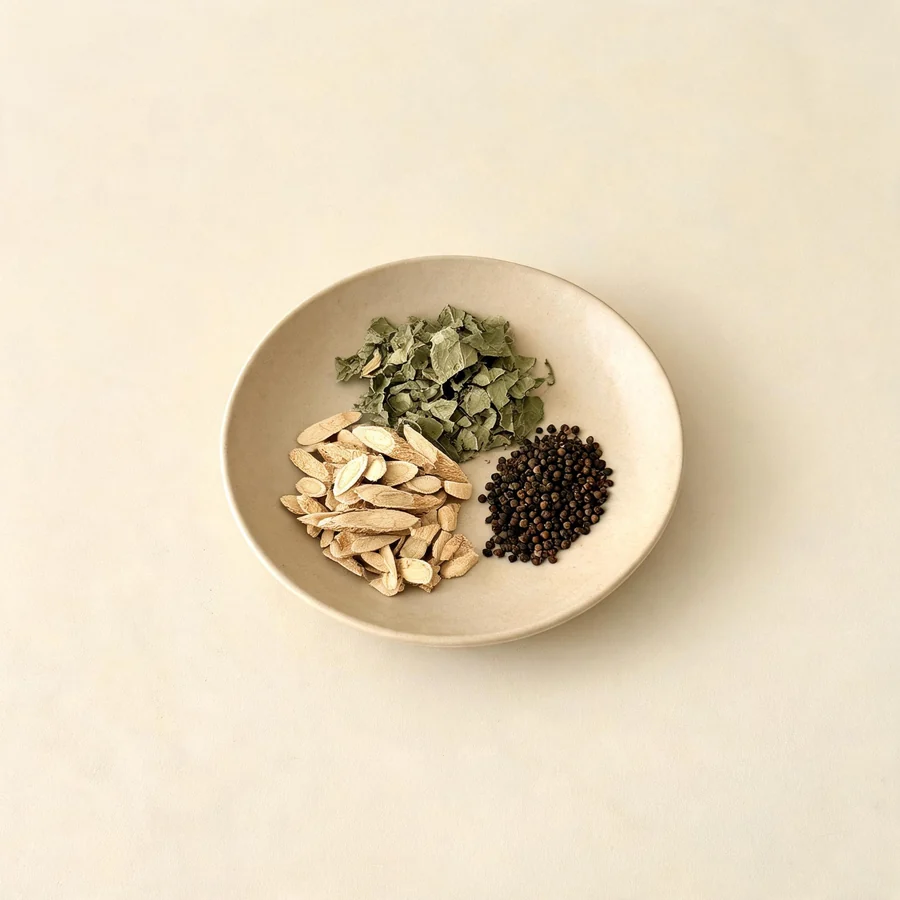
Understanding Oily sweat
The tradition describes oily sweat primarily as a sign of Damp-Heat, two factors combining to create a sticky turbid fluid that the body tries to push out through the skin.
Damp-Heat in the Stomach and Spleen gives sticky oily sweat that stains clothing yellow, a bitter taste, upper abdominal fullness, bloating and loose sticky stools.
Liver and Gallbladder damp heat gives the same yellow-staining oily sweat with a bitter taste, pain or distension below the ribs, irritability and restlessness.
Collapse of Yin is the serious pattern: sticky oily sweat that stains clothing yellow with a burning hot body but warm extremities, irritability, extreme thirst and a rapid deterioration. The classical literature treats that as an emergency picture, and so should any reader.
The classical literature treats the greasy quality itself as the diagnostic key. Sweat is normally clear and watery; when it leaves a stain or feels slick, the fluid is being described as turbid, which here means it is carrying Dampness. The Stomach and Spleen are the usual source, because they turn food and drink into usable fluids: overload them with rich meals, alcohol or irregular eating and they produce Dampness and Heat instead. That mixture steams upward and outward through the pores, and the result is a greasy, often yellowish sweat.
A second source is the Liver and Gallbladder. Frustration, stress and a heavy fatty diet are said to gather Damp-Heat there, and because the Liver channel climbs the sides of the body and the head, the sweat collects in those areas and comes with a bitter taste, irritability and fullness under the ribs. This is the pattern seen most often in people who swallow their anger or eat late at night. The rare third picture is a loss of Yin fluids after severe illness, long fever or heavy fluid loss, where hot sweat beads like oil: the classical literature is explicit that this needs hospital care, not herbs.
Conventional view
In Western medicine oily sweat is not a distinct diagnosis but a symptom that can accompany hyperhidrosis, hormonal change such as menopause or thyroid disorder, metabolic syndrome, or a diet high in fats and processed food. The sweat may look oily because of increased sebum production or excretion of fatty acids, and assessment involves a physical exam, history and sometimes blood tests to rule out endocrine or metabolic causes.
Treatment aims to reduce sweating and odour. Aluminium chloride antiperspirants are first-line, often in prescription strength, with oral anticholinergics such as glycopyrrolate or beta-blockers for more severe cases, Botox injections to block sweat glands temporarily, and iontophoresis for the hands and feet. Where an underlying thyroid or metabolic condition is found, treating it may improve the sweat.
These measures target the sweat glands and nervous system without addressing why the sweat is oily or why it follows a particular pattern. Antiperspirants can irritate the skin, systemic drugs carry side effects that limit long-term use, and the internal factors TCM examines, such as digestion, diet and stress, are not part of the conventional plan.
Selected PubMed records
Real PubMed records for the conventional discussion above, selected by condition name and title relevance. They are references, not a claim that any treatment is proven for this condition.
- Hyperhidrosis: A targeted literature review of the disease burden.. The Journal of dermatology, 2023. PMID: 37519134.
- Hyperhidrosis: Management Options.. American family physician, 2018. PMID: 30215934.
How it is assessed
The practitioner assesses the sweat, the constitutional signs and the urgency.
What a practitioner looks for
- Character: sticky yellow-staining sweat suggests damp heat.
- Site: upper abdominal fullness suggests the Stomach and Spleen; rib-side distension suggests Liver and Gallbladder.
- Collapse signs: burning body with warm limbs, extreme thirst and restlessness indicate a serious state.
- Red flags: sudden profuse sweating with weakness, confusion or chest pain.
The consultation starts with the sweat. A practitioner notes whether it is sticky or merely wet, whether it dries with a yellow mark on clothing, and whether there is an odour, because grease and colour point away from simple sweating and toward Damp-Heat. Spontaneous sweating from Qi deficiency, by contrast, is described as thin and watery, which is why the question about stains is asked so directly.
The tongue and pulse then locate the pattern. A thick yellow greasy coating with a rapid slippery pulse means Damp-Heat is brewing inside; if the coating sits thickest in the centre and the person feels bloated and heavy, the Stomach and Spleen are the site, and stools that are loose and sticky, hard to wipe clean, support that reading. Red sides to the tongue, a wiry pulse, fullness or pain below the ribs and a bitter taste bring the Liver and Gallbladder into the picture. Diet history is taken in detail, since rich food, alcohol and late meals are the usual drivers.
Collapse of Yin looks nothing like the other two. The sweat is profuse and hot rather than sticky, the person is gravely exhausted with dry cracked lips and a flushed face, and the pulse is rapid and thready under deep pressure. A practitioner recognises it from the urgency of the presentation and sends the person to hospital, because this is a loss of the body's deepest fluids rather than a damp-heat disturbance.
TCM patterns in Oily sweat
Oily sweat is differentiated by site, by accompanying signs and by how much of the body's fluid reserve remains. The common task is to decide where the Damp-Heat sits: in the middle burner, where it produces upper abdominal fullness, a heavy foggy head, loose sticky stools and a thick coating at the centre of the tongue, or in the Liver and Gallbladder, where rib-side distension, a bitter taste, irritability and red tongue sides point to stagnant Qi turning into fire. Both give the same yellow greasy stain, so the site of the discomfort rather than the sweat itself separates them. The third pattern is not a variation on damp-heat at all but its opposite in urgency: when Yin fluids have been badly depleted the sweat becomes hot and oily, the body burns, thirst is extreme and the pulse turns fine and rapid. That picture is a collapse and belongs in a hospital, never in self-treatment.
| Pattern | Key signs | The itch | Tongue | Main formula |
|---|---|---|---|---|
| Damp-Heat in Stomach and Spleen | Not specified | Not specified | Body: Red, possibly swollen with teeth marksCoat: Thick, yellow and greasy in the centre and root | Not specified |
| Liver and Gallbladder Damp-Heat | Pain or distension below the ribs | Not specified | Body: Red, with redder sidesCoat: Thick, yellow and greasy | Not specified |
| Collapse of Yin | Burning hot body with warm extremities | Not specified | Body: Deep red or crimson, completely dry, cracked and shrunkenCoat: None: a mirror tongue | Not specified |
Damp-Heat in Stomach and Spleen
Sticky yellow-staining sweat with bloating and a bitter taste.
Rich food and alcohol are the usual beginning. The Stomach and Spleen are described as the body's mill: they receive food and drink and separate the usable part from the waste. Given more grease, sugar and alcohol than they can process, the separation fails and the waste accumulates as Dampness, which Heat turns turbid. Because the Spleen belongs to the middle and its Qi moves upward, the mixture steams out through the pores rather than draining away, and the sweat arrives heavy and slightly yellow.
The tongue is red, sometimes swollen with teeth marks, under a greasy yellow coating that is thick in the centre and at the root; the pulse is soggy and rapid, often slippery, and strongest at the right guan position. Greasy fried food, alcohol, hot humid weather and stress all make it worse, while light easily digested meals, cooling foods such as cucumber and mung bean, gentle movement and a cool room help. Lian Po Yin is the formula named, with Huang Lian and Hou Po as its key herbs, and LI-11 (Quchi) with SP-9 (Yinlingquan) are the points used to clear Heat and drain Dampness.
Signs
- Sticky oily sweat that stains clothing yellow
- Bitter taste in the mouth
- Bloating and fullness in the upper abdomen
- Loose sticky stools
- Greasy coating
Diet and lifestyle for this pattern: Shift to a light, mostly plant-based diet that is easy to digest: steamed vegetables, congee and small portions of lean protein. Strictly avoid greasy, fried, sweet and spicy food as well as alcohol, which all fuel Damp-Heat, and keep daily movement gentle without heavy sweating that depletes fluids further.
Liver and Gallbladder Damp-Heat
Oily sweat with rib-side distension and irritability.
Here the Damp-Heat gathers along the Liver channel, which runs up the sides of the trunk and into the head. The pattern is built from two things: fatty, spicy food and alcohol, which supply the dampness and heat, and bottled-up frustration, which stagnates Liver Qi until it turns into fire. Because the channel is lateral, the sweat appears at the temples, the sides of the neck and the rib cage, and the trapped Qi produces distension or pain below the ribs. Heat rising into the mouth leaves a bitter taste that water does not clear.
The tongue is red with especially red sides and a thick yellow greasy coating, and the pulse is wiry, slippery and rapid, and most pronounced at the left guan position. Fried and fatty food, alcohol, anger and hot humid weather all aggravate it, while a calm cool environment, light meals, bitter greens and deliberate rest ease it. Long Dan Xie Gan Tang is the formula named, with Long Dan Cao and Zhi Zi as its key herbs, and LR-3 (Taichong) with GB-34 (Yanglingquan) are the points used to soothe the Liver and lead the heat downward.
Signs
- Bitter taste in the mouth
- Pain or distension below the ribs
- Sticky oily sweat that stains clothing yellow
- Irritability and restlessness
Diet and lifestyle for this pattern: Keep meals light: emphasise steamed vegetables, whole grains and mung bean soup while cutting back on fried, fatty and spicy food as well as alcohol. Gentle daily walking or tai chi helps Qi flow and reduces stagnation, and manage stress with calming activities, since frustration quickly fuels Liver Heat.
Collapse of Yin
The emergency picture: oily sweat with a burning body and restlessness.
This is the pattern that must not be missed. After a long fever, a severe illness or a heavy loss of fluid, the deep Yin fluids that cool and anchor the body run out. Without that anchor the remaining Yang rises unchecked, and the last fluids are pushed out through the skin as a hot oily sweat that beads rather than runs. The classical literature is blunt about what this means: it is a leakage of the deepest reserves, not a damp-heat discharge, and it needs immediate hospital care.
The tongue is deep red or crimson, completely dry and without coating, sometimes cracked and shrunken, and the pulse is fine, rapid and weak when pressed hard. Heat, exertion and dehydration make it worse, while rest, a calm cool environment and small sips of cool water help in the short term. Sheng Mai San is the formula named, with Ren Shen, Mai Dong and Wu Wei Zi, and PC-6 (Neiguan) with KI-7 (Fuliu) are the points described; none of this replaces emergency treatment.
Signs
- Sticky oily sweat that stains clothing yellow
- Burning hot body with warm extremities
- Irritability and restlessness
- Extreme thirst
- Rapid deterioration
Diet and lifestyle for this pattern: Collapse of Yin is a serious state that needs urgent medical care rather than dietary treatment alone. While help is arranged, keep the person calm and cool, give small sips of water or a mild cooling drink if they are conscious, and avoid hot, spicy and stimulant food and drinks.
Treatment approach
How the tradition treats oily sweat, with the herbs, formulas and points used for it.
Principles
- Treat profuse sweating with collapse signs as an emergency.
- Clear damp heat and support the Spleen in the ordinary patterns.
- Address diet, which is the main driver of damp heat in this framework.
- Investigate persistent abnormal sweating medically.
- The strategy is to clear the branch and steady the root at once, in different proportions according to pattern. Where damp-heat dominates, the first move is to dry and drain, with Lian Po Yin for the middle burner and Long Dan Xie Gan Tang for the Liver and Gallbladder, and the Spleen is supported only enough to keep the clearing from exhausting it. Collapse of Yin reverses the priority: rescuing Yin and astringing the sweat comes before any drainage, and the classical literature places that work in a hospital.
Herbs used
Formulas
Acupoints
- LI-11 (Quchi)
- SP-9 (Yinlingquan)
- ST-36 (Zusanli)
- ST-44 (Neiting)
- LR-3 (Taichong)
- GB-34 (Yanglingquan)
- LR-2 (Xingjian)
- PC-6 (Neiguan)
- KI-7 (Fuliu)
- SP-6 (Sanyinjiao)
What to expect
- Damp heat patterns improve over weeks with treatment and diet.
- Persistent sweating needs medical review for systemic causes.
- Collapse requires emergency care, not herbs.
- The first change is usually in quality rather than quantity: the sweat stops staining clothing before it stops altogether. Weekly treatment through the first month, with diet changes alongside, is the usual shape of a course, and humid weather can bring a temporary return of the greasy feel. Once the pattern has settled, many people continue with the dietary habits and occasional treatment through the summer.
Safety and when to get help
Seek medical help urgently for
- Sudden profuse sweating that is hot, sticky and beads like oil, especially with extreme weakness or confusion.
- Chest pain, breathlessness or fainting with sweating.
- Sweating with fever and rapid deterioration.
For anything severe, sudden or spreading quickly, read when a skin problem needs urgent care.
Cautions
- Night sweats and abnormal sweating need medical review.
- Do not ignore sweating with cardiac symptoms.
- Keep hydrated in hot weather.
Using this alongside conventional care
- TCM is described as complementary to conventional care: prescribed treatment continues, and acute collapse needs emergency care.
- Antiperspirants and prescribed medication for sweating can continue while herbs and acupuncture are used, and the classical literature reports no known serious interaction between damp-heat clearing herbs and the anticholinergics commonly prescribed. Both clinicians should still be told about everything being taken. If Botox has been injected for sweating, points in the treated area are left alone for a while, and any reduction in conventional products is made with the prescribing doctor rather than by stopping them.
Diet and lifestyle
- Avoid spicy, greasy and fried food, alcohol and excess sugar, and favour cooling light meals.
- Beyond cutting fried food, fatty meat, rich sauces, alcohol and sweets, the two damp-heat patterns respond to slightly different foods. For the Stomach and Spleen, plain congee, steamed vegetables and small portions of lean protein keep the middle burner light, and warm water or barley tea is preferred to iced drinks. For the Liver and Gallbladder, bitter greens such as dandelion and endive, cucumber and mung bean are used to cool and drain, and meals are kept regular because skipping food and then eating late is a common trigger.
If you're pregnant
Pregnancy is described as relatively hot and damp, which is why this pattern is common in it. The bitter-cold herbs usually chosen, such as Huang Lian and Long Dan Cao, are generally avoided, and acupuncture at points such as LI-11 (Quchi) and SP-9 (Yinlingquan) becomes the first option. Gentler aromatic herbs that transform dampness are preferred, and diet carries much of the work: less greasy, spicy and sweet food, and no attempt to sweat the dampness out.
If you're breastfeeding
Bitter-cold herbs such as Huang Lian and Long Dan Cao can pass into milk and may cause loose stools or digestive upset in a baby, so they are avoided or used only under close supervision. Milder draining herbs such as Fu Ling are substituted where possible, acupuncture is preferred because it exposes the infant to nothing, and cooling, easily digested food such as mung bean, cucumber and barley supports both mother and baby.
If treating a child
Oily sweat is uncommon in children and is usually tied to rich, greasy or sweet food overwhelming a young Spleen and Stomach. Because a child may not describe the symptoms, the practitioner relies on the look of the sweat, a tongue coating that is greasy and a history of bloating or loose stools. Correction of the diet comes first; if herbs are used the dose is a third to a half of the adult one, and tuina or acupressure at points such as ST-36 (Zusanli) and SP-9 (Yinlingquan) replaces needling.
If treating an elderly patient
In older people pure damp-heat is less common than a mixed picture in which damp-heat sits on top of a deficient Spleen and Kidney Yang. The sweat may still be oily, but tiredness, cold limbs and a weak pulse show that Yang is also low, so clearing has to be done without draining the remaining warmth. Doses are cut to roughly two thirds of the usual adult amount, the coldest herbs are used cautiously or left out, acupuncture is often better tolerated, and recovery is expected to take longer.
Urgent-sign guidance is based on standard sources: NHS anaphylaxis, NHS cellulitis, NHS Stevens-Johnson syndrome, NHS melanoma.
Evidence
Evidence status
Compiled for this page from the classical and modern literature; not a systematic review, so treat it as a pointer to sources rather than clinical guidance.
The evidence is thin and largely indirect. A systematic review of acupuncture for hyperhidrosis found moderate evidence that it reduces sweating severity, but no study treated oily or greasy sweat as a distinct subtype. A Chinese clinical observation of a modified formula reported improvement in sweat viscosity and greasiness scores without a placebo control. The classical link between oily sweat and damp-heat is well established in the texts, but that is a traditional framework rather than trial evidence.
Studies often cited
The review found moderate evidence that acupuncture can reduce sweating severity across forms of hyperhidrosis, while noting that no studies specifically addressed oily or greasy sweat as a distinct subtype. Systematic review of acupuncture for hyperhidrosis, multiple journals, 2010-2020, as recorded in the classical literature source.
A Chinese clinical observation reported significant improvement in sweat viscosity and greasiness scores compared with baseline, but the study lacked a placebo control group. Chinese-language clinical observation on Lian Po Yin for damp-heat sweating disorders, circa 2015.
Classical record
When dampness and heat steam together, sweat emerges like oil.
- Wen Bing Tiao Bian (Systematic Differentiation of Warm Diseases), Qing dynasty.
阳加于阴谓之汗。
When Yang is added to Yin, the outcome is called sweat.
Huang Di Nei Jing (Inner Classic), Su Wen, chapter on distinguishing Yin and Yang - Classical citation., from the Su Wen chapter on distinguishing Yin and Yang; the translation is our own.
Common questions
Why does my sweat stain yellow?
The classical literature reads it as damp heat with a turbid sticky fluid; persistent yellow staining should be medically reviewed.
Is oily sweat dangerous?
Usually it is a damp heat pattern, but sudden profuse oily sweating with weakness or confusion is an emergency.
Can herbs reduce it?
The tradition describes clearing damp heat, with improvement over weeks.
When should I seek care?
Profuse sweating with chest pain, fainting, confusion or fever.