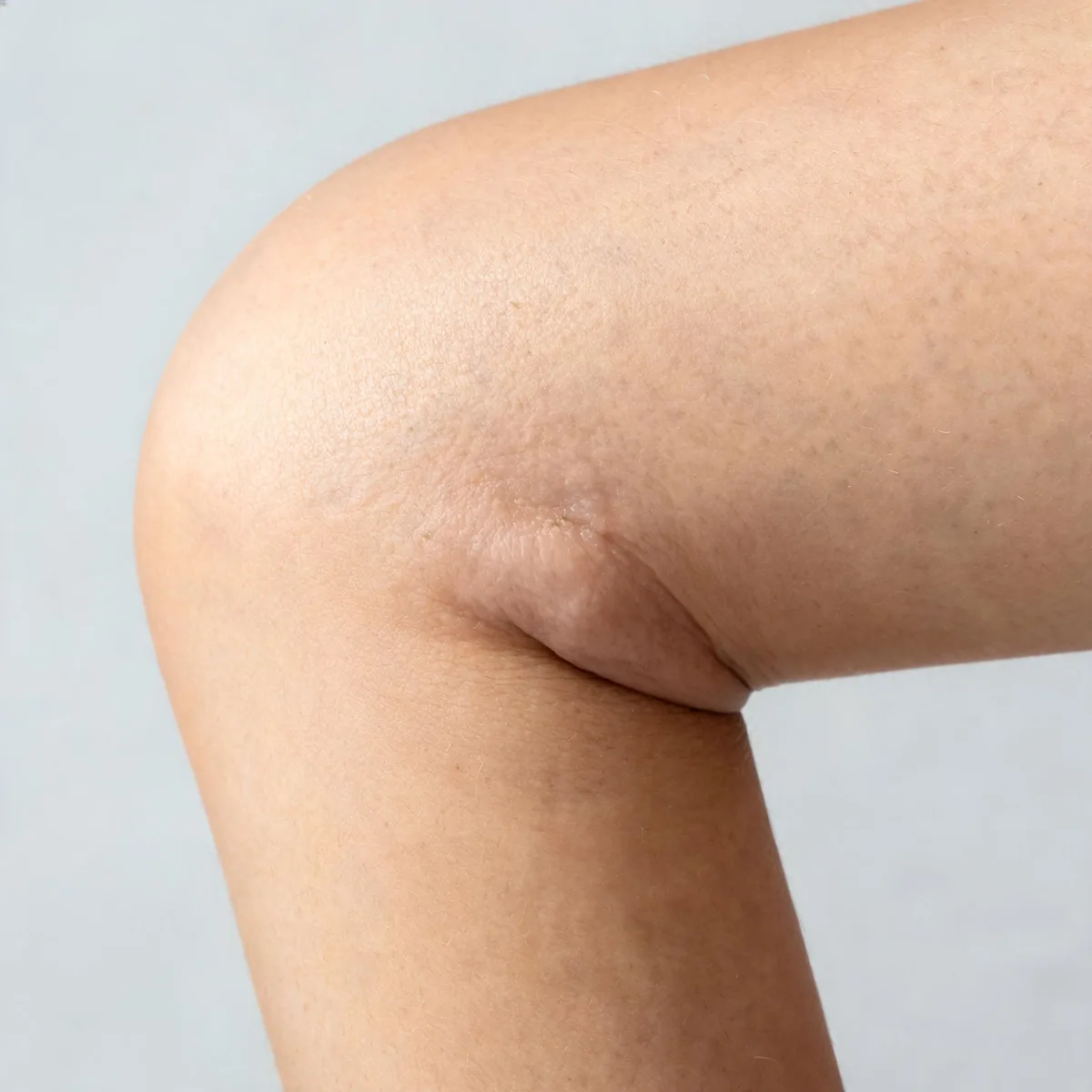
Understanding Elbow swelling
The tradition describes the elbow as a junction of the Large Intestine, Lung, Heart, Pericardium and Triple Burner channels, so swelling signals disruption in the free flow through that area.
Blood Stagnation gives fixed stabbing pain in the elbow, worse at night and with pressure, with purplish or bruised skin over the joint and a history of injury or repetitive strain.
Qi and Blood deficiency gives dull heavy swelling, worse with exertion and better with rest, with persistent fatigue, a pale complexion and numbness. That is the pattern of a chronically tired joint rather than an acutely injured one.
Painful obstruction due to damp heat in the channels gives a red hot swollen elbow with pain eased by cold and worsened by warmth, heavy aching and thirst. That picture overlaps with infection and inflammation and needs medical assessment.
Three tissues set the tone for how the joint behaves. The Spleen moves fluids and governs muscle, so a weak Spleen lets dampness gather in the soft tissue around the elbow; the Liver holds Blood and governs the sinews, so a Liver running short leaves the tendons undernourished and slow to recover; the Kidney rules bone and marrow, and long-standing Kidney weakness leaves a joint that swells at the least strain. That is why the same swelling can feel sharp and bruised in one person and heavy and puffy in another.
Reading the swelling therefore means reading its behaviour. It is described as a single symptom with several possible roots, and the classical literature is careful to say that a western label such as bursitis does not settle the question. The pattern decides where treatment is directed: the local channels for the injured elbow, the Spleen and Heart for the depleted one, and the channels and collaterals for the hot damp one.
Conventional view
From a Western perspective elbow swelling is a symptom with several causes: inflammation of the bursa over the elbow point, tendon injuries such as tennis or golfer's elbow, arthritis including rheumatoid arthritis and gout, infection, or trauma such as a fracture or sprain. Diagnosis rests on examination and may use X-ray, ultrasound or MRI, with fluid aspiration when infection or crystals are suspected.
Treatment targets the cause: rest, ice, compression and anti-inflammatory drugs for bursitis and tendinitis, corticosteroid injections for persistent inflammation, antibiotics or surgical drainage for infection, disease-modifying drugs or urate-lowering therapy for arthritis, and physical therapy to restore movement and strength.
These approaches reduce acute swelling and pain but often treat the symptom rather than the imbalance that made the elbow susceptible, repeated steroid injections can weaken tendons, NSAIDs can upset the stomach with long use, and chronic or recurrent swelling may leave patients without a clear preventive path.
Selected PubMed records
Real PubMed records for the conventional discussion above, selected by condition name and title relevance. They are references, not a claim that any treatment is proven for this condition.
- Intra-articular osteolipoma of the elbow: A case report and a review of the literature.. Bone reports, 2023. PMID: 36545325.
- Management of inflammatory arthritis around the elbow.. Hand clinics, 2002. PMID: 12143412.
- Glomus tumour of the elbow: a case of mistaken identity.. Shoulder & elbow, 2014. PMID: 27582928.
How it connects
Elbow swelling is grouped with arthralgia, and with arthritis when the swelling belongs to a wider joint condition. The reason is that the same stagnation which produces visible swelling also obstructs the movement of Qi and Blood, so pain and swelling arrive together. When damp heat is the pattern, a hot red elbow may be joined by similar changes in other joints, and treating the underlying pattern is described as easing the swelling and the pain at once.
How it is assessed
The practitioner establishes injury and heat first, then the constitutional pattern.
What a practitioner looks for
- History: a fall or twist suggests Blood Stagnation.
- Temperature: a red hot elbow suggests damp heat or infection.
- Fatigue: dull swelling with tiredness suggests Qi and Blood deficiency.
- Red flags: inability to move the joint, severe pain, fever or marked redness.
The consultation starts with the story. A fall, a blow, or years of lifting and gripping point towards stagnation of Blood, while a joint that swells a little every day and feels heavy by evening points towards deficiency, and a joint that became hot over hours points towards damp heat or infection. Aggravating and relieving factors are then mapped, because cold making it worse and warmth easing it is a very different finding from the reverse.
Tongue and pulse refine the reading. A dark tongue with purple spots and a choppy pulse supports stasis, a pale thin tongue with a weak pulse supports deficiency, and a red slightly swollen tongue with a yellow greasy coat and a slippery rapid pulse supports damp heat. Because a red hot joint with fever can be a septic joint, the classical literature puts medical assessment before any needling in that situation, and the examination for warmth, swelling and range of movement is kept brief.
TCM patterns in Elbow swelling
Three patterns are recorded, and the quickest way to separate them is to ask what the elbow does, not what it looks like. A joint that was normal until an injury and now has fixed stabbing pain with a purplish tint is read as Blood Stagnation, where the local channels are blocked by blood that has pooled. A joint that has grown steadily more puffy over months, feels heavy, and belongs to someone tired and pale is read as Qi and Blood Deficiency, where there is not enough substance to nourish the sinews and clear fluid leaks into the gap. A joint that is red, hot and visibly swollen, and that prefers cold, is read as Damp Heat in the channels, an inflamed pattern that shares ground with infection and needs assessment first. Mixed pictures are common, because a long-standing injury drains Qi and Blood, and the classical literature treats these patterns as stages of one process, not fixed boxes.
| Pattern | Key signs | The itch | Tongue | Main formula |
|---|---|---|---|---|
| Blood Stagnation | Fixed stabbing pain in the elbow; Pain worse at night and with pressure | Not specified | Body: Purple, dusky or with dark stasis spots; sublingual veins dark and distendedCoat: Often thin white; a yellow coat would suggest Heat as the cause | Not specified |
| Qi and Blood Deficiency | Dull heavy elbow swelling | Not specified | Body: Pale, possibly thin or with teeth marksCoat: Thin white | Not specified |
| Painful Obstruction due to Damp Heat in Channels | Red hot swollen elbow; Pain eased by cold and worse with warmth | Not specified | Body: Red, possibly slightly swollenCoat: Yellow and greasy | Not specified |
Blood Stagnation
Fixed stabbing elbow pain with bruising after injury.
The mechanism is mechanical before it is anything else. A blow, a fall or years of repeated gripping tears and compresses the small vessels around the elbow, and blood that leaves them stays in the channels instead of moving on. What remains is a physical block that keeps fresh blood from reaching the tendons and skin, so the joint swells, the skin over it takes a purple or bruised tone, and the pain holds one spot and stabs rather than aches. Cold weather, cold food and emotional stress all tighten the picture, while warmth and gentle movement loosen it.
The tongue is dusky or purple, sometimes with spots, with distended veins beneath it and a thin white coat, and the pulse is choppy, described as rough like a knife scraping bamboo. Pressure, overuse and cold draughts aggravate, while warmth, light stretching, massage and rest ease. Tao Hong Si Wu Tang and Xue Fu Zhu Yu Tang are the formulas recorded for this pattern, with Tao Ren, Hong Hua, Chuan Xiong and Dang Gui doing the moving. Points are Quchi (LI-11), Xuehai (SP-10), Geshu (BL-17) and Hegu (LI-4).
Signs
- Fixed stabbing pain in the elbow
- Pain worse at night and with pressure
- Purplish or bruised skin over the elbow
- History of injury or repetitive strain
Diet and lifestyle for this pattern: Keep the elbow warm and out of cold or damp draughts. Gentle pain-free range-of-motion exercise prevents stiffness while the joint rests from repetitive tasks, and warming, blood-moving food such as turmeric, ginger, black fungus and hawthorn helps, while cold raw food and iced drinks can congeal Blood.
Qi and Blood Deficiency
Dull heavy swelling with fatigue and numbness.
Here the swelling is not caused by a block but by a shortage. Qi is what moves fluids, and Blood is what nourishes the sinews, so when both run low the elbow loses its support and its supply at once. Circulation turns sluggish, clear fluid seeps into the soft tissue and stays there, and the result is a soft puffy swelling that feels dull and heavy rather than sharp. Because nothing is inflamed there is no heat in the joint, and the swelling worsens after use because exertion spends Qi and Blood that the body has not replaced.
A pale tongue, possibly thin or marked by teeth, with a thin white coat, and a fine weak pulse, most obvious at the right Guan position, confirm the picture, and the patient usually reports tiredness, a sallow complexion and tingling or numbness in the arm. Overwork, skipped meals and cold draughts make it worse, while rest, warm nourishing food and gentle warmth help. Ba Zhen Tang and Huang Qi Gui Zhi Wu Wu Tang are the formulas recorded, with Dang Gui, Huang Qi and Bai Zhu, and the points are Zusanli (ST-36), Sanyinjiao (SP-6), Qihai (REN-6) and Quchi (LI-11), with moxibustion where the joint feels cold.
Signs
- Dull heavy elbow swelling
- Worse with exertion and better with rest
- Persistent fatigue with pale complexion
- Numbness in the limb
Diet and lifestyle for this pattern: Focus on warm, easy meals such as congee with red dates and goji berries, with small amounts of grass-fed meat or bone broth to build Blood gently. Avoid raw cold food that weakens the Spleen, rest the elbow when it feels heavy, and keep up gentle non-weight-bearing movement daily to prevent stiffness.
Painful Obstruction due to Damp Heat in Channels
Red hot swollen elbow with heavy aching.
Dampness and heat arrive as a pair and settle where fluids already tend to collect. The dampness brings the heaviness and the visible puffiness; the heat supplies the redness, the burning quality and a pain that is sharp rather than dull. The usual route in is a hot humid climate or a run of greasy, spicy food and alcohol, and the joint becomes a place where the movement of Qi and Blood is held up on both counts. This is the pattern that most resembles infection, which is why the classical literature asks for medical assessment of a hot elbow with fever before treatment begins.
The tongue is red and perhaps a little puffy, with a yellow greasy coat, and the pulse is slippery and rapid. Heat, humidity, spicy food and alcohol make it worse, cold compresses, rest and cooling food ease it, and the joint prefers to be kept cool and dry. Xuan Bi Tang is the formula recorded, clearing damp heat from the channels with Fang Ji, Huang Bo and Yi Yi Ren. Points are Quchi (LI-11), Yinlingquan (SP-9), Zusanli (ST-36) and Shousanli (LI-10).
Signs
- Red hot swollen elbow
- Pain eased by cold and worse with warmth
- Heavy aching sensation in the limb
- Thirst with pain worse at night
Diet and lifestyle for this pattern: Avoid greasy, fried and spicy food as well as alcohol and sugar, which generate internal Dampness and Heat. Favour cooling, Dampness-draining food such as cucumber, celery, mung beans and barley, keep the elbow cool and dry rather than applying heat, and let the joint rest during acute flares.
Treatment approach
How the tradition treats elbow swelling, with the herbs, formulas and points used for it.
Principles
- Exclude fracture, dislocation and infection first.
- Move Blood and resolve stasis where the swelling follows injury.
- Clear damp heat where the joint is red and hot.
- Support Qi and Blood where swelling is chronic with fatigue.
- The root question is always whether the elbow is blocked, depleted or overheated, and the branch treatment follows directly: move Blood where there is stasis, build Qi and Blood where there is shortage, clear and drain where there is damp heat. Because chronic cases usually combine two of these, the classical literature expects treatment to begin with relief and then shift towards constitutional work that reduces the chance of a repeat.
Herbs used
Formulas
Acupoints
- LI-11 (Quchi)
- SP-10 (Xuehai)
- BL-17 (Geshu)
- LI-4 (Hegu)
- ST-36 (Zusanli)
- SP-6 (Sanyinjiao)
- qihai-ren-6
- SP-9 (Yinlingquan)
- LI-10 (Shousanli)
What to expect
- Injury-related swelling is described as settling over one to three weeks.
- Chronic deficiency patterns improve slowly over months.
- A hot swollen joint with fever needs medical care, not waiting.
- The timelines given are pattern specific. Recent injury with stasis often settles in two to four weeks of herbs and acupuncture, damp heat patterns in two to six weeks, and deficiency patterns, which have built up over months or years, take six to twelve weeks of consistent treatment before the change holds. The classical literature adds that recurrence is less likely if the course is finished and the lifestyle advice kept, and that maintenance sessions help where the root runs deep.
Safety and when to get help
Seek medical help urgently for
- Sudden severe swelling with intense pain and inability to move the elbow.
- A red hot swollen joint with fever.
- Numbness or weakness in the hand or fingers with the swelling.
For anything severe, sudden or spreading quickly, read when a skin problem needs urgent care.
Cautions
- Do not massage a fresh injury vigorously.
- Persistent joint swelling needs medical review.
- Do not push through severe pain.
Using this alongside conventional care
- TCM is described as complementary to conventional care: imaging and medical assessment where injury is suspected, with herbs for recovery.
- TCM is described as complementary here, useful for reducing pain and swelling but never a reason to delay imaging or antibiotics. Herbs that drain dampness and clear heat can sit alongside anti-inflammatory drugs or corticosteroids with supervision, and acupuncture may lessen the need for painkillers, though prescriptions should only be changed by the prescriber. The interaction that matters most is between blood-moving herbs such as Dang Gui, Chuan Xiong, Tao Ren and Hong Hua and anticoagulants including warfarin, aspirin and clopidogrel.
Diet and lifestyle
- Favour warm cooked food, and reduce cold raw food for stagnation patterns.
- Diet is adjusted to the pattern rather than applied in one form. The base is warm cooked food, soups, stews and congees, whole grains, legumes and lightly cooked vegetables, with sugar, dairy, alcohol and fried food reduced because they add dampness. Where the joint is hot and red, cooling and damp-draining foods such as cucumber, celery, mung beans and barley are added; where it is cold and achy, ginger, turmeric and black pepper are used, and cold raw food and iced drinks are limited because they congeal Blood.
If you're pregnant
Treating elbow swelling in pregnancy needs care. Blood-moving herbs such as Tao Ren and Hong Hua, the core of Tao Hong Si Wu Tang for Blood Stagnation, are generally avoided because they may stimulate contractions, and points contraindicated in pregnancy such as Hegu (LI-4) and Sanyinjiao (SP-6) are omitted.
For stagnation, a milder approach such as Si Wu Tang without the blood-breaking herbs may be considered, or acupuncture with safe points such as Quchi (LI-11) and Zusanli (ST-36). For Damp-Heat, strong bitter-cold herbs such as Huang Bo are avoided in favour of gentle dietary change and acupuncture, with a practitioner experienced in antenatal care supervising.
If you're breastfeeding
Herbs taken by a nursing mother can reach the milk. Bitter-cold herbs such as Huang Bo may alter milk taste and cause infant diarrhoea, so they are used cautiously or replaced with milder alternatives such as Yi Yi Ren, and blood-moving herbs such as Tao Ren and Hong Hua are considered safe in moderation with monitoring for fussiness or digestive upset.
Acupuncture is an excellent option because it poses no risk through milk, and points such as Quchi (LI-11), Zusanli (ST-36) and Yinlingquan (SP-9) can be used safely. The practitioner should be told that the patient is breastfeeding.
If treating a child
Elbow swelling in children most often follows acute trauma, giving Blood Stagnation, or infection, giving Damp-Heat, while Qi and Blood deficiency is rare. Young children cannot always describe pain, so observation of the joint's appearance, temperature and guarding behaviour is the main diagnostic tool.
Doses are a third to a half of the adult dose by age and weight, and acupuncture is often poorly tolerated, with acupressure or paediatric tuina on the same points, such as Quchi (LI-11) and Zusanli (ST-36), as gentler alternatives. For stagnation, mild external herbal pastes are often preferred to internal formulas.
If treating an elderly patient
Older adults with elbow swelling often have underlying Qi and Blood deficiency or Kidney and Liver deficiency beneath the acute stagnation. Treatments that strongly move Blood or drain Dampness can deplete them further, so formulas are modified with tonifying herbs and doses are about two-thirds of the adult dose, with longer courses expected.
Acupuncture is well tolerated but stimulation should be gentle, and interaction between blood-moving herbs and anticoagulant medication needs particular attention. Coordination with the patient's primary care provider is advisable when starting herbal treatment.
Urgent-sign guidance is based on standard sources: NHS anaphylaxis, NHS cellulitis, NHS Stevens-Johnson syndrome, NHS melanoma.
Evidence
Evidence status
Compiled for this page from the classical and modern literature; not a systematic review, so treat it as a pointer to sources rather than clinical guidance.
Direct evidence for elbow swelling as a symptom is sparse; most research concerns lateral epicondylitis (tennis elbow), where acupuncture has moderate-quality evidence for short-term pain relief and functional improvement. A 2002 Cochrane review found acupuncture may provide short-term benefit while the overall evidence was insufficient for firm conclusions, and later reviews and trials have generally supported effectiveness for elbow pain with fewer side effects than conventional treatment.
What evidence exists concerns tennis elbow rather than swelling as such. A Cochrane review from 2002 found that acupuncture may give short-term relief of lateral elbow pain but judged the evidence insufficient for firm conclusions, and later systematic reviews have generally supported a short-term effect and a better side effect profile than conventional care. Herbal treatment for elbow swelling has not been tested in large English-language trials; the studies recorded are mostly Chinese and small, suggesting that Xuan Bi Tang and Tao Hong Si Wu Tang ease swelling and pain, with low certainty.
Studies often cited
Acupuncture may provide short-term benefit, though the evidence was insufficient for firm conclusions. Cochrane review, 2002 (as recorded in the source)
Moderate-quality evidence for short-term pain relief and functional improvement, with fewer side effects than conventional treatment. Systematic reviews and randomised trials (as recorded in the source)
Acupuncture appeared effective for short-term relief of lateral elbow pain, although the quality of the included studies varied. Trinh KV, Phillips SD, Ho E, Damsma K. J Altern Complement Med. 2004;10(3):527-34. as recorded in the classical literature.
Real acupuncture produced significantly greater reduction in pain and improvement in function than placebo acupuncture in chronic lateral epicondylitis. Fink M, Wolkenstein E, Karst M, Gehrke A. Rheumatology (Oxford). 2002;41(2):205-9. as recorded in the classical literature.
Classical record
For elbow swelling and pain, needle Quchi (LI-11), Shousanli (LI-10) and Tianjing (SJ-10).
- Zhen Jiu Da Cheng (Great Compendium of Acupuncture and Moxibustion), Volume 5. The Chinese original is not reproduced here: it could not be recovered reliably from the source record, and is not guessed.
Common questions
Is elbow swelling always injury?
No. Inflammation, bursitis, gout and infection can cause it, which is why heat and fever change the urgency.
When should I get an X-ray?
After an injury with severe pain or inability to move the joint.
Can herbs reduce the swelling?
The tradition describes moving Blood and clearing damp heat, with improvement over weeks depending on the cause.
Why does it hurt more at night?
Fixed night pain is described in the Blood stagnation pattern.
Can acupuncture help reduce elbow swelling?
Yes. Needles placed around the elbow get Qi and Blood moving again, ease the fluid that has collected in the tissue and reduce pain, while points further away treat the underlying pattern, strengthening the Spleen so that dampness drains, for instance. Most people notice something after the first session, though a lasting change usually needs a course of treatment.
How long does it take to see results with TCM?
It varies with the pattern. Where an injury has left Blood stagnant, one to two weeks may bring change, damp heat often responds in two to four, and Qi and Blood Deficiency, which has developed over months, usually needs six to twelve weeks of steady treatment. The plan is adjusted as the joint changes.
Can I continue my regular medications while having TCM?
Usually yes, and the two approaches are described as working together. Tell both the practitioner and the doctor about every medicine and supplement, because blood-moving herbs can interact with anticoagulant drugs such as warfarin, and never stop a prescribed drug without the prescriber's agreement.
Will the swelling come back after treatment?
The aim is to correct the imbalance behind it, so a completed course plus the diet and lifestyle advice makes recurrence less likely. Where the root is deep, as in long-standing Kidney deficiency, or the same overuse continues, swelling can return, and periodic maintenance treatment is described as helpful.
Can TCM help if the swelling comes from arthritis?
It is described as helpful for arthritic joints, usually by addressing a mixture of dampness, Blood stasis and Kidney deficiency. Acupuncture and herbs may reduce inflammation and pain and improve function, and some patients reduce their reliance on painkillers over time, though badly damaged joints still need conventional management.