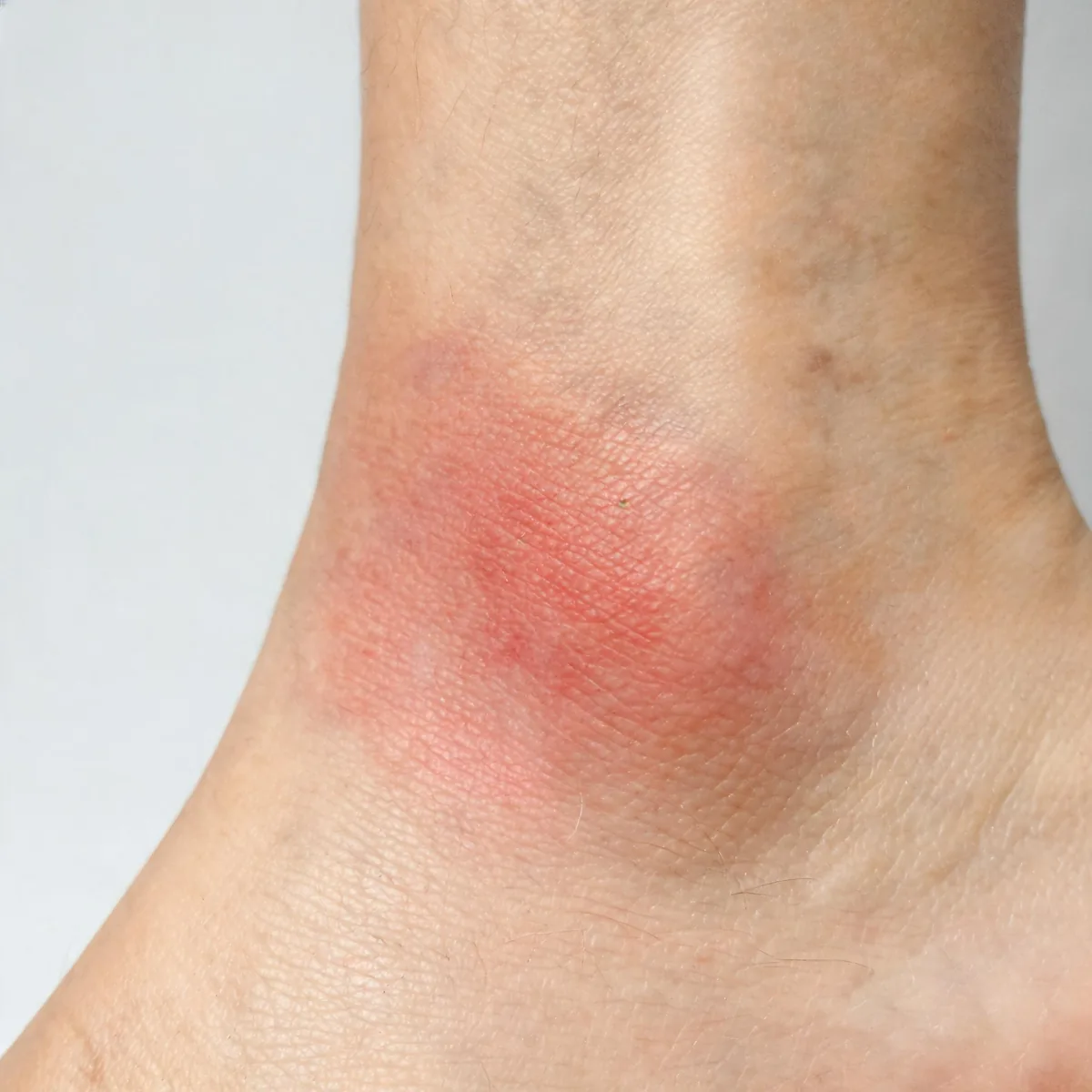
Understanding Lateral malleolus redness
The tradition describes the ankle as a crossroads for several major channels, especially the Gallbladder and Bladder channels that pass over the outer malleolus. Obstruction from trauma, dampness or deficiency produces redness and swelling there.
Painful obstruction due to damp heat in the channels gives a red hot swollen ankle with pain eased by cold and worsened by warmth, heavy aching in the leg and restlessness. That picture overlaps with inflammation and infection.
Blood Stagnation gives fixed stabbing pain that does not move, dark purplish-red swelling rather than bright red, worse at night and with pressure, usually after previous ankle injury or strain.
Painful obstruction with Liver and Kidney deficiency gives dull lingering redness and mild swelling with slow recovery after injury, low back and knee soreness and fatigue. Qi and Blood deficiency gives lingering puffiness that is not hot, with fatigue, pallor, poor appetite and numbness or tingling in the feet.
The outer ankle is a junction. The Gallbladder and Bladder channels cross the lateral malleolus, and much of the local tissue is fed by collaterals close to the surface, so obstruction there shows quickly. Trauma, dampness or plain deficiency can each block the movement of Qi and Blood, and the visible result is redness with swelling. TCM reads that as a blockage to be cleared, then asks what produced it.
Damp Heat pouring downward into the legs is the usual acute picture. Humid weather and heat combine, or rich food and alcohol generate them internally, and the mixture settles into the joint, giving a hot, bright red, throbbing ankle with a heavy aching leg. A direct injury gives the other common acute picture, Blood Stagnation, the sprain that turns purple with fixed stabbing pain worse at night. Both are excess, and the quality of the pain plus the tongue coating tell them apart.
In older people or in ankles with a long history, the redness is dimmer but recovery drags. Liver and Kidney essence nourishes the sinews and bones, and when it runs low even a small twist leaves a dull ache and swelling that will not settle. Qi and Blood deficiency produces a related picture, a pale puffy ankle that never quite settles because there is not enough vitality to move fluid and rebuild tissue. Treatment splits along the same line, clearing and draining for excess and building and nourishing for deficiency, with the tongue and pulse deciding which is at work.
Conventional view
Redness and swelling over the outer ankle, the bony bump called the lateral malleolus, usually follows a sprain, a strain or a direct blow. Infection, gout and inflammatory arthritis can produce a similar picture. Western diagnosis rests on examination together with X-ray, MRI and sometimes laboratory tests, mainly to exclude a fracture or an infection.
Standard care is the RICE routine of rest, ice, compression and elevation, with over-the-counter NSAIDs for pain and inflammation and a brace or cast for a severe sprain. Infection calls for antibiotics, and chronic inflammatory arthritis is treated with disease-modifying drugs or corticosteroid injections. These measures settle acute symptoms well.
What they do not explain is why some ankles stay swollen, heal slowly or sprain repeatedly. Long-term NSAID use can upset the stomach, and repeated sprains can leave the joint unstable. TCM looks for the pattern that makes an ankle vulnerable and slow to recover, with the aim of lowering the chance of recurrence.
Selected PubMed records
Real PubMed records for the conventional discussion above, selected by condition name and title relevance. They are references, not a claim that any treatment is proven for this condition.
- The terminology of skin disorders. Primary Care, 2000. PMID: 10815043.
How it connects
Redness at the outer ankle rarely appears on its own. The same pathogen that inflames the local tissue also distends it, so ankle pain arrives with the redness, and the swelling limits the free movement of Qi through the sinews, which brings stiffness. Where Liver and Kidney Deficiency sits behind a chronic ankle, the redness is milder while the ankle feels weak, and stiff after rest, because the sinews are poorly nourished. Treating the root pattern resolves redness, pain and stiffness as one cluster, and that is why the formulas treat the whole disharmony rather than chasing each symptom separately.
How it is assessed
The practitioner establishes injury and heat first, then the constitutional pattern.
What a practitioner looks for
- Injury: a twist with marked swelling suggests stagnation or fracture.
- Heat: a red hot ankle suggests damp heat or infection.
- Colour: dark purplish swelling suggests Blood stagnation.
- Red flags: inability to bear weight, fever, or redness spreading up the leg.
The practitioner begins with onset. A twist or a blow with immediate swelling makes injury the starting point, while redness that appears without trauma sends the enquiry towards damp heat, gout or infection. A joint that is hot, bright red and throbbing, with a thick yellow greasy coating on the tongue and a rapid slippery pulse, fits Damp Heat pouring into the channels. Prolonged standing, alcohol and greasy meals typically make it worse.
Where the colour is purplish rather than bright and the pain is a needle in one fixed spot, worse at night and under pressure, Blood Stagnation is the reading. The tongue can look dark, or carry purple spots, while the pulse feels rough or choppy, signs that Blood is no longer moving freely through the area. In an older person with years of ankle trouble, mild redness, weak ankles, aching knees and a sore back, with a pale tongue and a deep weak pulse, the pattern is Liver and Kidney Deficiency. If the acute heat has passed but puffiness stays and the person is tired, pale and short of breath, Qi and Blood Deficiency is likely, with a thin forceless pulse.
TCM patterns in Lateral malleolus redness
Four patterns explain most outer ankle redness, and the history does half the work of sorting them. Redness that arrives after a twist, turns purple and hurts in one fixed spot belongs to Blood Stagnation. Redness that appears without injury, feels hot, looks bright and throbs belongs to damp heat obstructing the channels. Dull redness with mild swelling that will not settle, in someone with a sore lower back and weak knees, belongs to a deficiency of the Liver and Kidneys. A pale, puffy ankle that is not hot, in a person who is tired and short of breath, belongs to Qi and Blood Deficiency. Temperature, colour and pain quality separate them, and the tongue and pulse confirm: a thick yellow greasy coat for damp heat, a dusky tongue for stagnation, a pale thin tongue for deficiency. Patterns also move into one another, since a sprain can turn hot days later.
| Pattern | Key signs | The itch | Tongue | Main formula |
|---|---|---|---|---|
| Painful Obstruction due to Damp Heat in Channels | Red hot swollen ankle joint; Pain eased by cold and worse with warmth | Not specified | Body: Red, possibly slightly swollenCoat: Yellow and greasy | Not specified |
| Blood Stagnation | Fixed stabbing pain that does not move; Dark purplish-red swelling, not bright red | Not specified | Body: Purple, dusky or with dark stasis spots; sublingual veins dark and distendedCoat: Often thin white; a yellow coat would suggest Heat as the cause | Not specified |
| Painful Obstruction with Liver and Kidney Deficiency | Dull lingering redness and mild swelling | Not specified | Body: Pale and thinCoat: Thin white | Not specified |
| Qi and Blood Deficiency | Not specified | Not specified | Body: Pale, possibly thin or with teeth marksCoat: Thin white | Not specified |
Painful Obstruction due to Damp Heat in Channels
Red hot swollen outer ankle with heavy aching.
Dampness and heat are two pathogens that settle where the body is already tired, and overwork, a humid climate or a diet of rich and spicy food all make that easier. When they pour downward they become trapped in the channels and joint around the lateral malleolus. The obstruction is what produces the heat, the swelling and the sharp pain, because Qi and Blood that should pass through the area are held back and generate local inflammation.
The tongue is red and may be slightly swollen, coated yellow and greasy, and the pulse is slippery and rapid. Hot weather, alcohol, greasy or spicy meals and long standing aggravate it, while a cold compress, rest with the foot raised and light cooling food relieve it. Si Miao San is the formula used to clear damp heat from the lower burner, and the points chosen are GB-34 Yanglingquan, SP-9 Yinlingquan, SP-6 Sanyinjiao and LR-3 Taichong.
Signs
- Red hot swollen ankle joint
- Pain eased by cold and worse with warmth
- Heavy aching sensation in the leg
- Irritability and restlessness
Diet and lifestyle for this pattern: Eat cooling, Dampness-draining food such as mung beans, barley and celery, and avoid alcohol, greasy, fried and spicy food that creates Damp-Heat. Rest the ankle, apply a cold compress to ease pain and swelling, and keep the foot raised when possible to support fluid drainage.
Blood Stagnation
Dark purplish swelling with fixed night pain after injury.
A sudden twist or a blow can tear the small vessels around the ankle, letting blood escape into the tissue where it stays and stagnates. Chronic strain or an injury that never fully healed produces the same sluggish, stuck flow over a longer period. Either way the result is the same signature: pain fixed in one place and stabbing in quality, with a dark purplish-red swelling rather than a bright one, worse under pressure and at night.
The tongue is purple or dusky with stasis spots and dark distended veins underneath, under a thin white coat, and the pulse is choppy or wiry. Cold weather, cold applications, long standing, inactivity and tight shoes all worsen it, while gentle ankle movement, warmth, rest with elevation and light massage after the acute phase ease it. Tao Hong Si Wu Tang is the foundational choice and Huo Xue Zhi Tong San is the powder designed for trauma, with SP-10 Xuehai, SP-6 Sanyinjiao, GB-34 Yanglingquan and LR-3 Taichong.
Signs
- Fixed stabbing pain that does not move
- Dark purplish-red swelling, not bright red
- Pain worse at night and with pressure
- History of ankle injury
Diet and lifestyle for this pattern: After the acute injury, rest and elevate the ankle to reduce swelling. Once the initial inflammation settles, apply warmth rather than ice, since cold can congeal blood and worsen stasis, and gentle ankle circles plus walking as pain allows move Qi and Blood. Warming, blood-moving food such as turmeric, ginger and black vinegar helps.
Painful Obstruction with Liver and Kidney Deficiency
Dull lingering redness with slow recovery and low back soreness.
The Liver feeds the sinews, while the Kidney governs bone. When their essence declines through age, long illness or overwork, the structures around the ankle lose their foundation, so a sprain or a strain heals slowly and leaves a dull redness with mild puffiness behind. The tissue is not being repaired because the raw material for repair is short, and fluids are not moved out of the area efficiently either.
The tongue is pale and thin with a thin white coating, and the pulse is fine and weak, often slow, with the rear position especially feeble. Cold damp weather, overexertion, long standing, cold raw food and emotional stress all make it worse, while warmth, rest, warm nourishing meals and moxibustion on the lower back and knees help. Du Huo Ji Sheng Tang both dispels lingering wind-damp and supplements the Liver and Kidneys, and the points named are KI-3 Taixi, BL-23 Shenshu, ST-36 Zusanli and GB-34 Yanglingquan.
Signs
- Dull lingering redness and mild swelling
- Slow recovery after injury or strain
- Lower back and knee soreness
- Fatigue and lack of strength
Diet and lifestyle for this pattern: Eat warm, easy, nourishing food such as bone broth, black sesame, walnuts and goji berries, and avoid cold raw food and iced drinks that further chill the body. Protect the ankle from cold and damp with warm socks, gentle moxibustion on the lower back helps, and slow mindful movement such as tai chi or swimming keeps mobility without depleting reserves.
Qi and Blood Deficiency
Lingering puffiness that is not hot, with fatigue.
After an injury or a long stretch of strain, the body needs Qi to move fluid and Blood to rebuild tissue, and when both are short the ankle never quite finishes healing. Fluid collects and stays, and Blood arrives too slowly to restore the damaged area. The result is lingering puffiness without much heat, often with a little redness that comes and goes, long after the original inflammation has settled.
The tongue is pale and may be thin or show teeth marks, with a thin white coat, and the pulse is fine and weak. Overexertion, long standing, cold damp weather, poor diet and stress all drain the supply further, while rest and sleep, warmth, warm nourishing meals and gentle movement rebuild it. Ba Zhen Tang tonifies Qi and Blood together, and the points used are ST-36 Zusanli, SP-6 Sanyinjiao, KI-3 Taixi and REN-6 Qihai.
Signs
- Lingering puffiness, not hot
- Fatigue and weakness
- Pale or sallow complexion
- Numbness or tingling in feet
Diet and lifestyle for this pattern: Eat warm, nourishing food such as bone broth, stews with goji berries and red dates, and dark leafy greens, and avoid cold, raw and greasy food that taxes the Spleen. Gentle movement such as tai chi or short walks promotes circulation without draining energy, and rest plus sleep allow the body to rebuild.
Treatment approach
How the tradition treats lateral malleolus redness, with the herbs, formulas and points used for it.
Principles
- Exclude fracture and infection first.
- Clear damp heat where the ankle is red and hot.
- Move Blood and resolve stasis where the swelling is dark and fixed after injury.
- Support Liver and Kidney, or Qi and Blood, where recovery is slow and swelling lingers.
- Fracture and infection are excluded before anything else, because the branch cannot be treated safely while the structure is broken or the tissue is infected. After that the strategy follows the pattern: cool and drain for Damp Heat, invigorate and break stasis for Blood Stagnation, and nourish Liver and Kidney or Qi and Blood where recovery keeps stalling, with external soaks and liniments added to speed local healing.
Herbs used
Formulas
Acupoints
- GB-34 (Yanglingquan)
- SP-9 (Yinlingquan)
- SP-6 (Sanyinjiao)
- LR-3 (Taichong)
- SP-10 (Xuehai)
- KI-3 (Taixi)
- BL-23 (Shenshu)
- ST-36 (Zusanli)
- qihai-ren-6
What to expect
- Injury-related swelling is described as settling over one to three weeks.
- Deficiency patterns and chronic swelling take months.
- A hot red ankle with fever needs medical assessment.
- Acute excess patterns usually begin to settle within one to two weeks of herbs and acupuncture and resolve over three to four. Deficiency patterns take longer, with four to eight weeks before the ankle feels stronger and less puffy, and several months of treatment to rebuild reserves. Swelling often reduces before strength returns, and a chronic ankle benefits from seasonal top-up treatment. Weight bearing is guided by pain and by the practitioner rather than by the calendar.
Safety and when to get help
Seek medical help urgently for
- Sudden severe pain and swelling with inability to bear weight.
- Redness spreading up the leg, or red streaks.
- A hot red swollen joint with fever.
For anything severe, sudden or spreading quickly, read when a skin problem needs urgent care.
Cautions
- Do not massage a fresh injury vigorously or apply heat in the first 48 hours.
- Persistent one-sided ankle swelling needs medical review.
- Do not walk through severe pain.
Using this alongside conventional care
- TCM is described as complementary to conventional care: imaging and medical care where injury or infection is suspected, with herbs for recovery.
- TCM works alongside conventional care rather than instead of it. Anyone taking NSAIDs regularly should tell both practitioners, because blood-moving herbs such as Dang Gui and Tao Ren may add a mild blood-thinning effect, and acupuncture is safe alongside the same drugs. A suspected fracture, an infection or redness spreading up the leg needs imaging and medical treatment first, with herbs supporting recovery afterwards. A full medication list at the consultation lets the practitioner choose the safest formula.
Diet and lifestyle
- Favour warm cooked food, and reduce cold raw and greasy food for damp patterns.
- To reduce swelling, greasy, spicy and rich food is cut back, because it generates the dampness and heat that keep a joint puffy. Cooling, diuretic foods such as cucumber, celery, watermelon and barley suit a hot ankle, and mung beans help the damp heat picture. When the ankle feels cold and achy instead of hot, warm cooked food and ginger tea suit better. Alcohol is best avoided since it deepens dampness, and water intake should stay steady. For slow healing, bone broth, black sesame, walnuts, goji berries and dark leafy greens help rebuild Qi and Blood.
If you're pregnant
The growing uterus presses on the pelvic veins, so mild ankle swelling and redness are common, especially in the third trimester. Any significant redness with heat and pain still needs assessment to exclude deep vein thrombosis. Pregnancy also makes Damp Heat pouring downward more likely because Qi stagnates more easily. Herbs that move Blood and break stasis, including Tao Ren, Hong Hua, Mo Yao and Ru Xiang, are strictly avoided for their abortifacient risk, and Si Miao San, which holds Cang Zhu and Huang Bai, is used only under professional guidance because bitter cold herbs can injure the Spleen. SP-6 Sanyinjiao and LR-3 Taichong are traditionally avoided, leaving gentle moxibustion and dietary change as safer first steps.
If you're breastfeeding
The concern here is transfer of herbal components into milk. Strong bitter cold herbs, Huang Bai in Si Miao San among them, can cause diarrhoea or digestive upset in the infant, and blood-moving formulas that contain Mo Yao and Ru Xiang are generally avoided because their aromatic nature may unsettle the baby. Topical poultices and acupuncture are safer alternatives, and internal herbs, when they are needed, are mild, food grade and dose adjusted. Needles on the lower leg are safe, though SP-6 Sanyinjiao is used with caution because it can influence the uterus.
If treating a child
Ankle redness in children mostly follows an acute sprain during play or sport, so Blood Stagnation dominates, often with visible bruising and swelling. Damp Heat is less common and usually follows infection or prolonged swelling. Assessment leans on observation, on whether the joint is hot and on whether the child will bear weight. Doses run from a quarter to a half of the adult amount, The powder Huo Xue Zhi Tong San itself can be adapted by using less and leaving out the strong aromatic herbs, and paediatric acupuncture uses fewer needles for a shorter time. Gentle moxibustion on ST-36 Zusanli, rest and elevation all help.
If treating an elderly patient
In later life the redness is often milder but far more stubborn, reflecting Liver and Kidney Deficiency and poorer circulation. The ankle looks slightly red and puffy and heals slowly after a minor sprain, and Blood Stagnation is usually mixed with deficiency, so strong blood-moving formulas such as Tao Hong Si Wu Tang are used carefully to avoid draining Qi and Blood, and Du Huo Ji Sheng Tang often suits better because it dispels stasis while tonifying. Doses are usually two-thirds of the adult amount, anticoagulant use makes Dang Gui and Hong Hua a monitoring issue, and moxa on BL-23 Shenshu and ST-36 Zusanli supports repair.
Urgent-sign guidance is based on standard sources: NHS anaphylaxis, NHS cellulitis, NHS Stevens-Johnson syndrome, NHS melanoma.
Evidence
Evidence status
Compiled for this page from the classical and modern literature; not a systematic review, so treat it as a pointer to sources rather than clinical guidance.
Evidence is moderate and mostly drawn from ankle sprain and gouty arthritis studies. A 2013 systematic review and meta-analysis by Kim and colleagues found acupuncture significantly reduced pain and swelling in acute ankle sprain compared with control, though trial quality varied. Si Miao San has shown promise in randomised trials for gouty arthritis of the ankle, reducing redness and inflammatory markers, though studies are small and mostly Chinese-language.
The evidence is moderate and comes mostly from research on ankle sprain and gout. A 2013 systematic review and meta-analysis by Kim and colleagues pooled twenty randomised trials and found that acupuncture reduced pain, swelling and functional loss in acute ankle sprain against various controls, though trial quality was only moderate. A 2017 meta-analysis by Li and colleagues reported that Si Miao San eased redness, swelling and pain in gouty joints and lowered serum uric acid, with most trials small and conducted in China. Work on blood-moving formulas such as Huo Xue Zhi Tong San after ankle trauma remains at the level of case series and observational study, and larger trials outside China are still needed.
Studies often cited
Acupuncture significantly reduced pain and swelling versus control, with variable quality among included trials. 2013 systematic review and meta-analysis (as recorded in the source)
Reduced redness and inflammatory markers in randomised trials, with small samples and Chinese-language publication. Randomised controlled trials (as recorded in the source)
Eighty patients with acute ankle sprain had less swelling and pain within seven days when the powder and an external application were added to standard RICE care. Journal of Traditional Chinese Medicine, 2015; 35(2): 142-146 (as recorded in the source)
Classical record
To treat ankle swelling and pain, use Yanglingquan (GB-34) and ashi points around the affected area to activate blood, remove stasis and unblock the meridians.
- Zhen Jiu Da Cheng (Great Compendium of Acupuncture and Moxibustion), volume on lower limb disorders. The Chinese original is not reproduced here: it could not be recovered reliably from the source record, and is not guessed.
When wind, cold and dampness reach the channels, the movement of Qi and Blood is blocked, and painful obstruction follows, with swelling, pain and joints that will not move freely.
Ling Shu, Chapter 46: On Bi Syndrome - Classical citation: which gives the passage in translation; the Chinese original is not reproduced in the source record.
Common questions
Is outer ankle redness always a sprain?
No. Gout, infection and inflammation can cause it, which is why heat and fever change the urgency.
When should I get an X-ray?
After injury with severe pain or inability to bear weight.
Why does it stay puffy?
Lingering puffiness without heat is described as Qi and Blood deficiency or Liver and Kidney deficiency with slow recovery.
When is it urgent?
Inability to bear weight after injury, spreading redness, or fever.
Will treatment help an ankle still swollen weeks after a sprain?
Yes. Swelling that persists long after the acute injury usually means Blood Stagnation has not cleared or an underlying deficiency is slowing repair. Acupuncture and formulas that quicken Blood or nourish Qi can ease the lingering puffiness and restore function, and many people improve in a few weeks, even when the swelling has been there for months.
Is acupuncture painful on a tender ankle?
Most people are surprised by how comfortable it is. The needles are very fine, and the brief prick or a dull ache on insertion is usually mild. Many patients report deep relaxation during treatment and less ankle pain soon afterwards, and the practitioner avoids needling directly into the tenderest spot.
When can I walk normally again?
With an acute sprain, many people find weight bearing easier a few days after beginning acupuncture and herbs. Returning fully to walking and sport depends on severity and on the underlying pattern, but steady improvement over two to four weeks is usual. The practitioner guides activity levels while the tissue heals.