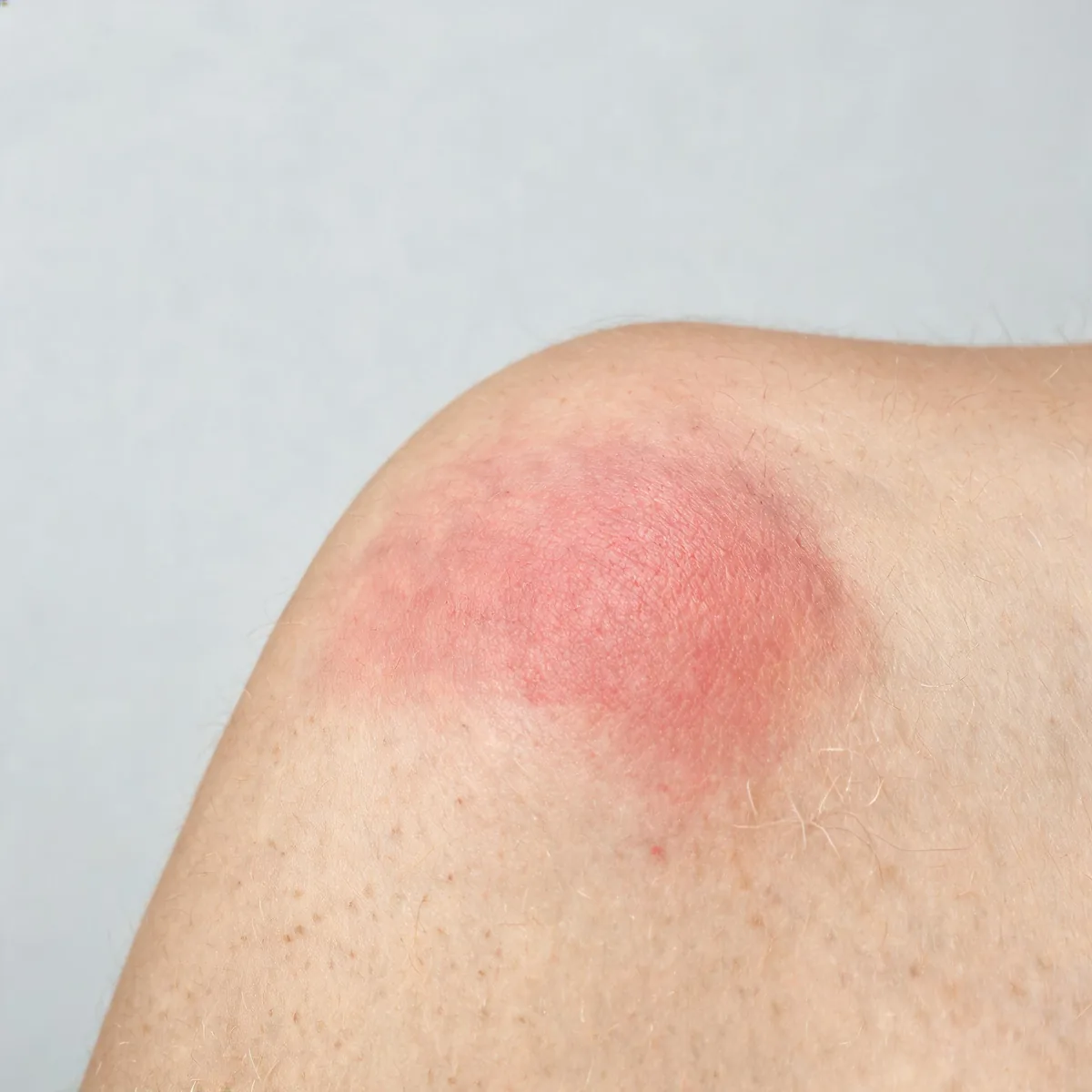
Understanding Shoulder redness
The tradition describes shoulder redness as pathogenic factors obstructing the channels that run through the shoulder. Heat, blood stasis and dampness are the commonest.
Heat invading the channels gives a red swollen hot shoulder with pain worse with warmth and relieved by cold, fever and thirst. Blood Stagnation gives fixed stabbing pain worse at night with reddish or purplish discolouration and a history of trauma or chronic strain.
Liver fire blazing gives a burning shoulder with irritability, a bitter taste, red painful eyes and a throbbing temple headache. Damp-Heat gives heavy swollen shoulders with a damp sticky feeling, a greasy yellow coating and loose sticky stools.
Phlegm in the channels gives fixed stabbing pain with a heavy numb sensation and firm nodular swelling around the joint, with a dull reddish-purple colour rather than bright red. Cold invading the channels gives severe fixed stabbing pain with a shoulder that feels cold to the touch, worse with cold and better with heat.
The shoulder is a junction. The Gallbladder, Large Intestine, Small Intestine and Triple Burner channels all cross it, and each belongs to an organ system, so trouble in any of them can surface in the same small patch of skin. The classical literature uses this to explain why one appearance has several possible roots, and why the practitioner asks about the whole body, including the temper and the digestion, before choosing a formula.
Each pathogen leaves a signature. Heat that arrives from outside produces a sudden bright redness with swelling and a burning quality. Heat generated inside by held-in frustration rises along the Gallbladder channel and settles over the top of the shoulder, producing burning pain with irritability, a bitter taste and a headache. Blood that has pooled after an old injury shows as a dusky purple tinge with fixed stabbing pain. Dampness makes the same redness heavy and sticky. Cold, the rarest route to redness, produces a dull purplish colour only when tight constriction traps blood near the surface, and the skin in that case stays cold to the touch.
Conventional view
In Western medicine redness over the shoulder is a sign rather than a diagnosis. It can follow infection of the skin or the bursa, an inflammatory arthritis such as gout, pseudogout or rheumatoid disease, an injury, or an allergic reaction. It usually appears with swelling, warmth and pain, and assessment is by examination, blood tests and imaging to find the cause.
Treatment follows that cause. Bacterial infection is treated with antibiotics, inflammatory conditions with anti-inflammatory drugs, steroid injection or ice, and rest, elevation and avoidance of the aggravating movement are advised in most cases. Where fluid has collected it may be aspirated, and an abscess may need surgical drainage.
These measures deal with the acute problem effectively, but they are aimed at the episode rather than at why it happened, so redness and pain can return if the underlying tendency, whether internal heat, sluggish circulation or accumulated dampness, is left alone. The classical literature offers its pattern approach at that point, as a way of reducing how often and how severely the episodes come back.
Selected PubMed records
Real PubMed records for the conventional discussion above, selected by condition name and title relevance. They are references, not a claim that any treatment is proven for this condition.
- Comparative efficacy of treatments for a first-time traumatic anterior shoulder dislocation: a systematic review and network meta-analysis.. Journal of shoulder and elbow surgery, 2024. PMID: 39025357.
- Neuropathic Arthropathy of the Shoulder: A Systematic Review of Classifications and Treatments.. JBJS reviews, 2019. PMID: 31663919.
How it connects
Shoulder redness is rarely an isolated finding, and the classical literature treats the overlap as useful information rather than noise. Heat invasion and damp-heat both give redness and warmth, and the difference is the greasy, heavy quality that damp-heat adds. Blood stagnation and Liver Fire both give sharp pain, but Liver Fire brings irritability and a bitter taste while stagnation brings the memory of an injury. Phlegm and Cold are the less common causes and give milder colour change with stiffness. Because these pictures merge, self-diagnosis is discouraged in favour of a tongue and pulse assessment, particularly when the redness is spreading or comes with fever.
How it is assessed
The practitioner checks temperature, firmness and the constitutional picture.
What a practitioner looks for
- Heat: a red hot shoulder suggests heat invading the channels or infection.
- Temperature: a cold painful shoulder suggests cold invading the channels.
- Firmness: nodular swelling with heaviness suggests phlegm in the channels.
- Red flags: spreading redness, red streaks or fever.
Tongue and pulse do most of the separating. Heat invading the channels gives a red tongue with a yellow coat and a rapid, floating pulse, often with a slight fever or thirst. Blood stagnation gives a dusky tongue with purple spots and a choppy or wiry pulse, and the history usually contains an injury, a fall or years of repetitive strain. Liver Fire gives a red tongue with redder sides and a dry yellow coat, a wiry rapid pulse, and the emotional signs that go with it.
Damp-heat gives a greasy yellow coat and a slippery rapid pulse, with puffiness and a heaviness that humid weather worsens. Phlegm gives a swollen tongue with teeth marks, a white greasy coat and a slippery pulse, with patchy rather than uniform redness and a doughy feel to the tissue. Cold gives a pale tongue, a thin white coat and a deep slow pulse. Because redness can also mean infection, spreading colour, a red streak tracking up the arm, or fever sends the person to a doctor rather than to a formula.
TCM patterns in Shoulder redness
Six patterns are described. The quickest separation is whether the shoulder is hot or cold, and whether the pain moves or stays. Bright redness with swelling, heat and a burning feel eased by a cold compress is heat, arriving from outside or flaring up from the Liver along the Gallbladder channel. A bruised, dusky colour with stabbing pain fixed in one spot, worse at night and following an old injury, is stagnant Blood. Redness with a heavy, swollen, sticky quality and a greasy yellow coat is damp-heat. A dull purplish change with hardness and numbness around the joint is phlegm congealed with Blood. Faint redness over a shoulder that feels cold to the touch and stiffens in a draught is Cold, where the colour comes from blood held back rather than from heat. The tongue and pulse confirm which is at work, and because several overlap, the reading is revised as the shoulder changes.
| Pattern | Key signs | The itch | Tongue | Main formula |
|---|---|---|---|---|
| Heat invading the Channels (Joints and Muscles) | Shoulder red swollen and hot to touch; Pain worse with warmth or pressure and relieved by cold | Not specified | Body: Red, sometimes with red pointsCoat: Yellow, greasy or dry | Not specified |
| Blood Stagnation | Fixed stabbing shoulder pain; Pain worse at night | Not specified | Body: Purple, dusky or with dark stasis spots; sublingual veins dark and distendedCoat: Often thin white; a yellow coat would suggest Heat as the cause | Not specified |
| Liver Fire Blazing | Burning sensation in the shoulder; Bitter taste with red painful eyes | Not specified | Body: Red with redder sides and raised red pointsCoat: Dry and yellow | Not specified |
| Damp-Heat | Redness with a damp sticky feeling | Not specified | Body: Red, often swollen with teeth marksCoat: Yellow, greasy and thick, usually in the middle and at the root | Not specified |
| Phlegm in the Channels (Joints and Muscles) | Fixed stabbing pain with a heavy numb sensation; Firm nodular swelling around the joint | Not specified | Body: Purple, with stasis spots and distended sublingual veinsCoat: White and greasy | Not specified |
| Cold invading the Channels (Joints and Muscles) | Severe fixed stabbing pain; Dull purplish-red or dark red discolouration | Not specified | Body: Pale, moistCoat: Thin white | Not specified |
Heat invading the Channels (Joints and Muscles)
Red hot swollen shoulder with fever and thirst.
This is the pattern of a shoulder that has been invaded from outside. Wind-Heat is described as entering the body and settling in the channels around the joint, where it accumulates because it cannot disperse. The local tissue becomes inflamed: the skin is red, the joint is swollen and hot to the touch, and there is a burning quality to the pain. Because the channel is blocked, movement is limited and the arm feels heavy rather than weak.
The tongue body is red and the coat yellow, greasy or dry, and the pulse is rapid and slippery, sometimes overflowing in an acute attack. Hot showers and heat packs, spicy and fried food, alcohol, overuse of the shoulder and a burst of anger all make it worse, while a cold compress, rest and cooling food and drink relieve it. Bai Hu Jia Gui Zhi Tang is the formula named, with Shi Gao, Zhi Mu and Gui Zhi, and the points are Jianyu (LI-15), Quchi (LI-11), Hegu (LI-4) and Fengchi (GB-20).
Signs
- Shoulder red swollen and hot to touch
- Pain worse with warmth or pressure and relieved by cold
- Fever with thirst for cold drinks
Diet and lifestyle for this pattern: Avoid spicy, greasy and fried food and alcohol, which add internal Heat. Eat cooling food such as mung beans, cucumber and watermelon, apply cold compresses to the shoulder and avoid hot showers or heat packs, and rest the shoulder rather than overusing it.
Blood Stagnation
Fixed stabbing shoulder pain with discolouration after strain.
Blood stagnation is what an injury leaves behind when it never quite resolves. The tradition describes an old trauma or years of strain blocking the flow of Qi, so that blood pools in the local channels instead of moving on. The trapped blood shows in the colour of the skin, which turns red or purple, and because it is not moving, the pain is fixed, sharp and stabbing rather than aching. Night makes it worse, since stillness slows circulation further.
The tongue is dark purple or dusky with stasis spots and distended dark veins under it, and the pulse is choppy and rough, described as a knife scraping bamboo. Cold, sitting still, overuse, stress and anger all aggravate it, while gentle stretching, warmth and rest with periodic movement ease it. Shen Tong Zhu Yu Tang is the formula named, with Tao Ren, Hong Hua and Chuan Xiong, and the points are Jianyu (LI-15), Xuehai (SP-10) and Geshu (BL-17).
Signs
- Fixed stabbing shoulder pain
- Pain worse at night
- Reddish or purplish discolouration
- History of trauma or chronic strain
Diet and lifestyle for this pattern: Eat warming, blood-moving food such as turmeric, ginger and black pepper, and avoid heavy greasy meals that bog down circulation. Gentle daily shoulder circles and stretches are essential so the joint does not freeze up, a warm compress or moxibustion on the shoulder helps, and intense exercise that re-injures the area is best avoided.
Liver Fire Blazing
Burning shoulder with irritability and temple headache.
This pattern is emotional in origin. The Liver is paired with the Gallbladder, and the Gallbladder channel crosses the top of the shoulder, so frustration held in and then flaring upward travels that route and settles at the shoulder. The result is a red, hot, sharply burning shoulder with a temper to match: irritability, a bitter taste, red and painful eyes and a throbbing headache at the temple or crown.
The tongue is red with redder sides and a dry yellow coat, while the pulse comes up wiry and rapid, most forceful at the left middle position. Anger, stress, alcohol, spicy and fried food and hot stuffy weather all feed it, while a cool compress, a quiet room and gentle movement settle it. Long Dan Xie Gan Tang is the formula named, with Long Dan Cao, Zhi Zi and Chai Hu, and the points are Taichong (LR-3), Ganshu (BL-18) and Jianyu (LI-15).
Signs
- Burning sensation in the shoulder
- Irritability and short temper
- Bitter taste with red painful eyes
- Throbbing temple or crown headache
Diet and lifestyle for this pattern: Stay away from alcohol, coffee and hot spicy food, which add fuel to the fire. Fill your plate with cooling greens such as cucumber, celery and chrysanthemum tea, and make stress relief a daily habit, since even short walks or deep breathing keep Liver Qi from stagnating.
Damp-Heat
Heavy swollen shoulder with a damp sticky feeling.
Dampness and heat settle into the shoulder channels together here, and the classical literature uses the image of steam trapped under a lid. Heat gives the redness, the warmth and the pain, while dampness adds the heavy, swollen, sticky quality that makes the joint feel waterlogged and slow. Between them they obstruct the movement of Qi and of Blood, and the shoulder becomes stiff and achy rather than sharply painful, with a greasy yellow coating on the tongue to match.
The tongue body is red with a yellow greasy coat and may be swollen with teeth marks, with a pulse that feels slippery and rapid, or soggy and rapid. Humid weather, greasy and spicy food, alcohol and overuse all make it heavier, while a dry cool room, a light bland diet, rest and gentle movement help drain it. Xuan Bi Tang is the formula named, with Fang Ji, Yi Yi Ren, Lian Qiao and Zhi Zi, and the points are Jianyu (LI-15), Quchi (LI-11), Zusanli (ST-36) and Yanglingquan (GB-34).
Signs
- Heavy swollen sensation in the shoulder
- Redness with a damp sticky feeling
- Greasy yellow coating with bitter sticky mouth
- Loose sticky stools
Diet and lifestyle for this pattern: Avoid greasy, fried, spicy and sweet food as well as alcohol, which create more Dampness and Heat. Eat light, easy meals with barley, mung beans and leafy greens, keep living space dry and aired, and use gentle stretching or tai chi to move Qi without overheating the joint.
Phlegm in the Channels (Joints and Muscles)
Fixed painful shoulder with firm nodular swelling.
Phlegm here is not sputum but a thick, congealed fluid that has settled in the channels and mixed with stagnant Blood. The obstruction it creates is heavy and hard rather than hot: firm nodular swelling around the joint, a dull reddish-purple colour instead of bright red, and a fixed stabbing pain with numbness or heaviness down the arm. The classical literature notes that this is a less common cause of redness and that the colour change is patchy.
The tongue is purple with stasis spots, a white greasy coat and distended veins beneath it, and the pulse feels wiry with a choppy or slippery quality. Damp and rainy weather, cold, sitting still, greasy food and dairy thicken it, while warmth, dry weather, gentle movement and a light bland diet without dairy or sugar thin it. Xiao Huo Luo Dan is the formula named, with Tian Nan Xing, Ru Xiang and Mo Yao, and the points are Jianyu (LI-15), Jianliao (SJ-14), Fenglong (ST-40) and Yanglingquan (GB-34).
Signs
- Fixed stabbing pain with a heavy numb sensation
- Firm nodular swelling around the joint
- Dull reddish-purple discolouration
- Numbness in the arm
Diet and lifestyle for this pattern: Avoid Dampness-producing food such as dairy, greasy meals and cold drinks. Eat warm, light, easy food such as congee, steamed vegetables and small amounts of ginger, and keep moving gently such as tai chi or walking so Qi moves and Phlegm transforms, without overexertion that strains the shoulder.
Cold invading the Channels (Joints and Muscles)
Cold painful shoulder worse with cold, better with heat.
Cold contracts, and a shoulder invaded by it is described as frozen in the literal sense: the channels narrow, Qi and Blood stop moving freely, and the pain becomes severe, fixed and stabbing. The skin is usually pale, but where the constriction is tight enough to trap blood near the surface it can turn a dull purplish red. That colour is the sign of blood held up, not of heat, and the shoulder feels cold to the touch and wants covering.
The tongue body is pale, its coat thin, white and moist, and the pulse is tight, often wiry and slow. Cold wet weather, a draught across the shoulder, iced drinks, raw food, long periods of stillness and overuse all deepen it, while heat, warm clothing, ginger or cinnamon tea and gentle movement relieve it. Wu Tou Tang is the formula named, with Zhi Fu Zi and Gui Zhi, and moxibustion at Jianyu (LI-15) and Yanglingquan (GB-34) is the usual needling approach.
Signs
- Severe fixed stabbing pain
- Shoulder feels cold to the touch
- Worse with cold and better with heat
- Dull purplish-red or dark red discolouration
Diet and lifestyle for this pattern: Keep the shoulder wrapped and warm at all times, with a heat pack or moxa stick daily. Eat warming food such as ginger, cinnamon and lamb, avoid iced drinks, raw salad and cold dairy, and use gentle range-of-motion exercise to prevent stiffness, never forcing a painful movement.
Treatment approach
How the tradition treats shoulder redness, with the herbs, formulas and points used for it.
Principles
- Exclude infection where the shoulder is hot, swollen and painful with fever.
- Clear heat and move the channels where redness is hot and acute.
- Move Blood and resolve stasis where pain is fixed after strain.
- Drain dampness, transform phlegm or warm the channels according to the pattern.
- The root of the treatment is the channel and the branch is whichever pathogen is blocking it. Local points open the shoulder itself, distal points on the same channel move Qi further along it, and the formula is chosen to warm Cold, clear Heat, drain Dampness, transform Phlegm or move Blood, with the shoulder reached by adding herbs that guide the action upward. Where the pattern is mixed, as it often is in a long-standing shoulder, treatment is sequenced rather than piled together, and moxibustion is added only where warmth is wanted.
Herbs used
Formulas
- Bai Hu Jia Gui Zhi Tang
- Shen Tong Zhu Yu Tang
- Long Dan Xie Gan Tang
- Xuan Bi Tang
- Xiao Huo Luo Dan
- Wu Tou Tang
Acupoints
- LI-15 (Jianyu)
- LI-11 (Quchi)
- LI-4 (Hegu)
- GB-20 (Fengchi)
- SP-10 (Xuehai)
- BL-17 (Geshu)
- LR-3 (Taichong)
- BL-18 (Ganshu)
- ST-36 (Zusanli)
- GB-34 (Yanglingquan)
- SJ-14 (Jianliao)
- ST-40 (Fenglong)
What to expect
- Acute heat patterns settle within one to two weeks.
- Stagnation, phlegm and cold patterns improve more slowly, often over weeks.
- Spreading infection needs urgent medical treatment.
- Improvement is described as running in a set order: the redness and the burning or aching settle first, then range of motion returns, which is slower because the channels have been restricted for longer. Sessions usually begin once or twice a week with a daily formula and are spaced out as the shoulder loosens. A shoulder that has been painful for months should be expected to take months, and a return of stiffness after a good stretch is normal rather than a failure.
Safety and when to get help
Seek medical help urgently for
- Rapidly spreading redness or red streaks over the shoulder.
- Fever with shoulder pain and swelling.
- Severe pain with inability to move the arm after injury.
For anything severe, sudden or spreading quickly, read when a skin problem needs urgent care.
Cautions
- Do not massage a hot swollen joint.
- Persistent shoulder pain needs medical assessment.
- Do not push through severe pain with exercise.
Using this alongside conventional care
- TCM is described as complementary to conventional care: imaging and medical assessment where needed, with herbs and acupuncture for the pattern.
- Conventional care should be continued rather than replaced. Antibiotics, anti-inflammatory drugs and corticosteroids are not stopped abruptly, and acupuncture and most formulas do not interfere with them. Herbs that invigorate Blood, Tao Ren, Hong Hua and Dang Gui among them, are used cautiously with anticoagulants, and a complete medication list belongs in the first consultation. Both the doctor and the practitioner should know what the other is prescribing.
Diet and lifestyle
- Reduce greasy, spicy and sweet food for damp patterns, and favour warm food for cold patterns.
- The general principle is to reduce what generates heat and dampness and to keep digestion light. Spicy, fried and greasy food, alcohol and excess sugar are the main offenders, and iced drinks are avoided because cold constricts the channels and stiffens a joint. Cooling foods suit the hot patterns: watermelon, pear, cucumber, celery and mung beans. Dairy and sugar are reduced where phlegm or dampness is present, and warming food and drink such as ginger or cinnamon tea suits the cold pattern. A base of lightly cooked vegetables with modest amounts of protein is a reasonable default.
If you're pregnant
Many of the herbs used for shoulder redness are avoided or modified in pregnancy. Blood-moving herbs are not used: Tao Ren and Hong Hua, both from Shen Tong Zhu Yu Tang, are capable of stimulating the uterus. Harsh or toxic herbs are excluded as well, Zhi Fu Zi in Wu Tou Tang and Tian Nan Xing in Xiao Huo Luo Dan among them. Acupuncture is the safer first line, with Hegu (LI-4), Sanyinjiao (SP-6) and Kunlun (BL-60) among the points traditionally left out.
Where a formula is judged necessary, a milder option such as Bai Hu Jia Gui Zhi Tang can be considered under close supervision, and all treatment in pregnancy should be guided by an experienced practitioner.
If you're breastfeeding
Bitter-cold herbs clear heat, and a few of them can enter the milk and may loosen an infant's stools or cause colic; Long Dan Cao and Zhi Zi, both carried in Long Dan Xie Gan Tang, are the usual examples. Acupuncture and topical treatment are therefore preferred as the main approach, and where herbs are needed the dose is kept low and the baby's bowel habit watched. Acupuncture is considered safe while nursing and can reduce shoulder inflammation without any medicine at all.
If treating a child
In children the usual cause is an acute invasion by Wind-Heat or by Damp-Heat, with a sudden onset and a clear history of exposure, and the redness often settles faster than it does in adults. Because a child cannot describe the sensation precisely, the practitioner relies on looking at the colour and swelling, watching how the child uses the arm, and reading the tongue and pulse. Doses are cut to between a half and two thirds of an adult's, according to age and weight, and acupressure or very brief, shallow needling replaces a full treatment.
If treating an elderly patient
In older patients the picture is usually mixed, with old injuries and years of repetitive strain leaving blood stagnant, while the deficiency of Qi and Blood underneath slows repair. Treatment is gentler: doses are often around two thirds of an adult's standard amount, strong blood-moving formulas such as Shen Tong Zhu Yu Tang are prescribed with care so as not to drain Qi, and Zusanli (ST-36) and other points that strengthen the Spleen and Stomach are added to support vitality. Recovery takes longer, and the aim is steady improvement rather than a quick result.
Urgent-sign guidance is based on standard sources: NHS anaphylaxis, NHS cellulitis, NHS Stevens-Johnson syndrome, NHS melanoma.
Evidence
Evidence status
Compiled for this page from the classical and modern literature; not a systematic review, so treat it as a pointer to sources rather than clinical guidance.
The evidence is indirect and concerns shoulder pain rather than redness. A Cochrane review of nine randomised trials found that acupuncture may improve pain and function in the short term compared with placebo or sham, while noting small samples and methodological shortcomings. Redness over the shoulder can indicate inflammation, infection or a vascular sign, and needs assessment rather than pattern treatment alone.
Studies often cited
The review of nine randomised trials found that acupuncture may improve pain and function in the short term compared with placebo or sham acupuncture, but the evidence was limited by small sample sizes and methodological shortcomings. Green S, Buchbinder R, Hetrick S. Cochrane Database of Systematic Reviews 2005, Issue 2. Art. No.: CD005319. doi:10.1002/14651858.CD005319
PubMed records for the TCM evidence
Real PubMed records for the TCM clinical evidence discussed above, selected by condition name and title relevance. They are references, not proof of benefit.
- Effects of manual lymphatic drainage combined with Kinesio taping on post-stroke shoulder-hand syndrome: a study protocol for a randomized controlled trial in the Southwest China region.. Trials, 2026. PMID: 42021349.
Classical record
風、寒、濕三氣雜至,合而為痹也……其留連筋骨間者疼久。
When wind, cold and dampness arrive together they combine to form Bi, painful obstruction; where they linger among the sinews and bones, the pain lasts a long time.
Huang Di Nei Jing (Su Wen), Chapter 43, On Bi - Classical citation: which uses it to explain how external pathogens lodge in the shoulder channels and later produce redness, pain and stiffness.
Common questions
Why is my shoulder red?
The classical literature reads it as heat, stasis, dampness, phlegm or cold in the channels. Infection and inflammation also need excluding.
When is it urgent?
Spreading redness, red streaks, fever, or inability to move the arm after injury.
Can herbs help?
The tradition describes clearing heat and moving the channels, with improvement over weeks depending on the pattern.
What if the shoulder feels cold?
A cold painful shoulder is described as cold invading the channels, which is treated by warming.