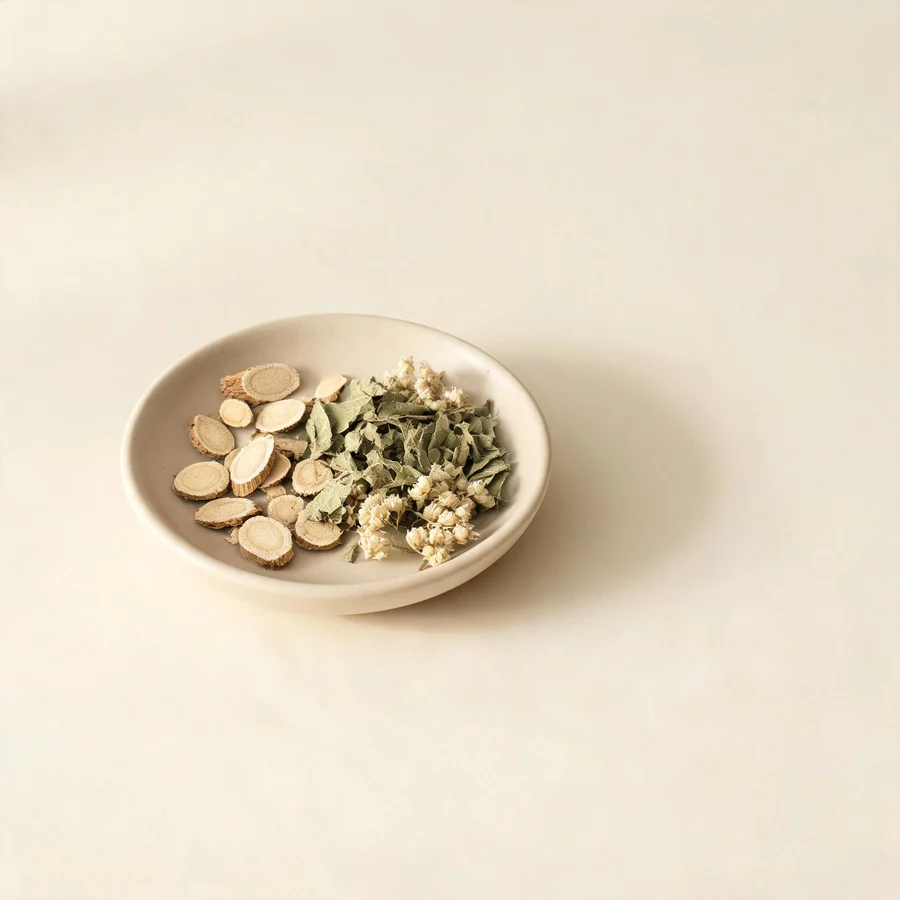
Understanding Breast eczema
The tradition describes breast eczema as an external sign of internal disharmony, with the Liver channel running through the breast and emotional stress a common trigger.
Damp-Heat in the Liver channel gives red swollen breast skin with weeping yellowish discharge, intense burning itch worse with heat, and a bitter taste especially in the morning.
Spleen deficiency with dampness gives dull-red thickened breast skin with slight oozing, bloating after eating, loose stools and heavy tired limbs. That is a deficiency pattern rather than an acute one.
Blood deficiency with external wind gives dry rough scaling or lichenified skin with intense itch worse at night, a pale complexion, dizziness and scanty periods. The treatment is to nourish, not to dry.
Three channels meet at the breast, which is why a rash here is read as a message about the inside. The Liver channel passes through the nipple and the chest, the Stomach channel crosses the breast, and the Spleen, which supplies the fluids those channels carry, sits upstream of both. When the Liver is stirred by stress or rich food it produces heat, and heat with dampness rises along the channel and spills into the skin, giving the red weeping burning flare. When the Spleen is too weak to move fluids, dampness gathers and drifts upward more slowly, giving a duller thickened rash that oozes only a little. When blood is short the skin simply lacks moisture, and the dryness lets wind stir an itch that wanders.
The distinction matters more than the label. These are not three stages of one disease so much as three different reasons for a similar-looking rash, and they call for opposite actions: one needs draining, one needs strengthening, and one needs nourishing. A topical steroid will quiet inflammation in all three, which is why it works for a while, but it does not remove dampness, rebuild the Spleen or replenish blood, so the eczema tends to return when the cream stops. Reading which of the three is running the flare, and treating that, is the difference between settling an episode and changing the pattern behind it.
Conventional view
In Western medicine breast eczema is a dermatitis affecting the skin of the breast, areola or nipple, with redness, itching, dryness, scaling and sometimes weeping or crusting. It can be part of a broader atopic dermatitis picture or arise from contact with irritants such as soaps, fabrics or laundry detergent. Diagnosis is usually clinical, though patch testing can identify triggers and a biopsy may be needed to rule out Paget's disease of the breast.
Standard care restores the skin barrier and reduces inflammation with regular emollients, topical corticosteroids for flares and sometimes calcineurin inhibitors for sensitive areas. Oral antihistamines may help itch, identifying and avoiding triggers is central, and severe cases may need short courses of oral steroids or another immunosuppressant.
Steroids and emollients soothe the skin but mainly manage symptoms rather than the cause, and for many women the eczema returns when treatment stops, while long-term steroid use can thin the delicate breast skin. Conventional care also treats all cases similarly, without distinguishing the acute weeping inflamed pattern from the chronic dry scaly one, a distinction TCM treats as essential.
Selected PubMed records
Real PubMed records for the conventional discussion above, selected by condition name and title relevance. They are references, not a claim that any treatment is proven for this condition.
- [50-year-old female patient with unilateral breast eczema].. Deutsche medizinische Wochenschrift (1946), 2024. PMID: 39504973.
- Radiation recall dermatitis occurring 6 years and 4 months after breast-conserving surgery: A case report.. Oncology letters, 2016. PMID: 27123065.
- [Breast eczema: mobile phones must not be overlooked].. Annales de dermatologie et de venereologie, 2012. PMID: 22325755.
How it connects
Breast eczema often arrives with digestive complaints such as bloating, distension and a sense of fullness, which in TCM points to Spleen deficiency with Dampness: a weak Spleen fails to transform fluids, dampness collects inside and seeps into the skin, and the breast, crossed by the Stomach and Liver channels, becomes an easy place for it to show. Anxiety and insomnia are the other common companions. Damp-Heat in the Liver channel disturbs the spirit and night-time itching breaks sleep further; where Blood deficiency underlies the eczema, the Heart and Liver lack nourishment and the mind becomes restless. Treating the root pattern tends to settle both skin and sleep. Two clusters stand out. The first is digestive: abdominal distention, a feeling of fullness and bloating commonly accompany breast eczema, and in this framework they share one root, since a Spleen too weak to transform fluids lets dampness gather inside and seep into the skin, and the breast, crossed by the Stomach and Liver channels, is an easy place for it to surface. The second is emotional: anxiety and insomnia travel with the rash, partly because damp-heat in the Liver channel disturbs the spirit and partly because night-time itching breaks sleep, while in blood deficiency the Heart and Liver lack nourishment and the mind cannot settle. Treating the root often eases both the skin and the sleep, which is why the whole picture is reviewed rather than the rash alone.
How it is assessed
The practitioner examines the skin, the nipple and areola, and the constitutional picture.
What a practitioner looks for
- Moisture: weeping and yellow discharge suggest Damp-Heat in the Liver channel.
- Texture: dry scaling and lichenification suggest Blood deficiency with wind.
- Digestive signs: bloating and loose stools support Spleen deficiency with dampness.
- Red flags: a persistent scaly or weeping nipple, a lump, or signs of infection.
The examination starts with the skin and the timeline. A rash that appeared over days, weeps yellow fluid and burns is read differently from one that has thickened over months and cracks in cold weather, and the difference is often enough to place the pattern before the tongue is even seen. The practitioner notes where the eczema sits, whether the nipple or areola is involved, how thick the skin has become and whether there is any discharge or crusting, because a persistent change confined to one nipple is a reason to pause and refer rather than to treat.
Tongue and pulse then confirm the reading. Bright red skin, a thick greasy yellow coat and a slippery rapid pulse point to the damp-heat pattern in the Liver channel, and the practitioner will ask about stress, irritability and fullness under the ribs, since the channel is easily disturbed by held emotion. A dull red thickened slightly moist patch with a pale puffy tongue, a white greasy coat and a soft soggy pulse points to the Spleen, and the questions turn to bloating, stools and fatigue. Dry cracked lichenified skin with a pale or red tongue that has little coat and a thin wiry pulse points to blood deficiency, and the questions turn to sleep, hair and nails, and the periods.
Breast eczema commonly changes shape over time, so the practitioner also asks what the skin was doing a month ago and what makes it flare now, since a rash that began weeping and has since dried out is treated differently from one that began dry. Diet, alcohol, clothing, sweating and emotional pressure are all reviewed, and the answers shape both the formula and the advice. Where the history suggests a contact trigger that is addressed in parallel, and where a lump, nipple discharge or infection is suspected, medical assessment comes first.
TCM patterns in Breast eczema
Breast eczema is differentiated first by appearance, because the skin shows the pattern plainly. A bright red swollen weeping surface with yellow discharge and a burning itch is damp-heat in the Liver channel: something has been added to the channel and must be drained. A dull red thickened patch that oozes only slightly, with bloating, loose stools and heavy limbs, is Spleen deficiency with dampness: the fluid is there but the system that should move it is too weak. Dry rough scaling or lichenified skin with an itch that wakes the person at night is blood deficiency with external wind: the skin is undernourished and its surface guard has failed. Duration and the rest of the body sharpen the reading, since a flare of days behaves differently from skin thick for a year, and a bitter taste with red eyes belongs to the Liver while fatigue with loose stools belongs to the Spleen.
| Pattern | Key signs | The itch | Tongue | Main formula |
|---|---|---|---|---|
| Damp-Heat in the Liver Channel | Red swollen breast skin with weeping yellowish discharge | Intense burning itch worse with heat | Body: Red, with redder sides and edgesCoat: Yellow and greasy, thicker at the centre and root | Not specified |
| Spleen Deficiency with Dampness | Dull-red thickened breast skin; Slight oozing or weeping | Not specified | Body: Pale and swollen, often with teeth marks along the edgesCoat: White, greasy and moist, thick in the middle | Not specified |
| Blood Deficiency with External Wind | Dry rough scaling or lichenified skin on the breast | Intense itch worse at night | Body: Pale and thin, sometimes slightly dryCoat: Thin, white and a little dry | Not specified |
Damp-Heat in the Liver Channel
Red swollen weeping breast skin with burning itch.
The channel runs through the nipple and the chest, and it is the channel that takes the strain when stress, alcohol and rich food arrive together. Greasy and fried meals and sweets add dampness, alcohol and frustration add heat, and the two combine in the Liver, which then pushes them upward along its pathway. The skin of the breast is the nearest exit, so the flare appears there: red, swollen, hot to the touch and weeping a yellow discharge. The itch has a burning quality that worsens with warmth, and the person often notices a bitter taste in the morning, irritability, dark scanty urine and a heavy feeling in the body.
The tongue is red with redder sides and a yellow greasy coat that is thickest at the centre and root, and the pulse is wiry, slippery and rapid. Spicy and fried food, alcohol, hot humid weather, tight synthetic clothing and scratching all aggravate it, while cooling compresses, a light bland diet, stress reduction, a dry airy room and enough water help. Long Dan Xie Gan Tang is the formula named, with Long Dan Cao, Huang Qin, Zhi Zi and Ku Shen clearing the channel and drying the dampness, and Huang Lian Jie Du Tang is added when the inflammation is intense or pustular. LR-3 (Taichong) and LR-2 (Xingjian) work on the channel itself, while SP-9 (Yinlingquan) drains the dampness.
Signs
- Red swollen breast skin with weeping yellowish discharge
- Intense burning itch worse with heat
- Bitter taste especially in the morning
- Irritability
Diet and lifestyle for this pattern: Eat cooling, Dampness-resolving food such as mung beans, bitter gourd, celery and barley, and avoid alcohol, spicy dishes, greasy fried food and too many sweets. Wear loose breathable cotton, keep the breast area clean and dry, and ease stress with gentle exercise or meditation, since frustration aggravates Liver Qi stagnation.
Spleen Deficiency with Dampness
Dull-red thickened skin with slight oozing and bloating.
The Spleen is described as the official who governs transformation, turning food and drink into substances the body can use and sending the rest downward. When it is weak that separation fails, and fluid stays in the body as dampness. Dampness is heavy and slow, so it drifts upward rather than pouring out, and it settles in loose tissue such as the breast, where it produces a dull red thickened patch that oozes a little clear fluid and itches in a dragging persistent way. Because the root is digestive, the rash is accompanied by bloating after eating, loose or unformed stools, a poor appetite, heavy tired limbs and fatigue that rest does not clear.
The tongue is pale, swollen and indented by the teeth, carrying a white greasy coating over a moist surface, and the pulse is soggy, slow and soft. Raw and cold food, iced drinks, greasy or sweet meals, a damp home, overthinking and irregular eating all make it worse, while warm cooked meals, a dry airy room, adequate rest and gentle walking help. Shen Ling Bai Zhu San is the formula named, with Bai Zhu strengthening the Spleen and drying dampness, Fu Ling leaching it out gently and Yi Yi Ren added for thickened oozing skin. ST-36 (Zusanli), SP-9 (Yinlingquan) and BL-20 (Pishu) treat the root by fortifying the Spleen and helping it transform fluids.
Signs
- Dull-red thickened breast skin
- Slight oozing or weeping
- Bloating worse after eating
- Loose stools with heavy tired limbs
Diet and lifestyle for this pattern: Favour warm, cooked, easy food such as soups, congees and steamed vegetables, and keep raw, cold and greasy food to a minimum because it chills and clogs the Spleen. Gentle daily movement supports Spleen Qi, but do not push through fatigue.
Blood Deficiency with External Wind
Dry scaling or lichenified skin with night itch.
Blood moistens the skin, so when it is insufficient the surface dries, thins and loses the defensive layer that keeps wind out. The breast is particularly exposed, being thin-skinned and crossed by the Liver channel, and Liver blood is the part of the system most easily drained by short sleep, heavy periods or long illness. Dryness then generates internal wind, which is why the itch wanders instead of staying in one place, and why it is worse at night when blood is drawn inward. The skin becomes rough, scaly and lichenified from repeated scratching, and the person reports a pale complexion, dizziness, brittle nails and scanty periods along with the itch.
The tongue is pale and thin with a thin white coat that is slightly dry, and the pulse is fine, wiry at the left middle and floating at the right front. Dry windy weather, spicy and fried food, frustration, overwork and sweating without moisturising all make it worse, while regular moisturising, nourishing food such as bone broth and dark greens, gentle movement and staying out of drafts help. Dang Gui Yin Zi is the formula named, with Dang Gui, Shu Di Huang and Bai Shao building blood and Fang Feng and Chan Tui dealing with wind and itch. SP-10 (Xuehai) nourishes and moves blood, ST-36 (Zusanli) and SP-6 (Sanyinjiao) build it from the Spleen, and LR-3 (Taichong) settles internal wind.
Signs
- Dry rough scaling or lichenified skin on the breast
- Intense itch worse at night
- Pale complexion with dizziness
- Scanty periods
Diet and lifestyle for this pattern: Nourish Blood with dark leafy greens, beetroot, goji berries and a moderate amount of red meat or bone broth, and avoid very dry, spicy or fried food that uses up fluids. Moisturise the breast skin with a plain emollient, protect it from wind and draughts, and keep stress and Liver Wind in check with gentle movement.
Treatment approach
How the tradition treats breast eczema, with the herbs, formulas and points used for it.
Principles
- Drain damp heat where the skin is weeping and red.
- Nourish Blood where the skin is dry, thickened and itchy at night.
- Support the Spleen where oozing is slight and digestion is weak.
- Any persistent nipple change or lump needs medical review.
- Treatment is organised around the branch and the root. The branch is the skin itself, which is cooled, dried or moistened according to what it is doing, and the root is the internal imbalance producing it, which is cleared or built over weeks. In practice that means draining damp-heat from the Liver channel in an acute weeping flare, strengthening the Spleen when the rash is subacute and the digestion is poor, and nourishing blood when the skin has become dry and lichenified, with formulas modified when two layers are present at once.
Herbs used
Formulas
Acupoints
- LR-3 (Taichong)
- LR-2 (Xingjian)
- SP-9 (Yinlingquan)
- LI-11 (Quchi)
- SP-10 (Xuehai)
- ST-36 (Zusanli)
- BL-20 (Pishu)
- SP-6 (Sanyinjiao)
- LI-4 (Hegu)
What to expect
- The tradition describes improvement over weeks with treatment and skin care.
- Recurrence follows stress and diet if the Liver pattern remains.
- Persistent or one-sided nipple eczema needs medical assessment.
- Timelines follow the pattern. Most people notice less itching and less weeping within two to four weeks of starting herbs and weekly acupuncture, and the skin then continues to settle as redness fades and new lesions stop appearing; longstanding dry eczema often needs three to six months because blood and moisture are rebuilt slowly. Fluctuation is normal, since stress, diet, heat and the menstrual cycle can each stir a flare, and treatment is spaced out to maintenance once the skin has been stable for a while rather than stopped abruptly.
Safety and when to get help
Seek medical help urgently for
- Increasing pain, swelling, warmth, pus or red streaks - possible infection.
- Fever with the breast rash.
- A persistent scaly or weeping nipple that does not respond.
For anything severe, sudden or spreading quickly, read when a skin problem needs urgent care.
Cautions
- Any breast lump needs medical assessment.
- Persistent nipple eczema can indicate Paget disease and needs review.
- Do not apply strong topical steroids to the breast and nipple without advice.
Using this alongside conventional care
- TCM is described as complementary to conventional care: emollients and prescribed topical treatment continue alongside herbs.
- Herbal treatment is usually begun while emollients or a topical steroid are still in use, and the steroid is reduced gradually as the skin improves rather than stopped in one step. Some Chinese herbs can interact with medication or affect liver function, so the practitioner and the dermatologist should both know the full list of products being taken, and anyone on oral immunosuppressants or with a history of liver problems needs the formula monitored. Acupuncture carries little interaction risk and can continue alongside any conventional therapy. Where a persistent one-sided nipple change is present, dermatological assessment comes first.
Diet and lifestyle
- Avoid spicy, greasy and fried food, alcohol and excess sugar, and favour cooling light food.
- The base is warm cooked simple food: congee, soups, steamed vegetables and a moderate amount of lean protein, with greasy and fried dishes, excess dairy, sugar and spicy food reduced, since these are the usual sources of dampness and heat. Cold and raw food is kept low because it weakens the Spleen, and bitter greens and mung beans are used to clear heat while yam and rice support the Spleen. Pattern detail adds the rest: for damp-heat, alcohol and fried food are the first things to go; for the Spleen, meals should be warm and regular rather than large and late; for blood deficiency, dark greens, beetroot, eggs and a little liver are added to build the blood the skin is missing.
If you're pregnant
Pregnancy makes safety the first consideration, and bitter-cold herbs that drain downward or strongly move Blood are generally avoided. For Damp-Heat in the Liver channel, Long Dan Xie Gan Tang is contraindicated because of its strong draining nature and herbs such as Mu Tong and Long Dan Cao, and milder options such as a modified Xiao Feng San or topical Qing Dai may be used under professional guidance.
Acupuncture is an excellent low-risk option, using points such as Quchi (LI-11) and Yinlingquan (SP-9) while avoiding points known to stimulate labour, such as Hegu (LI-4) and Sanyinjiao (SP-6), until the final weeks.
Pregnancy often tilts the body towards Blood deficiency and Dampness, so nourishing Blood and gently draining Dampness become the priorities. Dang Gui San in small doses may be considered under a qualified practitioner, and warm cooked food with avoidance of greasy and spicy items is safe and supportive throughout.
If you're breastfeeding
Herbs taken by a nursing mother can pass into breast milk. Bitter-cold herbs such as Huang Lian, Huang Qin and Long Dan Cao may cause infant diarrhoea or digestive upset and should be avoided or used with great care, and for Damp-Heat a milder approach with Fu Ling and Yi Yi Ren to leach out Dampness, plus soothing topical preparations, is safer.
Shen Ling Bai Zhu San for Spleen deficiency with Dampness is generally well tolerated and may even support milk quality, and Blood-nourishing herbs such as Dang Gui and Shu Di Huang are usually safe in moderation for the dry chronic form. Acupuncture is widely used during lactation, although trial evidence is limited, so the practitioner should always be told that the mother is nursing.
If treating a child
In children breast eczema usually appears as part of more widespread atopic dermatitis, with Spleen deficiency with Dampness most common because the digestive system is immature. Observation matters, since children cannot always describe symptoms: a pale puffy tongue with greasy coat, a tendency to loose stools and a dull thickened rash are key signs, and Damp-Heat flares can follow too much sugar or fried food.
Doses are reduced to a quarter to a half of the adult dose by age and weight, gentle food-grade herbs such as Yi Yi Ren, Shan Yao and Fu Ling are preferred, topical calamine or mild herbal washes are often enough, and acupuncture may give way to acupressure or paediatric tuina on points such as Zusanli (ST-36) and Pishu (BL-20).
If treating an elderly patient
In older people breast eczema tends to be chronic and dry, with Blood deficiency with External Wind the dominant pattern. The skin becomes thin, scaly and intensely itchy, especially at night, and Kidney Yin deficiency often coexists, so treatment may need to address both Blood and Yin.
Dang Gui Yin Zi suits this picture at about two-thirds of the standard adult dose, with liver and kidney function monitored, especially where multiple medications are taken, since herbs can interact with blood thinners or diabetes drugs. Acupuncture is a safe adjunct, points such as Xuehai (SP-10) and Sanyinjiao (SP-6) nourish Blood and calm Wind, and longer courses with attention to moisturising and a humidified home are realistic.
Urgent-sign guidance is based on standard sources: NHS anaphylaxis, NHS cellulitis, NHS Stevens-Johnson syndrome, NHS melanoma.
Evidence
Evidence status
Compiled for this page from the classical and modern literature; not a systematic review, so treat it as a pointer to sources rather than clinical guidance.
Evidence specific to breast eczema is limited and drawn from eczema and atopic dermatitis research more broadly. A 2013 systematic review by Gu and colleagues found Chinese herbal medicine more effective than placebo for atopic dermatitis, although many included trials were of low methodological quality. Several small randomised trials of acupuncture report positive results for eczema, and the overall evidence is considered moderate at best.
Most of the evidence is borrowed from eczema and atopic dermatitis rather than from breast eczema itself. A systematic review by Gu and colleagues in 2013 pooled randomised trials testing Chinese herbs in atopic dermatitis and found benefit over placebo on severity and quality of life, though the included trials were small and at risk of bias. A later meta-analysis of acupuncture trials by Kim and colleagues in 2016 reported reductions in itch intensity and in eczema area and severity scores against controls, again with the caveat that larger and more rigorous studies are needed. Creams that contain Qing Dai or Ku Shen have shown anti-inflammatory and antipruritic activity in laboratory work and small clinical studies. Nothing in the literature is specific to the breast, so the case for treatment here rests on the wider eczema evidence and on pattern-based practice.
Studies often cited
Chinese herbal medicine performed better than placebo for atopic dermatitis, with many included trials rated low quality. Gu SX, Zhang AL, Coyle ME, et al. Chinese herbal medicine for atopic dermatitis: a systematic review. J Am Acad Dermatol. 2013;69(2):295-304.
Several small randomised trials report positive effects on itch and lesion severity. Small randomised controlled trials (as recorded in the source)
Pooled trials of acupuncture in atopic dermatitis showed lower itch intensity and better eczema area and severity index scores than control treatment. The authors judged the early results promising while noting that the included trials were few and mostly small, so larger and more rigorous studies are still needed before the effect can be regarded as settled. Kim KH, Lee MS, Choi SM, et al. Acupuncture for atopic dermatitis: a systematic review and meta-analysis. Acupunct Med. 2016;34(1):3-11.
Classical record
The nipple pertains to the Liver and the breast to the Stomach. If damp-heat from the Liver and Stomach steams upward, the breast skin becomes red, eroded and weeping.
- Yi Zong Jin Jian (Golden Mirror of Medicine), section on breast diseases. The Chinese original is not reproduced here: it could not be recovered reliably from the source record, and is not guessed.
濕疹者,乃風濕熱邪客于肌膚,致氣血壅滯,發為丘疹、水疱、糜爛、瘙癢。
Eczema arises when wind, dampness and heat lodge in the skin, so that Qi and Blood become congested and papules, blisters, erosion and itching appear.
Wai Ke Zheng Zong (Orthodox Manual of External Medicine), chapter on eczema - Classical citation: ; the translation is our own. It names the three pathogenic factors that the pattern approach separates and treats in order of dominance.
Common questions
Is breast eczema serious?
Usually it is a skin condition, but persistent nipple scaling or weeping needs review to exclude Paget disease.
Why is stress a trigger?
The Liver channel runs through the breast, and the tradition describes stress as a common trigger of the Liver Qi pattern.
Can herbs help the itch?
The tradition describes draining damp heat or nourishing Blood, with improvement over weeks.
When should I see a doctor?
Infection signs, fever, a lump, or a persistent nipple change.
Can TCM help if I am already using steroid creams?
Yes. Herbs and acupuncture are aimed at the internal imbalance behind the eczema, so they can run alongside a topical steroid, and the steroid is then reduced gradually as the skin settles rather than stopped suddenly. Both practitioners should know what is being used, because long-term steroid use thins the delicate skin of the breast and nipple.
How long does treatment take for breast eczema?
Most people notice less itching and less weeping within two to four weeks of starting herbs and weekly acupuncture. Dry thickened eczema usually takes longer, often three to six months, because blood and moisture are rebuilt slowly, and consistency with diet and lifestyle makes a noticeable difference to the pace.
Will I have to change my diet?
Usually yes, at least during treatment. Spicy, greasy and sugary food, excess dairy and alcohol are reduced because they generate dampness and heat, and cold raw food is limited because it weakens the Spleen. Warm cooked meals form the base, with pattern-specific additions such as bitter greens for damp-heat or blood-nourishing food for dry eczema.
Is acupuncture on the breast itself painful?
In practice most of the points used lie on the limbs and the back, and the breast itself is rarely needled. The needles are extremely fine, discomfort is minimal, and points such as LI-11 (Quchi) at the elbow are commonly used to clear heat and calm the skin, with treatment given by a licensed practitioner.