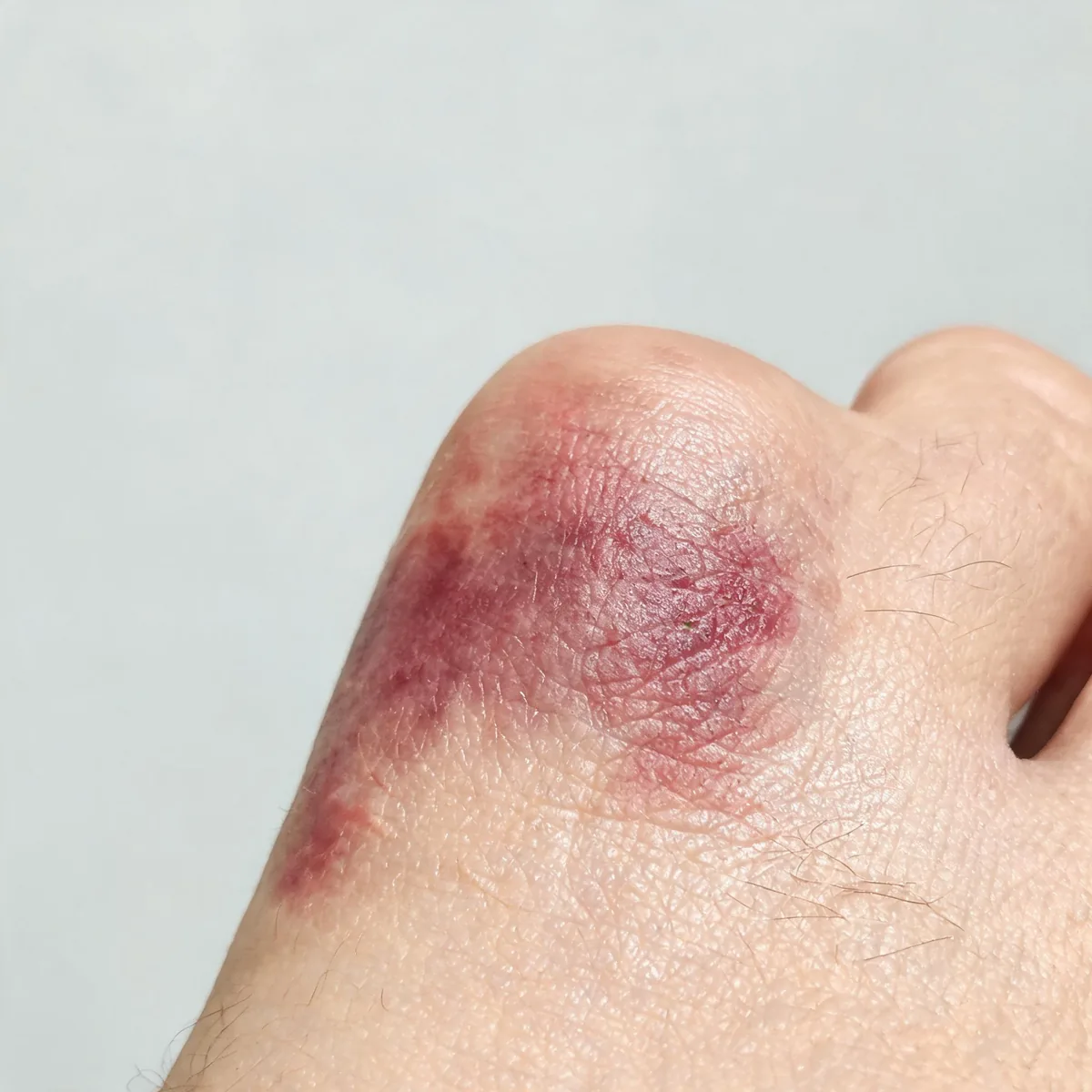
Understanding Erythromelalgia
The tradition describes the burning, redness and swelling as a disturbance of heat and Blood, involving the Heart which governs the vessels, the Liver which stores Blood, and the Spleen which manages fluids.
Heat in the Blood gives bright red or crimson skin with burning pain worse at night, internal heat and thirst for cold drinks. Blood stagnation with heat gives dark red or purplish patches with fixed stabbing pain rather than diffuse burning, worse with heat.
Damp-Heat in the channels gives swollen red hot hands or feet with a heavy aching sensation and heat-sensitive pain. Empty-Heat from Yin deficiency is different again: burning pain at night with dry peeling skin rather than swelling, night sweats and five-palm heat.
The classical literature treats this as a condition where the same symptom means different things, so cooling alone is not always right. In the deficiency pattern, the burning comes from lack of Yin rather than excess heat.
Three organs share the work in this picture. The Heart moves blood through the vessels, the Liver stores and releases it, and the Spleen governs how fluids are transformed and transported. When any of the three loses balance, heat can collect inside the blood, dampness can lodge in the channels, or the body's cooling Yin can run short, and each of those produces burning hands and feet in its own way.
The classical literature also describes how the heat behaves once it is there. Blood-level heat burns like a fire under the skin, so the redness is bright and the pain throbs. Congealed blood gives deep purple patches with heat trapped inside and nowhere to go, and that trapped heat thickens the blood further, which keeps the cycle running. Warming the limb eases nothing in either case and generally makes both worse, which is why the pattern has to be clear before treatment starts.
Conventional view
Erythromelalgia is a rare neurovascular disorder in which attacks of severe burning pain, redness and a rise in skin temperature affect the feet and hands. It can be primary, with no identifiable cause, or secondary to a myeloproliferative disorder, a neuropathy or an autoimmune condition. Diagnosis rests on the history and the appearance of the skin, with tests used to exclude a secondary cause. The prevailing explanation is a disturbance of the small vessels and of the nerves governing blood flow and pain signals.
Management begins with avoiding heat, tight footwear and prolonged standing, and with cooling measures such as fans, cool water or ice packs. Medicines include topical analgesics, aspirin (particularly where a myeloproliferative disorder is involved), gabapentin, pregabalin and sodium channel blockers such as mexiletine, with intravenous lidocaine or nerve blocks reserved for severe cases.
Relief is often partial. Cooling and drugs dampen symptoms without touching the underlying tendency for the vessels and nerves to overreact, and side effects such as dizziness, fatigue and stomach upset are common, so patients often cycle through options. Conventional care also treats every case as one process, without separating the internal patterns that TCM distinguishes, which is where an individualised approach adds something.
Selected PubMed records
Real PubMed records for the conventional discussion above, selected by condition name and title relevance. They are references, not a claim that any treatment is proven for this condition.
- Erythromelalgia. Part II: Differential diagnoses and management.. Journal of the American Academy of Dermatology, 2024. PMID: 37364616.
- Erythromelalgia: A Review of Medical Management Options and Our Approach to Management.. Mayo Clinic proceedings, 2023. PMID: 36470753.
How it connects
Erythromelalgia rarely travels alone in TCM: its underlying heat patterns often generate systemic symptoms. When it stems from Heat in the Blood or Damp-Heat in the channels, the body may also show internal Heat such as afternoon fever, a dry mouth with thirst, restlessness and disturbed sleep, all expressions of the same excess Heat agitating the Heart and consuming fluids. Where Damp-Heat is the primary driver, its heavy obstructive nature can settle in the lower limbs and cause aching or heavy legs and joint pain, with fullness and soreness in the knees and ankles alongside the burning redness. With Yin deficiency empty-heat, night sweats, a dry throat and a low-grade afternoon fever often accompany it, and the insomnia tends to involve waking with heat in the soles and palms.
How it is assessed
The practitioner distinguishes burning from stabbing pain, swelling from dryness, and triggers.
What a practitioner looks for
- Pain quality: diffuse burning suggests heat in the Blood; fixed stabbing pain suggests stagnation.
- Swelling and dryness: swollen hot limbs suggest Damp-Heat; dry peeling skin suggests Empty-Heat.
- Timing: worsening at night and with warmth is common to the heat patterns.
- Red flags: sudden severe worsening, or skin breakdown and ulceration.
The consultation turns on a handful of contrasts. Bright, fiery redness with swelling and throbbing pain that warmth aggravates points to heat sitting in the blood. Dull, deep red or purple patches with a stabbing pain pinned to one spot point to stagnation, where the heat is trapped inside blood that will not move. Swelling, heaviness and aching in the joints alongside the redness point to dampness in the channels, and that picture tends to settle in the feet and lower legs.
Chronic, milder episodes with papery dry skin and a burning that peaks at night belong to empty heat from Yin deficiency, the least common of the four, which usually appears in long-standing cases. A mouth that is dry without much thirst, night sweats and heat in the palms and soles support it. Tongue and pulse separate the damp picture from the deficient one cleanly: a red tongue carrying a thick greasy yellow coating, with a pulse that reads slippery and rapid, belongs to dampness, while a red, thin, peeled tongue with a fine rapid pulse belongs to deficiency.
TCM patterns in Erythromelalgia
Four patterns are recorded, and what separates them is the quality of the pain, the state of the skin and the timing of the flares. Heat in the blood gives bright crimson skin, diffuse burning that is worse at night and a restless thirst for cold drinks. When blood congeals the patches turn dark red or purple and the pain becomes fixed and stabbing instead of diffuse. Dampness in the channels adds swelling, heaviness and joint aching, and humid weather makes it worse. Empty heat from Yin deficiency is the odd one out: the skin is dry and peeling rather than swollen, the burning comes on at night with night sweats and hot palms, and the whole picture is one of depletion rather than excess. Because long-standing blood heat can thicken into stasis, the patterns are not fixed, and a practitioner looks for the dominant feature before choosing between cooling, moving, draining and nourishing.
| Pattern | Key signs | The itch | Tongue | Main formula |
|---|---|---|---|---|
| Heat in the Blood | Bright red or crimson skin; Burning pain worse at night | Not specified | Body: Deep red, often with red points or pricklesCoat: Thin, yellow and dry | Not specified |
| Blood Stagnation with Heat | Dark red or purplish-red patches; Fixed stabbing pain rather than burning | Not specified | Body: Reddish-purple, with stasis spots and dark sublingual veinsCoat: Thin, dry and yellow | Not specified |
| Painful Obstruction due to Damp Heat in Channels | Swollen red hot hands or feet; Pain worse with heat | Not specified | Body: Red, possibly slightly swollenCoat: Yellow and greasy | Not specified |
| Empty-Heat caused by Yin Deficiency | Burning pain worse at night; Dry peeling skin rather than swollen | Not specified | Body: Red, thin and dry, often crackedCoat: Little or none; the tongue may look peeled | Not specified |
Heat in the Blood
Bright red skin with diffuse burning pain and internal heat.
Heat that has reached the blood level stirs the vessels and drives blood outward toward the surface, which is what produces the crimson colour, the swelling and the burning pain. That deep heat also uses up fluids, so thirst and restlessness follow. Warmth from outside feeds it, and at night, when Yin should be settling the body, the shortage of cooling lets the heat rise further.
The tongue is red to deep red with prickles or spots under a thin dry yellow coat, and the pulse is rapid and forceful, wiry or slippery. Hot weather, alcohol, spicy food, anger and any exercise that overheats the body set off a flare, while cool air, cooling food, rest and a cool compress settle it. The tradition describes a blood-cooling formula centred on Shui Niu Jiao with Chi Shao and Mu Dan Pi, supported by SP-10 (Xuehai), LI-11 (Quchi), DU-14 (Dazhui) and LR-2 (Xingjian).
Signs
- Bright red or crimson skin
- Burning pain worse at night
- Sensation of internal heat
- Restlessness with thirst for cold drinks
Diet and lifestyle for this pattern: Avoid spicy, greasy and fried food, alcohol and coffee, which add Heat. Eat cooling food such as cucumber, watermelon, mung beans and pear, keep the living space cool and wear loose breathable clothing, use cool rather than ice-cold compresses during flares, and manage stress, since emotional upset can stir Liver fire.
Blood Stagnation with Heat
Dark red patches with fixed stabbing pain, worse with heat.
When blood becomes thick and moves sluggishly it pools, and a pool of still blood generates its own heat. That heat makes the blood thicker still, so the blockage deepens and the patches turn dark red or purple. The pain that results is fixed and stabbing rather than diffuse, because the obstruction sits in one place, and warming the limb enlarges the vessels and aggravates it.
The tongue body is reddish-purple with stasis spots under a thin dry yellow coat, and the pulse is choppy and rapid, sometimes wiry. Alcohol, hot weather, spicy and fried food, long periods on the feet and tight shoes worsen it, while a cool room, raised limbs, loose footwear and gentle movement ease it. Cold is avoided because it contracts the vessels and adds to the stasis. Si Miao Yong An Tang is the formula recorded, with Chi Shao, Dan Shen and Mu Dan Pi, and the points used are SP-10 (Xuehai), LR-3 (Taichong), LI-11 (Quchi) and SP-6 (Sanyinjiao).
Signs
- Dark red or purplish-red patches
- Fixed stabbing pain rather than burning
- Pain worse with heat
- Internal heat with dry rough skin
Diet and lifestyle for this pattern: Keep the limbs cool without ice-cold applications that constrict vessels and worsen stasis. Eat cooling, blood-moving food such as celery, cucumber, aubergine and a little vinegar, avoid alcohol, spicy food and red meat that generate Heat and thicken Blood, choose swimming or cycling for circulation without overheating, and raise the limbs when resting.
Painful Obstruction due to Damp Heat in Channels
Swollen hot hands or feet with heavy aching.
Dampness and heat can bind together and lodge in the channels, where they block the passage of Qi and Blood. The heat accounts for the redness and the burning, while the dampness accounts for the swelling, the heaviness and the ache that settles into the joints. Because dampness is heavy and slow, this is the pattern that most often settles in the feet and lower legs.
The tongue is red, sometimes a little swollen, with a greasy yellow coating, while the pulse reads slippery and rapid. Hot humid weather, greasy fried food, alcohol and long hours standing worsen it, while a cool compress, rest, plenty of water and light meals ease it. Xuan Bi Tang is the formula recorded, with Fang Ji, Yi Yi Ren and Lian Qiao, and the points named are GB-34 (Yanglingquan), SP-9 (Yinlingquan) and ST-36 (Zusanli), each recorded with a reducing technique.
Signs
- Swollen red hot hands or feet
- Heavy aching sensation in limbs
- Pain worse with heat
- Joint pain and stiffness
Diet and lifestyle for this pattern: Avoid hot, spicy, greasy and sweet food that creates Damp-Heat, and eat cooling, light food such as cucumber, celery, mung beans and watermelon. Keep the limbs cool without extreme cold, and gentle stretching and walking keep Qi moving and reduce stagnation.
Empty-Heat caused by Yin Deficiency
Night burning with dry peeling skin and night sweats.
When the cooling, moistening fluids of the body run low, the Yang has nothing to hold it in check and a low-grade fire develops. That fire tends to rise at night, when Yin should be dominant, and it gives a dry, deep burning in the hands and feet rather than the swollen inflamed redness of full heat. The skin stays dry and may peel, and the discomfort comes with a sense of internal heat and restlessness.
The tongue body is red, narrow, dry and cracked, with barely any coating left, and the pulse feels fine and rapid, going weak under deep pressure. Late nights, overwork, spicy food, alcohol and hot weather drain Yin further, while rest, hydration, cool surroundings and moistening food rebuild it. Zhi Bai Di Huang Wan is the formula recorded, with Zhi Mu among its herbs, and the points named are KI-3 (Taixi), SP-6 (Sanyinjiao) and KI-7 (Fuliu).
Signs
- Burning pain worse at night
- Dry peeling skin rather than swollen
- Night sweats
- Five-palm heat
- Dry mouth and throat
Diet and lifestyle for this pattern: Prioritise deeply nourishing, moistening food such as bone broth, pear, black sesame and tofu, and avoid spicy, drying food and alcohol, which consume Yin fluids directly. Going to bed early matters most, since the hours before midnight are when Yin regenerates.
Treatment approach
How the tradition treats erythromelalgia, with the herbs, formulas and points used for it.
Principles
- Cool the Blood and clear heat where burning is diffuse and the skin is red.
- Move Blood and clear heat where pain is fixed and stabbing.
- Drain dampness where the limbs are swollen and heavy.
- Nourish Yin where the burning is a deficiency phenomenon rather than excess heat.
- Which strategy leads depends on the pattern: cool and calm the blood where the redness is bright and the burning diffuse, invigorate the blood and prise apart the stasis, letting the trapped heat disperse, where the pain is fixed, drain dampness and clear the channels where the limbs are swollen, and nourish Yin to subdue a false fire where the burning comes from emptiness. Formulas carry most of the work, with acupuncture and diet supporting them, and the mixture is revised as one pattern gives way to another.
Herbs used
Formulas
- Si Miao Yong An Tang
- Xuan Bi Tang
- Zhi Bai Di Huang Wan
Acupoints
- SP-10 (Xuehai)
- LI-11 (Quchi)
- DU-14 (Dazhui)
- LR-2 (Xingjian)
- LR-3 (Taichong)
- SP-6 (Sanyinjiao)
- GB-34 (Yanglingquan)
- SP-9 (Yinlingquan)
- ST-36 (Zusanli)
- KI-3 (Taixi)
- KI-7 (Fuliu)
What to expect
- The tradition describes symptom reduction over weeks to months; it does not describe a cure.
- Cooling measures and avoiding heat triggers remain essential.
- Underlying causes need medical investigation.
- The tradition describes a course rather than a switch. Flares usually lose intensity within a few weeks, and the burning then cools faster than before, while the frequency of episodes falls over the following months. Progress is uneven, and a hot spell or a long day on the feet can still bring an episode, though a milder and shorter one. Yin deficiency patterns take longest, and the aim there is steady rebuilding rather than quick relief.
Safety and when to get help
Seek medical help urgently for
- Sudden severe increase in pain or burning unlike previous episodes.
- Skin breakdown, open sores or signs of infection.
- Chest pain or breathlessness with an episode.
For anything severe, sudden or spreading quickly, read when a skin problem needs urgent care.
Cautions
- Do not use ice or extreme cooling on the limbs; it can worsen the condition.
- Avoid prolonged standing, heat and alcohol as triggers.
- Investigation for underlying vascular, blood or connective tissue disease is needed.
Using this alongside conventional care
- TCM is described as complementary to conventional care: prescribed medication continues, and new severe symptoms need medical assessment.
- Most conventional treatment can continue alongside herbs. The herbs that cool blood and move stasis, including Chi Shao, Mu Dan Pi and Dan Shen, carry a mild blood-thinning effect, so anyone on aspirin, warfarin or another thinner needs doses watched. Acupuncture is generally safe next to oral medication. A full list of medicines and supplements should go to the TCM practitioner, no prescription should be stopped without the prescriber's agreement, and as symptoms settle the medical team can taper drugs safely rather than the patient doing it alone.
Diet and lifestyle
- Avoid foods that add heat: spicy dishes, alcohol, coffee and fried food, and favour cooling food.
- Every pattern here involves heat, so the shared rule is to stop adding fuel: less chilli, less fried food, less alcohol and coffee, and less red meat. Meals built around cooling, easily digested food suit most people: watermelon, cucumber, pear and celery, mung bean soup, lightly cooked greens. Room-temperature water is preferred to iced drinks, which the classical literature treats as a shock to the system. Where dampness is present, dairy, sugar and greasy food are reduced because they add heaviness. If Yin is low, millet, apple and black sesame support the cooling fluids. The general guidance is a base for the herbal treatment rather than a substitute for it.
If you're pregnant
Pregnancy raises blood volume and shifts hormones, which in the reference's terms can deepen a relative Yin deficiency and stir blood heat, so the blood heat and empty heat pictures often become more prominent. Herbs that move blood, break stasis or carry toxicity are avoided entirely. Xi Jiao Di Huang Tang is generally contraindicated because Shui Niu Jiao is very cold, and a modified formula using Sheng Di Huang with Mu Dan Pi may be used instead under close supervision.
Acupuncture is often preferred, with Xuehai (SP-10) and Quchi (LI-11) used cautiously, no strong stimulation and nothing on the lower abdomen. A practitioner experienced in pregnancy care should lead, and the obstetric team should know what is being done.
If you're breastfeeding
The aim during breastfeeding is to cool the blood and clear heat while keeping milk supply steady and sparing the infant any cold herbs. Bitter-cold herbs such as Huang Lian and Da Huang are avoided because they can loosen an infant's stools. For damp heat, Xuan Bi Tang may be used cautiously but Fang Ji is generally left out during lactation, and milder cooling herbs such as Jin Yin Hua and Lian Qiao are preferred. Where empty heat dominates, Zhi Mu and Sheng Di Huang are used in moderation. Acupuncture remains safe, and avoiding spicy greasy food prevents recurrence.
If treating a child
Primary erythromelalgia often starts in childhood or adolescence. Children are described as having an immature Spleen, so they tend to present with damp heat or with straightforward blood heat, sometimes after a febrile illness or a hot humid spell. Doses are reduced to between a third and a half of the adult amount by age and weight, and formulas such as Si Miao Yong An Tang are adjusted by lowering the strong blood movers. Younger children may be treated with acupressure or gentle moxibustion at Zusanli (ST-36) and Sanyinjiao (SP-6) rather than needles.
If treating an elderly patient
In older patients the condition is more often secondary, following a myeloproliferative disorder or diabetes, and empty heat from Yin deficiency tends to dominate. The burning is less violent but more persistent, the skin is dry and the nights are worse. Zhi Bai Di Huang Wan and its modifications are the reference's choice, at about two thirds of the usual adult dose. Plenty of older people are on anticoagulants or antiplatelet drugs, so strong blood movers such as Chi Shao and Dan Shen need caution, and gentle acupuncture with fine needles is often better tolerated than a strong decoction.
Urgent-sign guidance is based on standard sources: NHS anaphylaxis, NHS cellulitis, NHS Stevens-Johnson syndrome, NHS melanoma.
Evidence
Evidence status
Compiled for this page from the classical and modern literature; not a systematic review, so treat it as a pointer to sources rather than clinical guidance.
Evidence is limited to case series and clinical observation, largely because the condition is rare. A Chinese series of 46 patients treated with oral herbs plus external washes reported significant relief of burning pain and redness, using modified Xi Jiao Di Huang Tang and Si Miao Yong An Tang - formulas that match the Heat in the Blood and Blood Stagnation with Heat patterns. Acupuncture case reports describe benefit, particularly at Xuehai (SP-10) and Quchi (LI-11). No randomised controlled trials were identified.
The literature is thin because the condition is rare, and the classical literature is candid about it. The main support comes from a Chinese series of 46 patients given oral herbs together with external washes, who reported marked relief of burning and redness; the formulas were modifications of Xi Jiao Di Huang Tang and Si Miao Yong An Tang, which correspond to the blood heat and stasis pictures described here. Case reports of acupuncture at Xuehai (SP-10) and Quchi (LI-11) also describe benefit. No randomised trial or systematic review of TCM for erythromelalgia has been published in English, the Chinese literature consists of small uncontrolled studies, and the classical literature advises treating all of it as complementary to medical care.
Studies often cited
Oral herbal medicine combined with external washes produced significant relief of burning pain and redness. Case series (as recorded in the source)
Modified formulas used in the series, aligning with the Heat in the Blood and stagnation patterns. Case series (as recorded in the source)
Case reports suggest benefit; no controlled trials. Case reports (as recorded in the source)
Classical record
When heat enters the blood division, the body feels hot at night, the mind is agitated, faint skin eruptions appear, the tongue is deep scarlet, and the pulse is rapid. This pattern of deep blood-level heat mirrors the intense redness and burning pain of erythromelalgia.
- Wen Bing Tiao Bian, chapter on blood-level heat. The Chinese original is not reproduced here: it could not be recovered reliably from the source record, and is not guessed.
其热者,阳气多,阴气少,病气胜,阳遭阴,故为痹热。
In heat bi the yang qi is abundant and the yin qi is scarce; when the pathogenic qi dominates, yang meets yin and bi with heat results.
Huang Di Nei Jing, Su Wen, chapter 43 (Bi Lun) - Classical citation: for this condition. It is the earliest statement of the mechanism by which obstructed heat produces burning pain and redness in the limbs.
Common questions
Can herbs help erythromelalgia?
The tradition describes clearing heat and moving Blood with gradual symptom reduction. It is a rare condition that needs medical investigation alongside.
Why do my feet burn at night?
Night-time worsening is described for both Blood heat and Yin deficiency, which is why dryness versus swelling decides the pattern.
Should I put my feet in ice water?
No. Extreme cooling can aggravate erythromelalgia; cool water and rest are safer.
Is it dangerous?
The condition itself is not usually dangerous, but severe worsening or skin breakdown needs urgent review.
Can acupuncture ease a flare?
The tradition describes fine needles placed on the legs, the arms and sometimes the back, picked for cooling the blood and shifting stagnation. Most people feel only a mild ache or tingling, and many find the burning in the hands and feet settling during the session or shortly afterwards.
Is treatment safe during a severe flare?
Herbs and needles can be used to calm an episode, but infection, broken skin or a sudden severe turn for the worse should go to urgent medical care first. Once the acute problem is handled, TCM can help steady the pattern and reduce how often flares return.