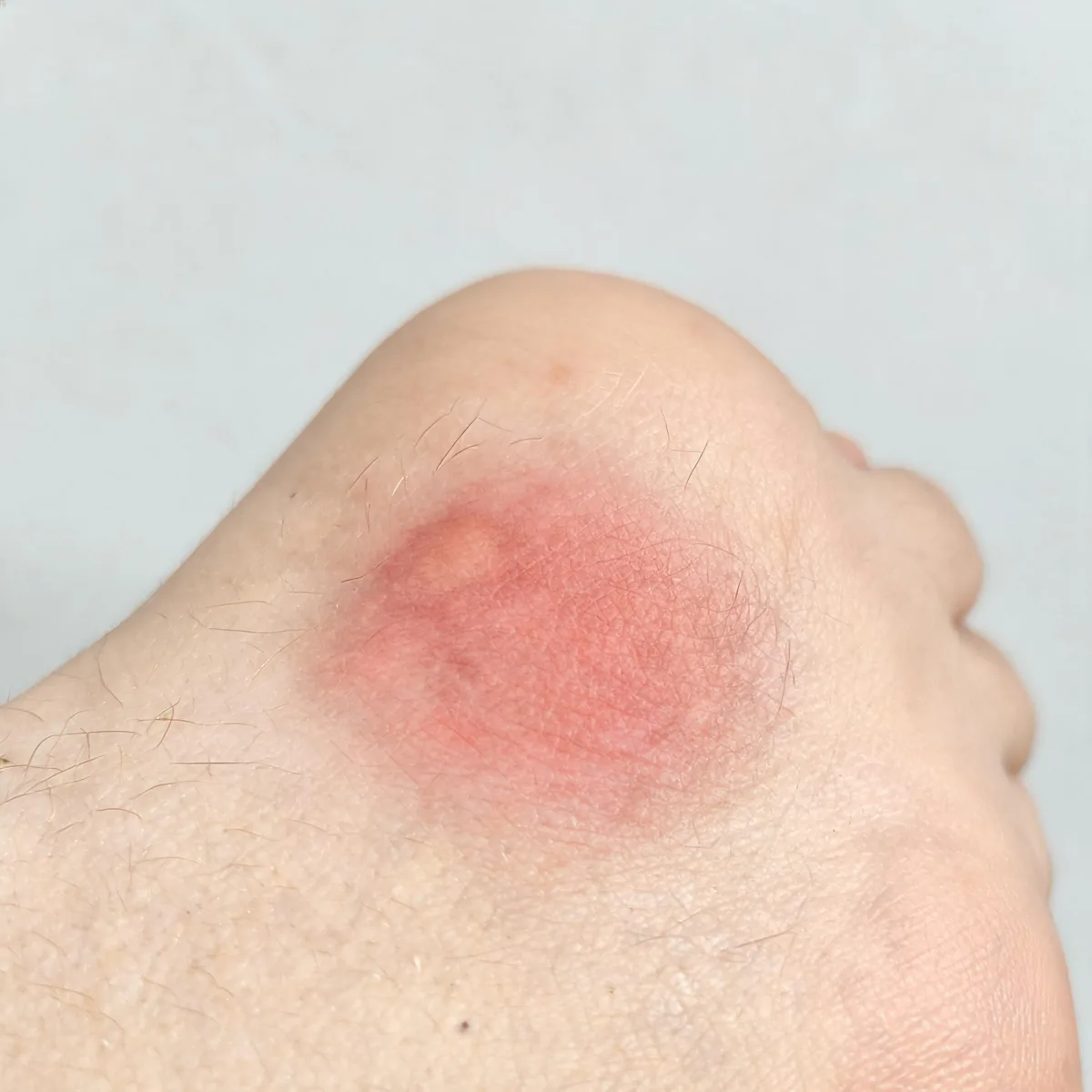
Understanding Foot dorsum redness
The tradition describes the foot dorsum as a crossroads where several channels pass, especially the Stomach channel. Redness and swelling there signal heat, dampness or stagnation in those pathways.
Toxic-Heat stagnation gives a bright red hot swollen foot dorsum with severe burning or throbbing pain, possible pus-filled blisters or abscess, high fever and intense thirst. That overlaps with infection and needs urgent assessment.
Damp-Heat in the Lower Burner gives swelling with oozing yellow sticky fluid, a heavy dragging sensation in the legs and redness with a dull heavy ache rather than sharp burning.
Blood deficiency with external wind gives dry flaky itchy skin on the foot dorsum that shifts around, with itch worse at night and after wind exposure, pale dull skin and brittle nails. Blood Stagnation gives fixed stabbing pain on the foot dorsum with dark purplish-red discolouration, worse at night and with pressure, and skin that may feel cool.
The dorsum of the foot is a crossing point rather than an edge: the Stomach channel and several others run across it, so redness there is read as heat, dampness, or stagnation affecting the channels and the tissue they feed. The cause may be local, with toxic heat entering through a small cut or an insect bite, or it may be internal, with dampness and heat overflowing downwards or a deficiency of Blood leaving the surface undefended.
Being the far end of the body, the foot is where heavy turbid factors collect, and TCM describes that tendency as downward pouring. It explains why a damp-heat constitution shows up as a red, swollen, weeping foot while long-standing stagnation shows up as a dusky purplish discolouration with fixed pain. The appearance is itself the clue: bright and burning, dull and oozing, and dry and itchy each point in a different direction.
This is where the approach differs from conventional practice. Two feet that look similarly red may carry entirely different patterns. One may be an acute Toxic-Heat Stagnation with blisters and a rapid pulse; the other a chronic picture of Blood Deficiency with External Wind, with dry cracked skin and a pale tongue. Cooling and detoxifying suits the first, nourishing and moistening the second, and treating them alike would miss the point.
Conventional view
Western medicine treats redness on the dorsum of the foot as a sign of inflammation with several possible causes: cellulitis from a bacterial skin infection, contact dermatitis from footwear or topical products, eczema, or gout. Diagnosis rests on appearance and history, with swabs or blood tests when infection is suspected, and treatment targets the presumed cause.
Cellulitis is treated with oral or intravenous antibiotics, contact dermatitis with emollients and topical corticosteroids, and gout with NSAIDs or colchicine. Most cases settle within days to a week of appropriate treatment, though chronic conditions such as eczema need ongoing emollients and intermittent medication.
Antibiotics and steroids quiet the redness quickly but do not explain why it occurred, and recurrent redness can lead to repeated courses with the associated risks of resistance and gut flora disruption, while topical steroids thin the skin over time. The conventional approach also treats all foot redness as one problem, without separating the hot, oozing, dry or dusky patterns that TCM reads as clues to a deeper imbalance.
Selected PubMed records
Real PubMed records for the conventional discussion above, selected by condition name and title relevance. They are references, not a claim that any treatment is proven for this condition.
- Nocardia brasiliensis infection seen on grafted skin of the dorsum of a foot.. Nihon Ishinkin Gakkai zasshi = Japanese journal of medical mycology, 2001. PMID: 11479535.
How it is assessed
The practitioner assesses heat, discharge, colour and the direction of spread.
What a practitioner looks for
- Heat and swelling: bright red hot swelling suggests Toxic-Heat stagnation.
- Discharge: oozing yellow fluid with dull ache suggests Damp-Heat in the Lower Burner.
- Dryness: dry flaky shifting itch suggests Blood deficiency with wind.
- Fixed pain: dark purplish discolouration with fixed pain suggests Blood Stagnation.
The practitioner looks at the foot and asks about onset and quality before anything else. In Toxic-Heat Stagnation the dorsum looks vividly red, feels hot, and is intensely painful; blisters are common, and there may be fever and thirst with a red tongue, a yellow coating, and a flooding rapid pulse, all pointing to a fierce inflammatory fire.
In the Lower Burner damp-heat picture, swelling and oozing dominate. The affected skin weeps yellow sticky fluid and feels heavy rather than simply burning, the coating is greasy and yellow over a red tongue, and the pulse runs slippery and fast. Questions about urinary change or fullness in the lower body help confirm that dampness is pouring downwards.
Blood Deficiency with External Wind belongs to the chronic or resolving stage, with dull, dry, cracked skin and itching that is worse in dry weather, a pale tongue with little coating, and a thin weak pulse; a long history, a pale complexion, or poor sleep support the reading that a lack of nourishing Blood is letting Wind stir at the surface. Blood Stagnation shows as a dark dusky discolouration with fixed stabbing pain that worsens with cold, a foot that feels cool, a pale or dusky tongue, and a wiry thin pulse, and the practitioner asks whether the pain stays in one spot and whether warmth helps, since the cause is sluggish circulation pooling in the area.
TCM patterns in Foot dorsum redness
Four patterns are described for a red foot dorsum, separating along two lines: whether heat is active, and whether the problem is excess or deficient. Toxic-Heat Stagnation is the hot, acute picture, with bright redness, swelling, burning or throbbing pain, blisters, fever, and thirst. The Lower Burner damp-heat picture is slower and wetter, with swelling, oozing yellow sticky fluid, heavy dragging legs, and a dull ache rather than a sharp burn. The dry, chronic picture belongs to Blood Deficiency with External Wind, with pale dull skin, and an itch that migrates and is worse at night. Blood Stagnation is the cold, fixed picture, with dusky purplish discolouration, stabbing pain in one place, and a foot that may feel cool. A hot acute phase often settles into a drier one, or leaves a stagnant residue, so a practitioner asks what the foot is doing now rather than at the start.
| Pattern | Key signs | The itch | Tongue | Main formula |
|---|---|---|---|---|
| Toxic-Heat Stagnation | Bright red hot swollen foot dorsum; Severe burning or throbbing pain | Not specified | Body: Deep red or crimson with raised red pointsCoat: Thick, dry and yellow | Not specified |
| Damp-Heat in the Lower Burner | Swelling and oozing of yellow sticky fluid; Redness with a dull heavy ache rather than sharp burning | Not specified | Body: Red, slightly swollen, with a coating thickest at the rootCoat: Yellow and greasy | Not specified |
| Blood Deficiency with External Wind | Pale dull skin with brittle nails | Dry flaky itchy skin on the foot dorsum that shifts around | Body: Pale and thin, sometimes slightly dryCoat: Thin, white and a little dry | Not specified |
| Blood Stagnation | Fixed stabbing pain on the foot dorsum; Dark purplish-red discolouration | Not specified | Body: Purple, dusky or with dark stasis spots; sublingual veins dark and distendedCoat: Often thin white; a yellow coat would suggest Heat as the cause | Not specified |
Toxic-Heat Stagnation
热毒壅滞
Bright red hot swollen foot with throbbing pain and fever.
Heat toxin reaches the dorsum through a small cut, an insect bite, or damp-heat that has transformed into toxin, and lodges in the skin and flesh. The toxin blocks the movement of Qi and blood, so the area becomes intensely red, swollen, and burning, and if the stagnation deepens it turns to pus and forms an abscess.
The tongue is deep red or crimson with prickly papillae and a thick dry yellow coating, and the pulse is rapid and forceful, sometimes overflowing. Greasy or spicy food, alcohol, humid heat, long hours on the feet, and tight shoes all aggravate it, while cool compresses, rest with the foot raised, cooling foods, loose footwear, and keeping the skin clean and dry relieve it. Huang Lian Jie Du Tang is the internal formula and Jin Huang Gao a topical paste, supported by Pu Gong Ying, Lian Qiao, and Jin Yin Hua, with Hegu (LI-4), Quchi (LI-11), Neiting (ST-44), and Taichong (LR-3) as the points.
Signs
- Bright red hot swollen foot dorsum
- Severe burning or throbbing pain
- Pus-filled blisters or abscess formation
- High fever with intense thirst
Diet and lifestyle for this pattern: Avoid spicy, greasy and fried food, alcohol and coffee. Keep the foot clean and dry, avoid tight shoes, rest it, apply cool compresses to ease burning, and drink plenty of water while eating cooling food such as cucumber, watermelon and mung beans.
Damp-Heat in the Lower Burner
下焦湿热
Swelling with yellow sticky oozing and a heavy dragging ache.
Here heavy, hot, turbid fluid pools in the body's lower drainage system, and the channels that cross the foot carry it to the surface. The dorsum becomes red, swollen, and oozy with a yellow sticky discharge, wet and heavy from the dampness, inflamed from the heat.
The tongue is red with a thick yellow greasy coating that is thickest at the root, and the pulse is slippery and rapid, most marked at the rear (Chi) position. Hot humid weather, alcohol, greasy or spicy food, hot stuffy footwear, and long hours of standing or walking worsen it, while a cool dry environment, a light bland diet of barley and mung beans, rest with the foot raised, and cooling herbal soaks help. Ba Zheng San and Si Miao San drain the dampness downwards and out, with Cang Zhu and Yi Yi Ren, and Sanyinjiao (SP-6), Yinlingquan (SP-9), and Neiting (ST-44) as the points.
Signs
- Swelling and oozing of yellow sticky fluid
- Heavy dragging sensation in the legs
- Redness with a dull heavy ache rather than sharp burning
- Thirst with a greasy taste
Diet and lifestyle for this pattern: Avoid greasy, fried and spicy food as well as alcohol and sugar, which generate internal Damp-Heat. Keep the feet clean and dry in breathable shoes, and walk lightly to move Qi and drain Dampness while avoiding long periods standing in humid conditions.
Blood Deficiency with External Wind
血虚生风
Dry flaky shifting itch on pale dull skin.
When Blood is short, the skin and channels of the dorsum lose their nourishment and become dry and liable to crack. That dryness breeds internal Wind and also lets external Wind in, and the Wind stirs the deficient Blood, producing itch that shifts from place to place and worsens at night; a peripheral area like the foot is especially exposed to this combination.
The tongue is pale and thin with a thin white, slightly dry coat, and the pulse is fine, wiry at the left Guan position and floating at the right Cun position. Wind and draughts, dry cold weather, overwork and lost sleep, spicy or drying food, and stress worsen it, while rest, warm blood-nourishing meals, regular moisturising, gentle massage, and socks against draughts relieve it. Dang Gui Yin Zi is the formula, with Dang Gui and He Shou Wu as the herbs, and Sanyinjiao (SP-6), Xuehai (SP-10), Quchi (LI-11), and Fengshi (GB-31) as the points.
Signs
- Dry flaky itchy skin on the foot dorsum that shifts around
- Itch worse at night and after wind exposure
- Pale dull skin with brittle nails
Diet and lifestyle for this pattern: Eat plenty of blood-nourishing food such as dark leafy greens, beetroot, black sesame, eggs and bone broth. Avoid excess wind exposure and dry environments, moisturise the skin of the feet with natural oils, and keep movement gentle such as walking or tai chi so Blood moves without being depleted.
Blood Stagnation
血瘀
Fixed stabbing pain with dark purplish skin.
Sluggish blood congeals in the dorsum and creates a local blockage. The trapped blood turns the skin a drab purplish-red and produces a fixed, deep, stabbing pain; fresh blood cannot reach the area, so it may feel cool and look dark. The usual history is an old injury, circulation that has been poor for years, or cold that has settled in and frozen the blood, and the discolouration is dark rather than the bright red of active infection.
The tongue is purple or dusky, showing stasis spots and distended dark veins beneath it, under a thin white coat, and the pulse runs choppy, as if a knife were scraping bamboo, or wiry. Cold weather, prolonged standing or walking, night time, and tight shoes worsen it, while warmth, gentle movement, and gentle massage ease it. Xue Fu Zhu Yu Tang moves the blood and breaks the stasis, with Hong Hua, Tao Ren, and Chuan Xiong, and Taichong (LR-3), Xuehai (SP-10), and Xiangu (ST-43) as the points.
Signs
- Fixed stabbing pain on the foot dorsum
- Dark purplish-red discolouration
- Pain worse at night and with pressure
- Skin may feel cool to touch
Diet and lifestyle for this pattern: Keep the foot warm and avoid cold exposure. Gentle walking or ankle circles move blood, while long sitting or standing lets it pool. Eat blood-moving food such as black beans, turmeric and dark leafy greens, and limit greasy heavy meals that can thicken the Blood.
Treatment approach
How the tradition treats foot dorsum redness, with the herbs, formulas and points used for it.
Principles
- Treat spreading redness or red streaks as urgent infection.
- Clear heat and resolve toxicity where the foot is bright red and hot.
- Drain dampness where there is oozing and a heavy ache.
- Move Blood where the discolouration is dark and the pain fixed, and nourish Blood where the skin is dry and itchy.
- The aim is to restore the movement of Qi and blood through the dorsum while correcting the internal imbalance behind it. Hot toxic pictures need heat cleared and blood cooled, damp-heat needs the lower burner drained, blood deficiency with wind needs nourishing and moistening alongside wind dispersal, and stagnation needs the blood invigorated and the stasis broken. Mixed pictures are the rule rather than the exception, so the formula and the points are adjusted to the pattern that is present on the day.
Herbs used
Formulas
Acupoints
- LI-4 (Hegu)
- LI-11 (Quchi)
- ST-44 (Neiting)
- LR-3 (Taichong)
- SP-6 (Sanyinjiao)
- SP-9 (Yinlingquan)
- SP-10 (Xuehai)
- GB-31 (Fengshi)
- ST-43 (Xiangu)
What to expect
- Infection-related redness improves quickly with medical treatment.
- Damp patterns settle over weeks with care.
- Recurrence follows the underlying pattern and any circulation problem.
- Visible improvement in redness and discomfort usually appears within two to three weeks. Acupuncture runs once or twice weekly with daily herbs, and hot acute pictures respond faster than chronic dry or stagnant ones. As healing proceeds the redness fades, the swelling falls, and the itch and pain lessen, and the practitioner tracks the tongue and pulse to adjust the plan and the diet.
Safety and when to get help
Seek medical help urgently for
- Redness spreading rapidly, with red streaks moving up the leg.
- High fever or severe pain.
- Pus, ulceration, or any foot redness in someone with diabetes.
For anything severe, sudden or spreading quickly, read when a skin problem needs urgent care.
Cautions
- Do not delay antibiotics for spreading infection.
- Diabetic foot problems need urgent specialist care.
- Elevate and rest the foot where advised.
Using this alongside conventional care
- TCM is described as complementary to conventional care: antibiotics and medical care come first where infection is suspected.
- Conventional care and TCM can run together, provided each practitioner knows what the other is doing. Antibiotics should be declared so herbs that might interfere can be avoided, and blood-moving herbs used for stagnation, such as Hong Hua, Tao Ren, and Chuan Xiong, need care alongside anticoagulant or antiplatelet medication. Topical steroids should be applied at a different time from any herbal cream or soak, prescribed medicines should never be stopped abruptly, and rapidly spreading redness with fever or red streaks is a reason to seek urgent medical care.
Diet and lifestyle
- Avoid spicy and greasy food while the foot is hot and red, and favour cooling light food.
- Keep spicy, greasy, and deep-fried food, alcohol, and excess sugar out of the diet, since they feed heat and dampness. Dairy, rich desserts, and cold raw food encourage dampness and are best limited while there is swelling or oozing, and cooling light foods such as cucumber, watermelon, mung beans, and barley are preferred. If Blood Deficiency is part of the picture, add moderate amounts of good-quality protein, eggs, and dark leafy greens. Everyday care matters too: breathable socks and shoes, feet washed and dried properly, and no long spells in damp footwear.
If you're pregnant
Pregnancy tends to aggravate Damp-Heat, so the dorsum may flare more readily. Herbs with a strong heat-clearing or blood-moving action need great caution: Da Huang, Tao Ren, and Hong Hua are generally contraindicated. Milder choices in moderate doses, under professional guidance, include Pu Gong Ying, Lian Qiao, and Jin Yin Hua. Acupuncture is generally safe, but points traditionally avoided in pregnancy, such as Sanyinjiao (SP-6), Hegu (LI-4), and any point on the lower abdomen, are left alone.
If you're breastfeeding
Da Huang and Huang Lian, being bitter and cold, can pass into milk and cause diarrhoea or digestive upset in a baby, so they are best left out, or used only briefly and under supervision. For the Damp-Heat picture, milder herbs such as Cang Zhu and Yi Yi Ren are safer. Acupuncture carries no risk of transfer and reduces inflammation well, and topical washes with cooling herbs such as Jin Yin Hua are safe and act directly on the area.
If treating a child
In children the usual picture is Toxic-Heat Stagnation after a minor injury, an insect bite, or exposure to a damp-hot environment. It comes on fiery and fast, with swelling and blistering appearing quickly. Formula doses run at a quarter to a half of the adult amount depending on age. External treatment is well tolerated: Jin Huang Gao paste, or a soak of Pu Gong Ying and Jin Yin Hua. Where needles are refused, acupressure or laser acupuncture can replace them.
If treating an elderly patient
With age, Blood Deficiency and Blood Stagnation tend to dominate, so the foot may look dull, dry, and cracked instead of bright red and weeping. Healing is slow, and strong heat-clearing herbs can injure an already weak Spleen and Stomach, which makes Xue Fu Zhu Yu Tang or Dang Gui Yin Zi the more suitable choice, at roughly two thirds of the usual adult dose. Gentle moxibustion at Spleen and Kidney points supports Qi and Blood, local acupuncture improves circulation, and the whole medicine list should be reviewed first.
Urgent-sign guidance is based on standard sources: NHS anaphylaxis, NHS cellulitis, NHS Stevens-Johnson syndrome, NHS melanoma.
Evidence
Evidence status
Compiled for this page from the classical and modern literature; not a systematic review, so treat it as a pointer to sources rather than clinical guidance.
Direct research on this symptom is scarce. The evidence comes from related conditions such as erysipelas, cellulitis and eczema, where Chinese randomised trials suggest internal and topical herbal medicine can reduce redness, swelling and pain in acute skin infection, usually alongside antibiotics. Methodological quality is often low and English-language trials are virtually absent. Acupuncture has a stronger evidence base for inflammatory pain generally.
Studies often cited
Chinese randomised trials suggest reduced redness, swelling and pain, usually combined with conventional antibiotics, with low methodological quality. Chinese randomised controlled trials (as recorded in the source)
A more robust evidence base than for the skin lesion itself, but indirect for this presentation. Clinical literature (as recorded in the source)
Classical record
Dan toxin is a condition where the body suddenly becomes inflamed and red, as if painted with cinnabar. It may appear on the hands, feet, abdomen or back, and is always caused by wind-heat and virulent toxin.
- Zhu Bing Yuan Hou Lun (Treatise on the Origins and Symptoms of Diseases), volume on Dan toxin (erysipelas). The Chinese original is not reproduced here: it could not be recovered reliably from the source record, and is not guessed.
足发背者,乃足三阳经湿热下注,或外伤染毒,以致气血凝滞,红肿热痛,甚则溃烂。
Foot dorsum redness arises either when damp-heat pours downward along the foot's three Yang channels, or when injury admits toxin, so that Qi and blood stagnate and the area becomes red, swollen, hot, and painful, ulcerating in severe cases.
- Classical citation: chapter on carbuncles and deep-rooted sores.
Common questions
Why is the top of my foot red?
The classical literature reads it as heat, dampness or stagnation in the channels crossing the foot. It can also be infection or inflammation, which needs medical review.
When is redness urgent?
Spreading redness, red streaks up the leg, fever, or any foot redness with diabetes.
Can herbs reduce the redness?
The tradition describes clearing heat and draining dampness, but infection needs medical treatment first.
What if the skin feels cool?
Cool dark skin with fixed pain is described as Blood stagnation rather than active heat.
What if my symptoms overlap two patterns?
Overlap is common, because the internal climate shifts once an acute inflammation begins to settle into a slower, drier phase. A foot that is hot, throbbing, and discharging yellow fluid leans towards heat or damp-heat; one that has turned cracked, pale, and itchy as the redness fades points to blood deficiency; a fixed, cold, stabbing pain that eases with warmth suggests stagnation. The tongue and pulse usually show which is dominant, and professional advice is wise when the area feels hot, is spreading, or comes with fever.