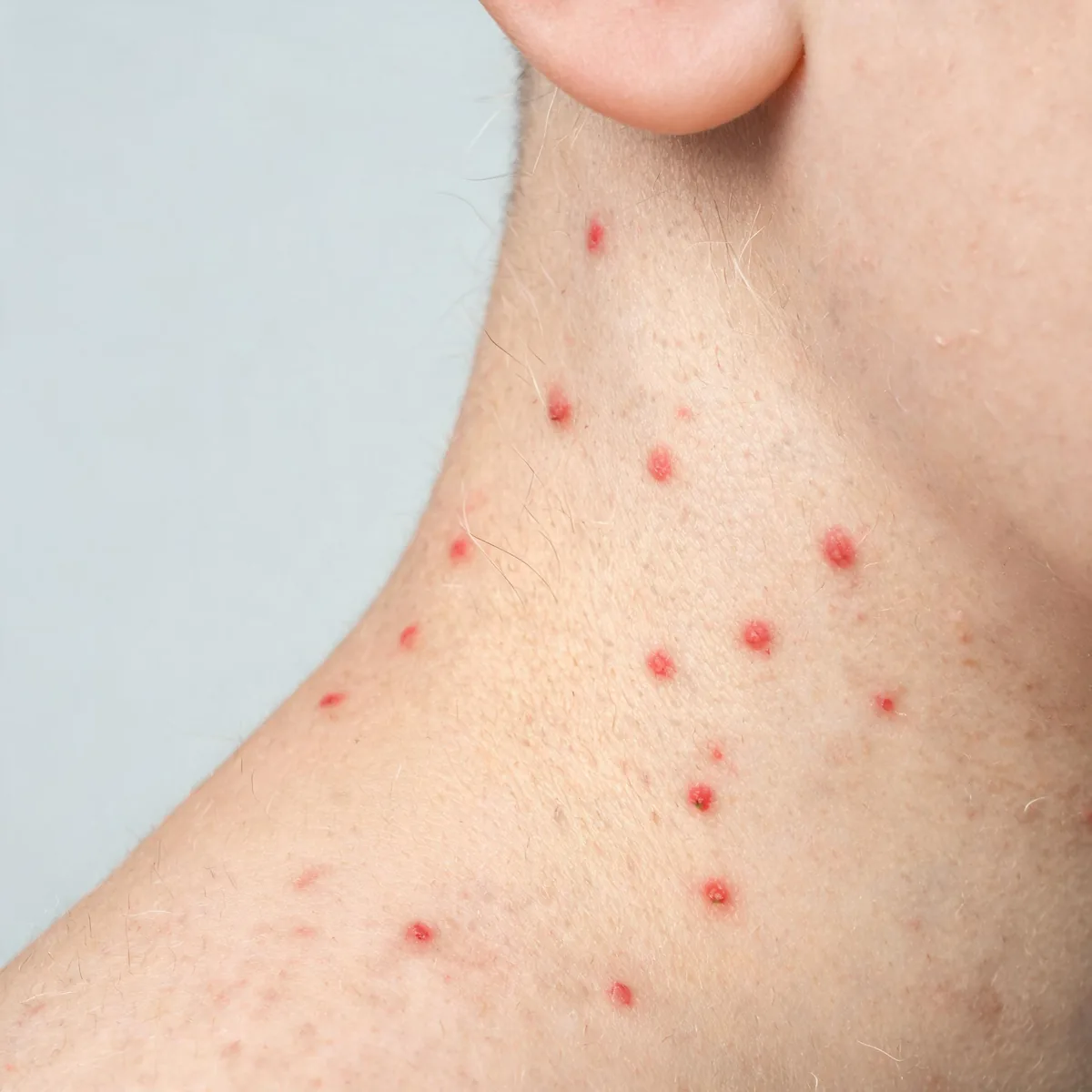
Understanding Papules
The tradition describes the skin as an extension of the organs, particularly the Lungs, which govern the skin and its defensive Qi, and the Spleen and Liver.
When Wind and Heat invade, the Lungs cannot shield the surface and red itchy papules appear. This is Wind-Heat: sudden onset after wind or a weather change, with burning itch, thirst and a mild sore throat.
Damp-Heat gives red swollen papules that may ooze sticky fluid, with heaviness and loose sticky stools. Spleen deficiency with dampness gives the opposite texture: dull pale papules with little exudate, plus bloating and fatigue.
Two patterns explain longstanding papules. Yin and Blood deficiency gives dry rough thickened papules with itch that worsens at night. Qi and Blood stagnation gives dark red or purplish papules with fixed stabbing pain and stubborn itch.
The Lungs sit at the centre of this picture because they govern the skin and the defensive Qi that patrols its surface. When Wind or Heat slips past that defence, small raised lesions appear, and the same invasion often leaves a sore throat or a tickle of thirst. The Spleen adds the fluid side of the story: if it cannot transform what it receives, dampness gathers and seeps outward. The Liver adds movement, and when stress knots Qi and Blood they lodge in place.
Because one bump can carry several of these stories at once, the practitioner reads more than colour. Moisture, how quickly the lesion arrived, whether it feels hot or rough, and what the rest of the body reports all narrow the field. Eczema, for instance, may be treated as Damp-Heat in one person and as Blood dryness in another, and the herbs and points follow the pattern rather than the label. Wind, dampness, heat and deficiency are not separate diseases here but different climates inside one body, and the lesion is where that climate reaches the surface.
Conventional view
A papule is a solid raised lesion smaller than a centimetre, with no fluid inside it. Papules may be red, pink, brown or the colour of the surrounding skin, and may stand alone or in clusters. Acne and eczema are the commonest causes, followed by viral rashes, insect bites and allergic reactions. A doctor identifies them by looking, and by asking when they started, what eases or aggravates them and what else is going on; a lesion that has changed shape or colour may need a dermatoscope or a sample.
Treatment follows the cause rather than the lesion. Topical steroids and antihistamines calm itching and inflammation, antibiotics are used where infection is present, and chronic acne is managed with retinoids or hormonal treatment. Moisturisers and gentle cleansing protect the skin barrier. Where a drug reaction or a systemic illness is suspected, the medicine is stopped or the underlying condition treated.
The limit of this approach is that it works on the skin and not on the internal climate that keeps producing lesions. Steroids thin the skin with prolonged use, antihistamines block the itch without resolving it, and antibiotics disturb the gut flora. Above all, every crop of papules with the same diagnosis receives the same treatment, whereas the classical literature reads dampness, heat, deficiency and stagnation as four different roots needing four different strategies.
Selected PubMed records
Real PubMed records for the conventional discussion above, selected by condition name and title relevance. They are references, not a claim that any treatment is proven for this condition.
- The terminology of skin disorders. Primary Care, 2000. PMID: 10815043.
How it connects
Papules rarely stand alone. They are the signature lesion of acne, where they sit beside pustules and nodules, and both share the Damp-Heat and Wind-Heat that rise to the face and chest, so a greasy yellow coating and inflamed bumps belong to one story. Atopic dermatitis tells the same story from the other side: weeping papules during a flare point to Dampness and Heat that a weak Spleen has failed to manage, and treating that root calms the dermatitis and the lesions together.
How it is assessed
The practitioner examines the papules and asks how they started.
What a practitioner looks for
- Onset: sudden papules after wind or weather change suggest Wind-Heat.
- Moisture: oozing sticky fluid suggests Damp-Heat; no exudate with pale colour suggests Spleen deficiency.
- Texture: dry rough thickened papules suggest Yin and Blood deficiency.
- Colour: dark red or purplish with fixed pain suggests Qi and Blood stagnation.
A consultation starts with the lesion itself. Redness and swelling that weep a sticky fluid point towards Damp-Heat, and the person usually describes heaviness, sluggish digestion and a sticky taste. On the tongue, a thick yellow greasy coat covers a red body, and the pulse runs slippery and fast. Bloating, a weak appetite or a bitter taste all back that reading.
A crop that appears overnight, burns, itches fiercely and follows a cold, a windy day or a sudden change in weather reads as Wind-Heat. Thirst, a mild sore throat, redness at the tip and edges of the tongue beneath a thin yellow film, and a pulse that floats and runs fast separate it from the slower, wetter Damp-Heat picture. The speed of onset and the strength of the burning carry as much weight as the colour.
Pale lesions that barely rise and ooze little belong to a weak Spleen; the tongue is puffy and pale with teeth marks, the pulse soft and slow, and the person reports bloating, loose stools and tiredness. Dry, thickened, relentlessly itchy lesions, a red tongue short of coating and a thin pulse indicate Yin and Blood deficiency. Dark or purplish lesions that stay fixed, with purple spots on the tongue and a choppy or wiry pulse, point to Qi and Blood stagnation.
TCM patterns in Papules
Five patterns cover most papular eruptions, and four questions separate them: colour, moisture, how suddenly the lesions arrived, and how long they have stayed. Colour shows whether Heat is involved and how deeply it sits. Moisture separates a pattern that weeps from one that stays dry. Sudden onset points to something arriving from outside the body, while months of stubborn lesions point to an imbalance built up inside. Reading the lesions beside the rest of the body helps too, because a red crop after a windy day, a greasy face with a heavy head, tiredness after eating, a night-time itch with a dry throat and dark lesions that never shift each tell a different story. Two patterns often run together, most often dampness with heat, or a long-standing deficiency that has let dampness gather. A practitioner confirms the reading with tongue and pulse.
| Pattern | Key signs | The itch | Tongue | Main formula |
|---|---|---|---|---|
| Damp-Heat | Red swollen papules that may ooze sticky fluid | Not specified | Body: Red, often swollen with teeth marksCoat: Yellow, greasy and thick, usually in the middle and at the root | Not specified |
| Wind-Heat | Not specified | Red itchy papules with burning | Body: Red at the tip and edgesCoat: Thin yellow or white turning yellow | Not specified |
| Spleen Deficiency with Dampness | Dull or pale papules with little exudate | Not specified | Body: Pale and swollen, often with teeth marks along the edgesCoat: White, greasy and moist, thick in the middle | Not specified |
| Yin and Blood Deficiency | Dry rough or thickened papules; Dry mouth and throat | Intense itch worse at night | Body: Pale to pale-red, thin, dry and crackedCoat: Scanty or peeled | Not specified |
| Qi And Blood Stagnation | Dark red or purplish papules | Fixed stabbing pain or stubborn itch | Body: Purple or dark, with stasis spots; sublingual veins dark and distendedCoat: Thin white | Not specified |
Damp-Heat
Red swollen papules that may ooze sticky fluid, with heaviness.
Rich, fried or heavily spiced food, and a hot humid climate, both leave the Spleen and Stomach with more than they can process. What cannot be transformed stays behind as a sticky turbid fluid, and heat from the same food, from alcohol or from the weather joins it. Dampness produces the swelling and the weeping, heat produces the redness and the sting, and together they congest the pores so the lesion cannot discharge cleanly.
The tongue is red under a thick yellow greasy coat and may be puffy with teeth marks; the pulse is slippery and rapid. Lesions worsen after a heavy meal, in humid weather or with alcohol, and settle with lighter meals, a cool dry room and gentle exercise that brings a light sweat. San Ren Tang is the formula, with Huang Qin, Yi Yi Ren and Ku Shen, and the points LI-11 (Quchi), SP-9 (Yinlingquan), ST-44 (Neiting) and SP-6 (Sanyinjiao).
Signs
- Red swollen papules that may ooze sticky fluid
- Heaviness in body and head
- Greasy or sticky taste
- Loose sticky stools
Diet and lifestyle for this pattern: Eat light, cooling food such as mung beans, cucumber and bitter greens, and avoid greasy, fried, spicy and sugary food that feeds Dampness and Heat. Gentle exercise that produces a light sweat helps drain Dampness, and keep living spaces cool and dry.
Wind-Heat
Red itchy papules with sudden onset after wind.
Wind-Heat arrives from outside the body. It enters through the skin and the throat, and where it lodges it disturbs the movement of Qi and Blood at the surface, producing local heat and inflammation. Because the pathogen is recent and superficial, the lesions come in a rush, burn, itch intensely and feel hot to the touch, and they are often preceded by a sore throat, thirst or a shivery feeling.
The tongue tip and its edges look red beneath a thin yellow film, and the pulse floats and beats fast. Wind, spicy food, fried food and alcohol all feed it, while a cool room, rest and cooling teas such as chrysanthemum or dandelion settle it. Xiao Feng San is the classical choice, with Jing Jie and Fang Feng to release the exterior, supported by LI-4 (Hegu) and LI-11 (Quchi).
Signs
- Red itchy papules with burning
- Sudden onset after wind or weather change
- Thirst with mild sore throat
- Fever or mild chills
Diet and lifestyle for this pattern: Avoid spicy, greasy and fried food that generates internal Heat. Drink plenty of water and choose cooling food such as mung beans, cucumber and chrysanthemum tea, protect the skin from wind and extreme temperature change.
Spleen Deficiency with Dampness
Dull pale papules with little oozing and bloating.
Here the lesion is the least dramatic part of the picture. A Spleen worn down by overwork, worry or irregular meals cannot turn food and fluid into usable energy, so a heavy turbid dampness collects inside and leaks outward into the skin. Because no heat sits behind it, the lesions stay dull and pale and ooze very little, and because the root is digestive the skin flares when the digestion flares.
Expect bloating that builds after eating, loose or unformed stools, a poor appetite, heaviness in the limbs and tiredness that deepens after meals. The tongue is pale and swollen with teeth marks under a moist white greasy coat, and the pulse is soft, soggy and slow. Cold and raw food, humid weather, skipped or oversized meals and worry all worsen it, while warm cooked food, small portions and gentle walking help. Shen Ling Bai Zhu San or Wei Ling Tang, with Bai Zhu, Fu Ling, Yi Yi Ren and Cang Zhu, and the points ST-36 (Zusanli), SP-9 (Yinlingquan), BL-20 (Pishu) and SP-6 (Sanyinjiao).
Signs
- Dull or pale papules with little exudate
- Bloating worse after eating
- Loose or unformed stools
- Heaviness in the body
- Poor appetite
Diet and lifestyle for this pattern: Eat warm, cooked meals such as soups, stews and congees, and avoid cold, raw and greasy food that burdens the Spleen. Gentle daily walking helps the Spleen transform Dampness and keeps Qi flowing.
Yin and Blood Deficiency
Dry rough thickened papules with night itch.
Blood and Yin are what keep skin soft, supple and supplied. When they run low through overwork, late nights, long illness or the passage of years, the surface is undernourished: it dries, thickens and cracks, and the cracks themselves read as rough raised lesions. The deficiency also breeds a quiet internal heat with nothing to moisten it, and that heat is why the itch sharpens at night, when Yin should be at its most settled.
The tongue is pale to pale-red, thin and dry with cracks and little coating; the pulse is fine and rapid. Dry heated rooms, spicy or fried food, late nights and stress make the skin worse, while humid air, rest, moisturising and hydrating food ease it. Dry mouth and throat, dry hair, dizziness and broken sleep usually accompany it. Dang Gui Yin Zi, with Dang Gui and He Shou Wu, is the formula, and SP-6 (Sanyinjiao), KI-3 (Taixi) and SP-10 (Xuehai) the points.
Signs
- Dry rough or thickened papules
- Intense itch worse at night
- Dry mouth and throat
- Dry skin and hair
- Dizziness or light-headedness
Diet and lifestyle for this pattern: Moisturise the skin with gentle natural oils straight after bathing. Eat Yin- and Blood-building food such as pear, black sesame, spinach and bone broth, avoid spicy, fried or very drying food, and prioritise deep rest on a regular sleep schedule, since late nights burn Yin and worsen the itch.
Qi And Blood Stagnation
Dark red or purplish papules with fixed pain.
When stress or frustration keeps Qi from moving, the Blood it should be pushing begins to pool, and the pool settles in the small vessels of the skin. What forms is not an inflamed lesion but a congested one: dark red or purplish, sometimes nodular, and stuck. Because the obstruction is physical rather than functional, the itch or pain stays in one place and does not wander, and the lesions resist the usual clearing and draining strategies.
The tongue is dark purple with stasis spots and distended sublingual veins; the pulse is wiry and choppy. Emotional stress, cold or raw food, heavy greasy meals and long sedentary hours worsen it, while gentle movement, warmth on the area and light warming meals ease it. Chest or rib distension, mood swings and dark lips often accompany it. Tao Hong Si Wu Tang, with Tao Ren and Hong Hua, is the classical formula, and SP-10 (Xuehai) and LR-3 (Taichong) the points.
Signs
- Dark red or purplish papules
- Fixed stabbing pain or stubborn itch
- Chest or rib distension
- Mood swings or depression
- Dark lips or complexion
Diet and lifestyle for this pattern: Keep the body moving with gentle daily exercise such as walking or stretching so Qi and Blood flow. Avoid cold, heavy or greasy food that congeals Blood, and use mild warming spices such as turmeric and black pepper in cooking. Manage emotional stress with regular relaxation, since frustration and resentment are the main drivers of this pattern.
Treatment approach
How the tradition treats papules, with the herbs, formulas and points used for it.
Principles
- Clear Wind-Heat where papules are new, red and itchy.
- Drain dampness where they ooze and the body feels heavy.
- Nourish Yin and Blood where papules are dry and thickened.
- Move Qi and Blood where they are dark, fixed and painful.
- Treatment runs on two levels at once: the visible lesion is cleared while the imbalance that produced it is corrected. Excess patterns are drained, cleared and dispersed, deficiency patterns are strengthened and nourished, and stagnation is moved.
- In practice Damp-Heat is met with San Ren Tang and SP-9 (Yinlingquan), a Wind-Heat crop with Xiao Feng San and LI-4 (Hegu), and dry blood-deficient skin with Dang Gui Yin Zi and SP-6 (Sanyinjiao). Internal medicine, acupuncture and sometimes an external wash are used together.
Herbs used
Formulas
Acupoints
- LI-11 (Quchi)
- SP-9 (Yinlingquan)
- ST-44 (Neiting)
- SP-6 (Sanyinjiao)
- LI-4 (Hegu)
- ST-36 (Zusanli)
- BL-20 (Pishu)
- KI-3 (Taixi)
- SP-10 (Xuehai)
- LR-3 (Taichong)
What to expect
- Acute heat and wind patterns are described as settling within one to two weeks.
- Dry and stagnant patterns take longer.
- A rapidly spreading papular rash with fever needs urgent medical review.
- Most people notice less itch and fewer new lesions within two to four weeks, with acupuncture weekly for six to eight weeks before sessions are spaced out. Herbs are taken daily as granules dissolved in warm water.
- Acute Wind-Heat and Damp-Heat settle fastest, while chronic deficiency and stagnation take months, and the formula is adjusted as the pattern shifts.
Safety and when to get help
Seek medical help urgently for
- A rapidly spreading rash with fever.
- Difficulty breathing or swelling of the face or lips.
- Papules that become blistered, ulcerated or bleed.
For anything severe, sudden or spreading quickly, read when a skin problem needs urgent care.
Cautions
- Do not squeeze or pick papules.
- A changing lesion needs dermatological review.
- Persistent papules should be diagnosed, not only treated.
Using this alongside conventional care
- TCM is described as complementary to conventional care: prescribed topical treatment continues alongside herbs.
- Nothing about herbs or acupuncture requires stopping a prescribed cream, antihistamine or oral medicine, but both practitioners should know the full list. Blood-moving herbs such as Dang Gui and Hong Hua can add to the effect of anticoagulants, and cooling herbs are worth monitoring alongside blood pressure medication. Never stop a prescribed medicine abruptly. A coordinated plan, with the dermatologist looking after the skin barrier and the TCM practitioner after the internal pattern, gives the best result.
Diet and lifestyle
- Favour a simple light diet and avoid greasy, fried, spicy and overly sweet food.
- The general rule is a simple, light diet: plenty of cooked vegetables, whole grains such as barley and millet, a moderate amount of lean protein, and less greasy, fried, spicy and very sweet food, all of which generate Dampness and Heat. Dairy, alcohol and caffeine are worth limiting. Chrysanthemum or dandelion tea gently clears heat, while dry skin benefits from moistening food such as pear, apple and sesame. Eating at regular times matters as much as what is eaten, since an overloaded Spleen is the common root. For Damp-Heat add mung beans, cucumber and bitter greens; for Wind-Heat avoid spicy food and cover the skin against wind; for Spleen deficiency choose warm soups, stews and congees; for Yin and Blood deficiency add black sesame, spinach and bone broth.
If you're pregnant
Pregnancy tends to push the picture towards dryness, because Yin and Blood are stretched, so a dry itchy eruption is often what appears. Dang Gui Yin Zi is the classical formula for that presentation, but Dang Gui moves Blood and is used cautiously in the early months, so a practitioner may lower the dose or substitute He Shou Wu. Any formula aimed at Damp-Heat or Wind-Heat needs review before use: Xiao Feng San contains Mu Tong, which is avoided in pregnancy, and Tong Cao may replace it or the herb may simply be left out. Acupuncture is generally safe, though LI-4 (Hegu) and SP-6 (Sanyinjiao) are avoided because they can encourage uterine contractions. Tell the practitioner that you are pregnant.
If you're breastfeeding
Herbs pass into milk, so the strength of the formula matters. Bitter-cold herbs taken to clear Damp-Heat, Ku Shen among them, can loosen an infant's stools, and Xiao Feng San includes Ku Shen, so it is used with care or avoided. Gentler food-grade herbs such as Yi Yi Ren and Fu Ling can be taken in soups to drain Dampness, and Jing Jie and Fang Feng are usually regarded as safe for Wind-Heat. Acupuncture passes nothing to the infant and is a good alternative, easing both the itch and the inflammation.
If treating a child
In children papules usually appear with eczema or a food allergy, and the Spleen Deficiency with Dampness pattern dominates because the digestive system is still immature. Lesions tend to be pale, weepy and placed on the cheeks and in the skin folds. A quarter to a half of the adult dose of Shen Ling Bai Zhu San supports the Spleen and drains Dampness gently. Children cannot always describe what they feel, so diagnosis leans on what can be seen: the coating on the tongue, how the stool smells and how lively the child is. Paediatric tui na is a gentle alternative to needles, and ST-36 (Zusanli) and BL-20 (Pishu) can be massaged daily. Cold, harsh herbs are avoided so as not to strain a delicate digestion.
If treating an elderly patient
Yin and Blood deficiency is the commonest pattern in older skin: it thins, dries and itches at night, and the lesions become chronic. Dang Gui Yin Zi is the usual formula, at about two thirds of the adult dose, because metabolism is slower and kidney function may have declined. Several prescriptions are common at this age, so interactions need checking: Dang Gui has a mild anticoagulant effect and can add to blood thinners. Acupuncture is particularly safe here because it brings no drug interaction, and treatment runs longer, with nourishment and moisture as the aim rather than strong clearing.
Urgent-sign guidance is based on standard sources: NHS anaphylaxis, NHS cellulitis, NHS Stevens-Johnson syndrome, NHS melanoma.
Evidence
Evidence status
Compiled for this page from the classical and modern literature; not a systematic review, so treat it as a pointer to sources rather than clinical guidance.
Evidence for papules sits inside studies of the conditions they accompany, mainly acne and eczema. Acupuncture for acne has been evaluated in randomised trials and a meta-analysis, which found reduced inflammatory lesion counts versus no treatment or placebo, possibly as effective as topical medication with fewer side effects, though many trials are small. Chinese herbal medicine for atopic dermatitis shows promise for itch and lesion severity, and one Cochrane review noted some herbal preparations were more effective than placebo.
The meta-analysis in question pooled 43 randomised controlled trials and reported fewer inflammatory lesions than with no treatment or placebo, a low rate of adverse events and results comparable to topical medication, though small samples and uneven quality temper the finding. The Cochrane review of Chinese herbal medicine for atopic dermatitis examined four trials and found some preparations reduced redness and itching, concluding that the evidence was inconclusive. Xiao Feng San, the formula used for Wind-Heat lesions, has shown anti-inflammatory and antipruritic activity in animal studies, and robust human trials of it are still needed.
Studies often cited
Significantly reduced inflammatory lesion counts compared with no treatment or placebo, possibly as effective as topical medication with fewer side effects, though trial quality varied. Meta-analysis of randomised trials (as recorded in the source)
Promising reductions in itching and lesion severity; a Cochrane review noted some preparations beat placebo. Cochrane review and trials (as recorded in the source)
Classical record
All sores and skin lesions are caused by wind, dampness, heat and toxins lodging in the skin and flesh, leading to stagnation of Qi and blood, disharmony of the nutritive and defensive Qi, and reversal in the flesh texture, giving rise to swellings.
- Wai Ke Zheng Zong (Orthodox Manual of External Medicine), general discussion on sores. The Chinese original is not reproduced here: it could not be recovered reliably from the source record, and is not guessed.
Wind itch begins when a weakened body is invaded by wind. The wind lodges in the spaces of the skin, contends with Qi and Blood and moves about within, so itching follows, with lesions that look like millet grains or like patches of cloud.
Zhu Bing Yuan Hou Lun - Zhu Bing Yuan Hou Lun (Treatise on the Causes and Symptoms of Diseases), chapter on wind itch, recorded from the reference. The Chinese original is not reproduced here because the source record does not carry it.
Common questions
What is the difference between a papule and a pustule?
A papule is solid and raised; a pustule contains pus. The classical literature treats them as different patterns with different urgency.
Can herbs clear papules?
The tradition describes clearing heat and dampness for acute papules, with improvement over weeks.
Why do they itch more at night?
Night-time itch is described as a feature of Blood deficiency and Yin deficiency patterns.
When should I see a doctor?
A rapidly spreading rash with fever, breathing difficulty, or a lesion that bleeds or changes.
What causes papules in TCM?
The tradition describes them as an internal imbalance reaching the surface. Dampness and Heat from the diet, an invasion of Wind-Heat, a weak Spleen that cannot manage fluids, depleted Blood and Yin, or Qi and Blood held back by stress each produce a differently looking lesion.
How long does treatment take?
A sudden Wind-Heat crop may settle in a week or two. Damp-Heat and Spleen deficiency usually need four to eight weeks, and dry deficient skin or stubborn stasis eight to twelve weeks or longer. Itch and new lesions often ease before the skin looks clear.
Can I keep using my steroid cream?
In most cases yes. Tell both the dermatologist and the TCM practitioner what is being applied or taken, because some herbs interact with medication, and never stop a prescribed treatment without medical advice.