Understanding Vulvar leukoplakia
The tradition describes vulvar leukoplakia as a reflection of deeper imbalance in the Liver, Kidney and Spleen, with the Liver channel running through the genital area.
Kidney and Liver Yin deficiency gives itching worse at night, dry pale thin vulvar skin, low back and knee soreness, dry eyes and night sweats. That is the depletion pattern most often described.
Liver Blood stagnation gives fixed stabbing pain or itch, dark or mottled white patches, dark clotty periods and purple lips and nails. Damp-Heat in the Liver channel gives intense burning and itching with redness, swelling and foul-smelling yellow discharge.
Spleen and Stomach Qi deficiency gives pale thin atrophic white patches with fatigue, poor appetite and loose stools. Liver Wind agitating internally from Liver Blood deficiency gives intense paroxysmal itching in waves, dry scaly white patches, dizziness, brittle nails and fine tremor.
Three organ systems meet at the vulva. The Liver channel runs through the genital area, so emotional strain, frustration and a stagnant flow of Qi show up there early. The Kidney holds the Yin and the reproductive essence that keep tissue moist and elastic, and the Spleen and Stomach make the Qi and Blood that reach the surface. A patch of white, thin or thickened skin is therefore read as the place where one of those systems has run down, not as a skin disease that began in the skin.
Because several roots can produce a similar patch, the diagnosis rests on more than the surface. The practitioner asks when the itch is worst, whether it burns or stabs, what the discharge is like, and how the cycle, the digestion and the sleep behave, then reads the tongue and the pulse to decide which system is carrying the strain. Each answer points to a different internal strategy, from nourishing Yin and clearing deficiency heat to moving Blood, draining Damp-Heat or building the Spleen, which is why the same white patch is not treated the same way in two women.
Conventional view
Vulvar leukoplakia is a descriptive term for white patches on the vulva that are thickened or thinned, and it is not one disease. Most cases prove to be lichen sclerosus or squamous cell hyperplasia, or a blend of the two, and the cause is not settled, though autoimmune tendency, hormonal change and chronic irritation are all thought to contribute. Assessment is by examination, with a biopsy where the appearance is suspicious, because the change is benign but carries a small risk of malignancy over many years.
First-line treatment is a potent topical corticosteroid ointment used for some weeks before being tapered to a dose that is kept up, with emollients and barrier creams to protect the skin. Cases that do not respond may be tried on topical calcineurin inhibitors, and systemic treatment is used rarely. Surgery is reserved for severe scarring or architectural change, and follow-up is scheduled to catch any suspicious development.
Steroids settle itching and inflammation quickly, which makes them valuable, but they do not change why the skin became vulnerable, and symptoms commonly return when the cream stops. Prolonged potent steroid use on vulvar skin can thin it, make it more fragile and encourage fungal infection. The conventional approach also treats these patches as one condition varying only in severity, while TCM separates several internal patterns that need different support, which is where a combined plan can add something.
Selected PubMed records
Real PubMed records for the conventional discussion above, selected by condition name and title relevance. They are references, not a claim that any treatment is proven for this condition.
- Vulvar leukoplakia: therapeutic options.. Przeglad menopauzalny = Menopause review, 2020. PMID: 33100949.
How it connects
Vulvar leukoplakia rarely appears in isolation; it often co-occurs with symptoms that reflect the underlying pattern. When Kidney and Liver Yin deficiency is the root, people frequently also experience night sweats, lower back soreness and insomnia, because depleted Yin fails to anchor Yang and nourish the lower back and Heart Shen, and these are different faces of the same deficiency. Damp-Heat in the Liver channel, another common pattern, tends to bring a bitter taste in the mouth, irritability and anger, as the Heat disturbs the Liver's smooth flow and rises upward, while Spleen and Stomach Qi deficiency shows as fatigue and poor appetite, since the body's engine for producing Qi and Blood is weak. The patterns behind vulvar leukoplakia rarely stand alone. Long-standing Kidney and Liver Yin deficiency can fail to nourish the skin and eventually lead to Liver Blood stagnation, while Spleen Qi deficiency may create internal Dampness that combines with Heat to produce Damp-Heat. The timing and quality of the itch help show which is dominant: dry night itch points to Yin or Blood deficiency generating Wind, a burning moist itch suggests Damp-Heat, and stabbing pain with mottled skin suggests Blood stagnation. Reviewing the formula at follow-up matters because the mixture evolves.
How it is assessed
The practitioner examines the skin and asks about itch, pain and discharge, after medical assessment.
What a practitioner looks for
- Skin: dry pale thin atrophic patches suggest Yin or Qi deficiency.
- Itch pattern: paroxysmal waves of itch suggest Liver wind from Blood deficiency.
- Pain and colour: fixed stabbing pain with dark patches suggests Blood stagnation.
- Red flags: a new sore, ulcer or lump that does not heal needs biopsy.
The consultation starts with the itch itself: when it peaks, whether it burns, stabs or crawls, what makes it better and whether it disturbs sleep. The practitioner then examines the skin for colour, thickness and moisture, because a pale dry surface and a red weeping one point in opposite directions. Discharge, odour, urination, the menstrual pattern and the digestion are part of the same reading, and the tongue and pulse confirm it.
Night-time itch with a dry pale thin surface, a dry mouth, a sore lower back and heat in the palms and soles is read as Kidney and Liver Yin Deficiency, with a red tongue that has little coat and a thin rapid pulse. Dark or mottled patches with a fixed prickling discomfort, worse before a period, are read as Liver Blood Stagnation, with a dark red tongue showing spots and a wiry choppy pulse.
Redness, swelling and a burning itch that cooling relieves, with yellow sticky discharge, are read as Damp-Heat in the Liver Channel, with a red tongue, a thick yellow greasy coat and a slippery rapid pulse. Pale atrophic patches with tiredness, poor appetite and loose stools are read as Spleen and Stomach Qi Deficiency, with a pale tongue, a thin white coat and a weak thready pulse. An itch that comes in waves with dry scaly patches is read as internal Wind from deficient Liver Blood, which the tongue and pulse support when they are pale, thin and fine.
TCM patterns in Vulvar leukoplakia
Five patterns are described, and each names a different reason why the vulvar skin has lost its nourishment. Two are shortages, of Liver and Kidney Yin and of Spleen and Stomach Qi and Blood. One is a blockage, Liver Blood stagnating in the channel that serves the genitals. One is an excess, Damp-Heat sinking downwards from a diet and a temper that keep producing it. The fifth, internal Wind rising from deficient Liver Blood, is a consequence of long-standing dryness rather than a cause in itself. The patterns overlap and evolve, because Yin that has been low for years leaves the Blood sluggish, and a Spleen that cannot transform food slowly gathers the Dampness that Heat then turns turbid. Reading which one is leading matters more than naming it correctly, since the leading pattern decides whether the formula nourishes, moves, drains or warms.
| Pattern | Key signs | The itch | Tongue | Main formula |
|---|---|---|---|---|
| Kidney and Liver Yin Deficiency | Dry pale thin vulvar skin; Dry eyes with blurred vision | Itching worse at night | Body: Red, thin and dry, often crackedCoat: Little or none; the tongue may look peeled | Not specified |
| Liver Blood Stagnation | Not specified | Fixed stabbing pain or itch in the vulva | Body: Purple or dark with stasis spots on the sides and distended sublingual veinsCoat: Thin white | Not specified |
| Damp-Heat in the Liver Channel | Redness and swelling | Intense burning and itching of the vulva | Body: Red, with redder sides and edgesCoat: Yellow and greasy, thicker at the centre and root | Not specified |
| Spleen and Stomach Qi Deficiency | Not specified | Not specified | Body: Pale, puffy and teeth-markedCoat: Thin white | Not specified |
| Liver Wind agitating Internally due to Liver Blood Deficiency | Dry scaly white patches; Dizziness and blurred vision | Intense paroxysmal itching in waves | Body: Pale and thin, sometimes tremblingCoat: Thin white | Not specified |
Kidney and Liver Yin Deficiency
Night itch with dry pale thin vulvar skin and night sweats.
The Liver channel runs through the genital region and the Kidney holds the Yin fluids that keep tissue supple. When both are depleted the vulvar skin loses its moisture and its nourishment, so it becomes thin, pale and dry, and the Yang that is left unopposed rises as a low-grade heat. That heat explains why the itch is at its worst at night, when Yin should be at its fullest and the deficiency is most exposed.
The tongue is red, thin and cracked with little or no coat and a dry surface, and the pulse is fine, rapid and wiry, weakest where the Kidney and Liver are read. Late nights, overwork, spicy and fried food, emotional strain, dry hot weather and sexual overactivity all spend Yin, while rest, a cool humid room, moistening foods and gentle stretching restore it. Zhi Bai Di Huang Wan is the formula named here, with Shu Di Huang, Gou Qi Zi and Shan Zhu Yu, and treatment uses Taixi (KI-3), Sanyinjiao (SP-6) and the local point Zigong (EX-CA-1).
Signs
- Itching worse at night
- Dry pale thin vulvar skin
- Low back and knee soreness
- Dry eyes with blurred vision
- Night sweats and hot palms and soles
Diet and lifestyle for this pattern: Eat moistening, Yin-nourishing food such as black sesame, goji berries, mulberries and bone broth, and avoid spicy, drying food, alcohol and caffeine. Prioritise restful sleep and avoid late nights, which deplete Yin, and keep exercise gentle such as tai chi or walking to support circulation without overexertion.
Liver Blood Stagnation
Fixed stabbing pain or itch with dark mottled patches.
The Liver channel reaches the genitals, and when frustration or long-standing stress leaves Liver Qi stagnant the Blood in that channel slows and begins to congeal. The tissue is then fed by stale Blood that cannot be renewed, which produces patches that are dark or mottled rather than pale, and a discomfort that is fixed and stabbing instead of diffuse.
The tongue is dark purple with stasis spots on the sides and a thin white coating, while the pulse is wiry and choppy. Emotional stress, a sedentary routine, cold raw food and drinks, and tight synthetic underwear all keep the stagnation in place, while stress reduction, warm sitz baths and gentle exercise relieve it, helped by loose breathable clothing. Tao Hong Si Wu Tang is the formula, with Dang Gui, Chi Shao and Chuan Xiong, and treatment uses Taichong (LR-3), Xuehai (SP-10) and Sanyinjiao (SP-6).
Signs
- Fixed stabbing pain or itch in the vulva
- Dark or mottled white patches
- Dark menstrual blood with clots
- Purple or dark lips and nails
Diet and lifestyle for this pattern: Incorporate gentle daily movement such as walking or yoga to keep Qi and blood flowing, and avoid cold raw food and iced drinks that can congeal blood. Manage stress with meditation or deep breathing, keep the genital area clean and dry, and wear loose cotton underwear.
Damp-Heat in the Liver Channel
Burning itchy redness with foul yellow discharge.
Rich food, alcohol and chronic anger all load the Liver with heat, and when Dampness is present as well the mixture becomes heavy and turbid. Being heavy, it sinks along the Liver channel to the genitals, where it produces redness, swelling, burning and an itch that is hard to ignore. The Dampness keeps the problem sticky and persistent while the Heat keeps it inflamed, so the two together are slower to clear than either alone.
The tongue is red with redder sides and a thick yellow greasy coat at the centre and root, and the pulse is wiry, slippery and rapid. Hot humid weather, spicy fried food, alcohol and frustration all make it worse, while a cool light diet, cooling sitz baths and loose breathable clothing help. Long Dan Xie Gan Tang is the formula, with Long Dan Cao, Huang Qin and Ku Shen, the last also used as a wash, and treatment uses Taichong (LR-3), Xingjian (LR-2) and Yinlingquan (SP-9).
Signs
- Intense burning and itching of the vulva
- Redness and swelling
- Foul-smelling yellow vaginal discharge
- Bitter taste with dark scanty urine
Diet and lifestyle for this pattern: Avoid spicy, greasy and fried food, alcohol and excess sugar, which all generate Dampness and Heat. Eat more cooling, Dampness-draining food such as cucumber, mung beans, celery and barley, keep the genital area clean and dry in breathable cotton, and a lukewarm sitz bath with dried chrysanthemum flowers or a mild salt solution can soothe burning.
Spleen and Stomach Qi Deficiency
Pale thin atrophic patches with fatigue and loose stools.
The Spleen and Stomach are the body's workshop: they turn food into Qi and Blood and send it out to the skin and the membranes. When the workshop is underpowered the vulvar tissue is fed thinly, so the patches are pale, thin and atrophic rather than inflamed, and the whole body shares the shortfall. A little Dampness may gather because the Spleen also manages fluids, but the leading problem is a lack of supply, not heat.
The tongue is pale, puffy and slightly enlarged with teeth marks and a thin white coating, while the pulse is weak, soft and without force, especially at the right middle position. Cold raw food, heavy greasy meals, overwork and constant worry weaken the Spleen further, while rest, warm cooked meals and small frequent portions rebuild it. Ba Zhen Tang is the formula named for this pattern, with Dang Shen and Huang Qi among its herbs, and treatment uses Zusanli (ST-36), Sanyinjiao (SP-6) and Pishu (BL-20).
Signs
- Pale thin atrophic white patches
- Fatigue and physical weakness
- Poor appetite
- Loose or poorly formed stools
Diet and lifestyle for this pattern: Eat warm, easy food such as soups, stews and congee, and avoid raw, cold and greasy food that taxes the Spleen. Rest adequately and protect yourself from overwork and excessive worry.
Liver Wind agitating Internally due to Liver Blood Deficiency
Paroxysmal waves of itch with dry scaly patches.
Liver Blood feeds the skin and also anchors the Hun, the aspect of the spirit that stays settled when Blood is sufficient. When Blood is short the skin is undernourished and the Hun is restless, and that restlessness is what classical theory calls internal Wind. Wind is defined by sudden movement, so the itch arrives in paroxysms, shifts, and leaves the skin scaly and dry between bouts.
The tongue is pale and thin, sometimes trembling, under a thin white coating, while the pulse is fine and wiry. Overwork, late nights, frustration, dry hot weather, spicy fried food and long hours standing all consume Blood and stir the Wind, while rest, warm humidified air, blood-nourishing foods and a moisturising routine settle it. Dang Gui Yin Zi is the formula, with Dang Gui, Bai Shao and Shu Di Huang, and treatment uses Taichong (LR-3), Sanyinjiao (SP-6), Xuehai (SP-10) and Qihai (REN-6).
Signs
- Intense paroxysmal itching in waves
- Dry scaly white patches
- Dizziness and blurred vision
- Pale complexion with brittle nails
- Fine tremor
Diet and lifestyle for this pattern: Eat blood-nourishing food such as dark leafy greens, beetroot, black sesame and goji berries, and avoid spicy and drying food that consumes Yin and Blood. Keep the skin moisturised with gentle unscented oils, and prioritise rest while avoiding overwork, since fatigue depletes Liver Blood and stirs Wind.
Treatment approach
How the tradition treats vulvar leukoplakia, with the herbs, formulas and points used for it.
Principles
- Medical assessment and monitoring come first because of the small risk of malignant change.
- Nourish Liver and Kidney Yin where the skin is thin, dry and itchy at night.
- Move Blood and resolve stasis where patches are dark with fixed pain.
- Settle Liver wind where the itch comes in paroxysmal waves, and drain damp heat where burning and discharge dominate.
- The root and the branch are treated together, which in practice means the internal formula carries the nourishing or clearing action while a topical wash, cream or sitz bath reaches the skin directly. Points are chosen along the Liver, Kidney and Spleen channels to support the internal strategy, with local points added for circulation and itch. When two patterns are present, as they often are, the formula is written for the leading one and adjusted as the balance changes.
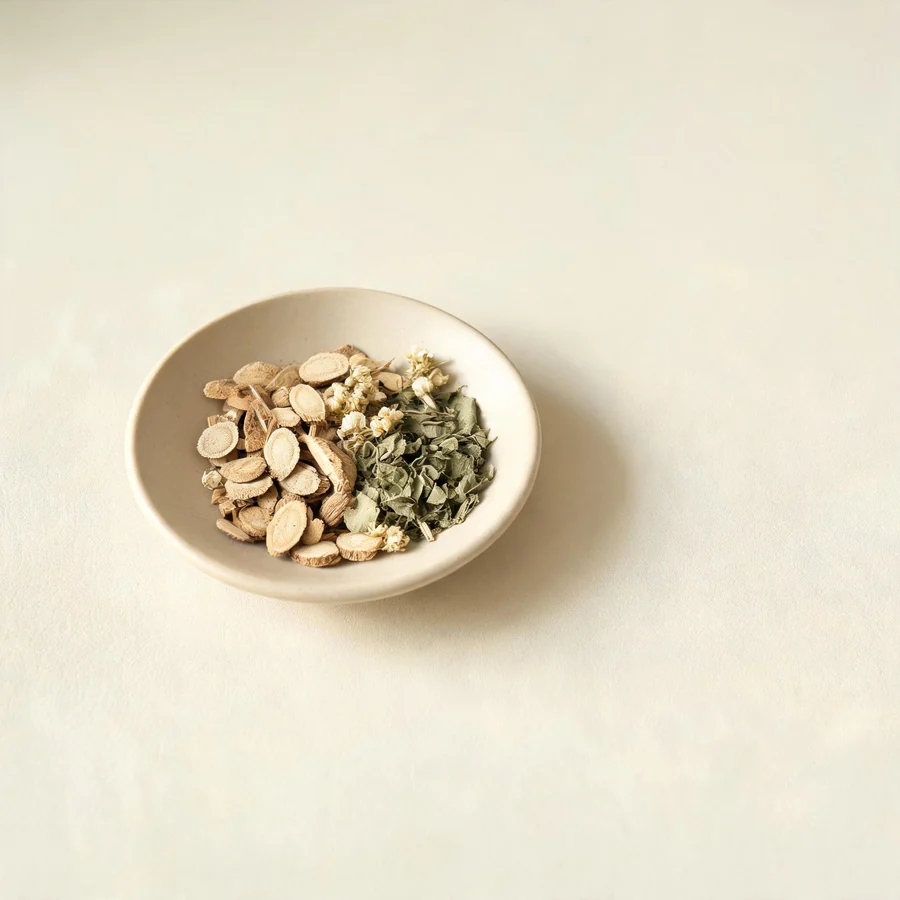
Herbs used
Formulas
- Zhi Bai Di Huang Wan
- Tao Hong Si Wu Tang
- Long Dan Xie Gan Tang
- Ba Zhen Tang
- Dang Gui Yin Zi
Acupoints
- KI-3 (Taixi)
- SP-6 (Sanyinjiao)
- LR-3 (Taichong)
- SP-10 (Xuehai)
- LR-2 (Xingjian)
- SP-9 (Yinlingquan)
- ST-36 (Zusanli)
- BL-20 (Pishu)
- qihai-ren-6
What to expect
- The tradition describes symptom control and softening over months; atrophy may not reverse.
- Regular medical monitoring is required regardless of symptom improvement.
- Any new ulcer, lump or non-healing sore needs biopsy.
- Itch usually settles before the skin changes, so the first weeks may bring comfort without any visible difference. Texture and colour respond over months, and atrophy of long standing may not reverse fully even when the tissue becomes comfortable. Fluctuation is normal, since a stressful month, a hot spell or a change in diet can bring a flare, and the plan is adjusted rather than abandoned. Once the skin is stable, visits are spaced out and a maintenance formula is kept at a lower dose.
Safety and when to get help
Seek medical help urgently for
- A new sore, ulcer or lump on the vulva that does not heal.
- Bleeding or a rapidly changing patch.
- Severe pain with fever.
For anything severe, sudden or spreading quickly, read when a skin problem needs urgent care.
Cautions
- Vulvar white patches need medical diagnosis and periodic review.
- Avoid harsh soaps, scented products and scratching.
- Do not use strong topical steroids without specialist advice.
Using this alongside conventional care
- TCM is described as complementary to conventional care: specialist assessment, biopsy where indicated, and prescribed topical treatment continue alongside herbs.
- Topical steroids and emollients continue as prescribed, and no reduction should happen without the prescribing doctor's agreement, because stopping suddenly can provoke a flare. Tell both practitioners about everything in use, including washes and supplements, and keep the monitoring appointments even when the skin is comfortable. Dang Gui and Chuan Xiong carry a mild antiplatelet effect that matters if you take a blood thinner, and no serious interaction between these herbs and topical corticosteroids is known.
Diet and lifestyle
- Favour warm nourishing easily digestible food with plenty of cooked vegetables and whole grains.
- The base is warm, cooked and easy to digest, with plenty of vegetables, whole grains and moderate good quality protein, because the Spleen has to convert all of it into the Blood and Yin that the skin needs. Blood and Yin are supported by dark leafy greens, beetroot, black sesame, goji berries and bone broth. When Damp-Heat leads, keep spicy, greasy and fried food, alcohol and coffee low. Cold raw food and iced drinks are limited if you feel the cold, tire easily or pass loose stools, since they weaken the Spleen.
If you are pregnant
Pregnancy naturally increases Dampness and Qi stagnation, so a Damp-Heat pattern can flare, but the bitter-cold herbs that clear it, Long Dan Cao and Huang Qin among them, are contraindicated in pregnancy because they may disturb the fetus. A dilute wash of Ku Shen applied topically, and acupuncture at distal points such as Taichong (LR-3) and Yinlingquan (SP-9), are safer options. Blood Deficiency becomes more prominent as pregnancy advances, and Dang Gui is used only cautiously under expert guidance because of the risk of stimulating the uterus.
If you are breastfeeding
Bitter-cold herbs can pass into breast milk and cause diarrhoea or colic in a baby, so oral formulas such as Long Dan Xie Gan Tang are usually left out while feeding. Topical washes and sitz baths made with Ku Shen and Bai Xian Pi are traditional alternatives, with limited trial evidence, and acupuncture can be used to regulate the Liver and the Spleen without risk to the infant. If internal herbs are needed, a short, gentle course of Zhi Bai Di Huang Wan at reduced dose can be considered where Yin is deficient, always under professional supervision.
If treating an elderly patient
In older women the picture is almost always one of deficiency, with Spleen Qi Deficiency or Kidney and Liver Yin Deficiency, and the skin is more atrophic and fragile. Doses are usually cut to roughly two thirds of what an adult would take, and treatment runs longer, because the capacity to regenerate is lower. Polypharmacy needs checking, since Dang Gui may interact with anticoagulants, and acupuncture with topical treatment is often better tolerated than systemic herbs.
Urgent-sign guidance is based on standard sources: NHS anaphylaxis, NHS cellulitis, NHS Stevens-Johnson syndrome, NHS melanoma.
Evidence
Evidence status
Compiled for this page from the classical and modern literature; not a systematic review, so treat it as a pointer to sources rather than clinical guidance.
The evidence is moderate but of mixed quality. A review of integrated treatment summarises the common patterns and concludes that combined therapy can improve symptoms and reduce recurrence compared with conventional treatment alone, and a randomised trial of local encircling needling plus body acupuncture reported greater reduction in itching and lesion size than topical treatment. Long-standing vulvar leukoplakia carries a malignant potential and needs gynaecological follow-up regardless of treatment.
The evidence base is small and mostly published in Chinese. The trials that exist are limited by small samples and the absence of double blinding, which makes the results promising rather than conclusive. Larger randomised trials reported in English are needed before the approach can be judged against topical steroids on equal terms, and the classical literature is explicit about that gap.
Studies often cited
The review summarises the common patterns (Liver-Kidney Yin Deficiency, Liver Depression with Blood Stasis, Spleen-Stomach Qi and Blood Deficiency, and Damp-Heat pouring downward), describes internal formulas, topical washes and acupuncture, and concludes that integrated therapy can improve symptoms and reduce recurrence compared with Western medicine alone. Zhang L, Wang H, et al. Advances in Clinical Medicine. 2021;11(5):2154-2160.
In a randomised trial of 60 patients, local encircling needling around the lesion plus systemic acupuncture at Liver, Spleen and Kidney points produced a significantly greater reduction in itching score and lesion size after 12 weeks than conventional topical treatment, with a higher total effective rate. Li X, Wang Y, et al. Chinese Acupuncture and Moxibustion. 2021;41(9):987-992.
PubMed records for the TCM evidence
Real PubMed records for the TCM clinical evidence discussed above, selected by condition name and title relevance. They are references, not proof of benefit.
- Clinical efficacy evaluation of crisaborole ointment in the treatment of vulvar leukoplakia.. Revista da Associacao Medica Brasileira (1992), 2023. PMID: 36820717.
Classical record
For women with cold in the vagina, use a warming suppository; She Chuang Zi powder is indicated.
- Jin Gui Yao Lue (Synopsis of Prescriptions of the Golden Chamber), Chapter 22.
妇人阴寒,温中坐药,蛇床子散主之。
For women with cold in the vagina, use a warming suppository; Shechuangzi powder is indicated.
Jin Gui Yao Lue (Synopsis of Prescriptions of the Golden Chamber), Chapter 22: Women's Miscellaneous Diseases - Classical citation; the translation is our own.
Common questions
Is vulvar leukoplakia dangerous?
It carries a small risk of malignant change, which is why medical diagnosis and monitoring are essential.
Can herbs reverse the white patches?
The tradition describes improving symptoms and nourishment, but atrophy may not reverse, and monitoring continues.
Why does it itch so much at night?
The Yin deficiency and Liver wind patterns both describe night-time and paroxysmal itch.
When should I have a biopsy?
Any new sore, ulcer or lump that does not heal needs assessment.
Is acupuncture used directly on the vulvar area?
Needles are not placed in the vulvar skin. Points are used on the lower abdomen, the back, the legs and sometimes around the sacrum, because the channels that serve the genital area can be reached from a distance, and a surrounding technique may be applied over the inner thigh or the lower abdomen, always at a safe distance from delicate tissue. The treatment is gentle and generally well tolerated.
Can stress make vulvar leukoplakia worse?
Yes. Stress acts on the Liver, which keeps Qi and Blood moving smoothly, and when that movement stalls the itch tends to worsen and healing slows. Many women notice flares during difficult periods. Treatment therefore includes herbs and points that regulate the Liver, and managing stress is treated as part of prevention rather than as an optional extra.
How long does it take to see results with TCM?
Itching usually begins to ease within two to four weeks of starting herbs and acupuncture. Changes in skin colour, thickness and moisture take longer, typically three to six months of consistent treatment, and the timeline depends on the pattern, how long the condition has been present and general health.
Is acupuncture used directly on the vulvar area?
No. Needles are not placed on the vulvar skin itself: treatment uses points on the lower abdomen, back, legs and around the sacrum to influence the channels that pass through the genital area. In some cases a surrounding technique may be used on the lower abdomen or inner thigh, always at a safe distance from sensitive tissue, and it is gentle and well tolerated.
Will the white patches go away completely?
With consistent treatment many women see the patches shrink, become pinker and regain normal texture, though the degree of reversal depends on how long they have been present and how deep the tissue change goes. Even where some pallor remains, the skin can become comfortable, elastic and free of itching, which is often the outcome that matters most for quality of life.