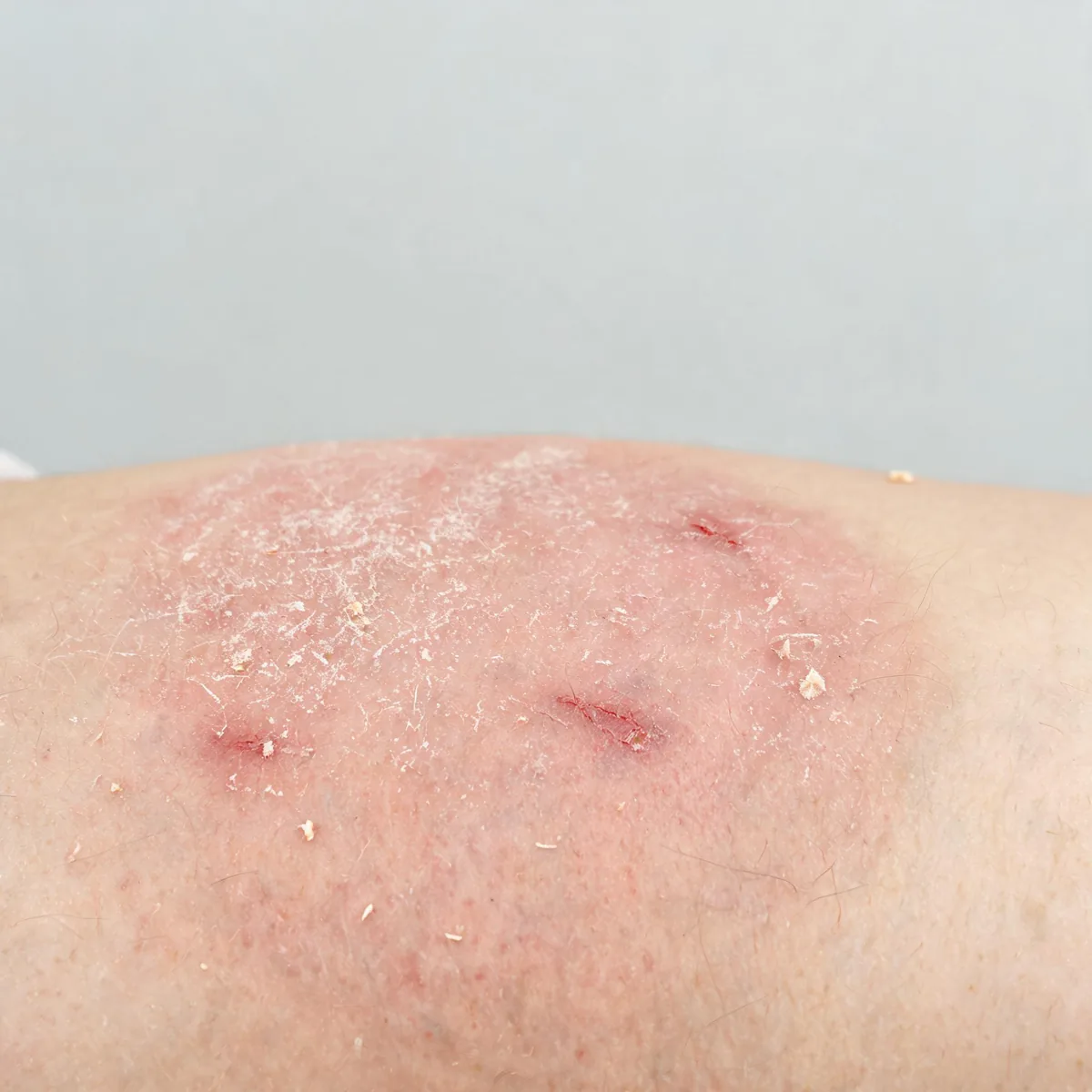
Understanding Skin irritation worsened by bathing
The classical literature explains bathing-related flares as internal dampness meeting external water. The Spleen transforms and transports fluids; when it is weakened, often by a heavy or greasy diet, dampness accumulates and the skin reacts to water.
Damp-Heat gives lesions that ooze yellow fluid, red inflamed patches and intense itching worse after bathing, with a heavy body, a bitter taste and thirst.
Spleen deficiency with dampness gives itchy skin with mild oozing that is worse after bathing, with bloating, loose stools, fatigue, heaviness and poor appetite. That is the chronic pattern behind repeated flares.
Blood deficiency with external wind gives dry flaky rough skin with little to no oozing, itching worse at night and after bathing, a pale complexion and dull brittle nails. Here the water is not the enemy so much as the missing oils that the skin cannot hold.
The Spleen is described as transforming and transporting fluids. When a diet heavy in greasy, sweet or cold food weakens it, moisture is not managed properly, internal Dampness accumulates and rises to the skin, leaving it vulnerable. Bathing then adds external Dampness that the overburdened system cannot process, so the skin flares after contact with water.
Dampness is not the only factor. Combined with Heat from stress, spicy food or alcohol it becomes Damp-Heat, and the skin turns red, hot and weepy, so bathing feels like adding fuel. In chronic cases long-standing Damp-Heat depletes Blood and Yin, producing a Blood deficiency picture where the skin is dry and malnourished and the water strips away what little protection remains. The same symptom can therefore come from very different roots, which is why the practitioner looks at digestion, energy and tongue coating as well as the rash.
Conventional view
In Western medicine skin that worsens after contact with water is often linked to eczema, contact dermatitis or aquagenic pruritus. Bathing, especially with hot water, strips the skin's natural protective oils and disrupts the moisture barrier, triggering itching, redness and irritation. For some the water itself is a direct irritant, for others residual soap or hard-water minerals play a role. Diagnosis rests on the appearance of the skin and a history of flares after exposure, and patch testing may rule out specific allergies.
Standard care restores the skin barrier and calms inflammation: short lukewarm showers with mild cleansers, immediate application of a thick moisturiser, and avoidance of harsh soaps. Topical corticosteroids or calcineurin inhibitors are used for flares, oral antihistamines may help itch, and severe cases may need systemic immunosuppressants or biologics.
These measures soothe the skin but mainly manage symptoms rather than explaining why it reacts so strongly to water. Long-term topical steroids can thin the skin and relief is often temporary, and the conventional approach treats all water-aggravated skin conditions as the same barrier defect, without separating the distinct internal imbalances that TCM uses to choose treatment.
Selected PubMed records
Real PubMed records for the conventional discussion above, selected by condition name and title relevance. They are references, not a claim that any treatment is proven for this condition.
- Pearls and pitfalls of bathing in atopic dermatitis.. Allergy and asthma proceedings, 2019. PMID: 31018897.
- Skin cleansing in children.. Journal of the European Academy of Dermatology and Venereology : JEADV, 2001. PMID: 11720072.
How it is assessed
The practitioner assesses moisture, timing and the digestive picture.
What a practitioner looks for
- Oozing: yellow fluid and red patches suggest Damp-Heat.
- Chronicity: mild oozing with bloating and fatigue suggests Spleen deficiency with dampness.
- Dryness: dry flaky skin with no oozing suggests Blood deficiency with wind.
- Red flags: infection signs, or widespread blistering or peeling.
The practitioner starts with the skin. In Damp-Heat it is bright red, hot and may weep or ooze. In Spleen deficiency with Dampness the patches are dull red or slightly darkened, less hot and sometimes finely scaling. In Blood deficiency with External Wind the skin is dry, rough, thickened and may crack rather than weep.
What bathing does to the skin helps separate the patterns: in Damp-Heat the external moisture feeds internal fire-and-dampness and itching surges quickly, in Spleen deficiency a bath adds fluid the system cannot clear and the skin feels sluggish, and in Blood deficiency it is the loss of natural oils and the drying effect of water that provokes wind-like itch. The tongue and pulse confirm it: a red tongue with thick yellow greasy coating and rapid slippery pulse for Damp-Heat, a pale puffy tongue with white greasy coat and soft or slippery weak pulse for Spleen deficiency, and a pale tongue with little coating and a thin wiry pulse for Blood deficiency. Digestion, thirst and general comfort add the final distinctions.
TCM patterns in Skin irritation worsened by bathing
In TCM the aim is to treat the pattern behind the symptom rather than the symptom alone. Skin that flares after bathing can come from three different pictures. Damp-Heat produces red, hot, weeping skin that worsens sharply with water and humidity. Spleen deficiency with Dampness gives a duller, mildly oozing irritation with heaviness, bloating and loose stools, where the system is already struggling to process fluids. Blood deficiency with External Wind gives dry, rough, thickened skin that cracks, because water strips oils the skin no longer has. They can overlap and shift over time, so the same post-bath irritation can move from one pattern to another as the condition changes. The self-check above is a thinking tool, not a diagnosis; a practitioner confirms the pattern from the skin, the tongue, the pulse and the history.
| Pattern | Key signs | The itch | Tongue | Main formula |
|---|---|---|---|---|
| Damp-Heat | Skin lesions that ooze yellow fluid; Red inflamed patches | Intense itching worse after bathing | Body: Red, often swollen with teeth marksCoat: Yellow, greasy and thick, usually in the middle and at the root | Not specified |
| Spleen Deficiency with Dampness | Not specified | Itchy skin with mild oozing, worse after bathing | Body: Pale and swollen, often with teeth marks along the edgesCoat: White, greasy and moist, thick in the middle | Not specified |
| Blood Deficiency with External Wind | Dry flaky rough skin with little to no oozing; Dull brittle nails with dry hair | Itching worse at night and after bathing | Body: Pale and thin, sometimes slightly dryCoat: Thin, white and a little dry | Not specified |
Damp-Heat
Oozing yellow lesions with intense itch worse after bathing.
Greasy, spicy and sweet food, alcohol and humid environments build internal Damp-Heat that rises to the skin, producing red, swollen, oozing lesions with intense itch. Bathing adds external dampness to the internal Damp-Heat, overwhelming the skin's ability to stay dry and cool, so itching, weeping and irritation worsen markedly afterwards.
The tongue is red with a yellow greasy coating, sometimes swollen with teeth marks, and the pulse is soggy and rapid or slippery and rapid. Hot humid weather, long hot showers, greasy or spicy food, alcohol and stress aggravate it, while a cool dry environment, cooling foods such as mung beans and cucumber, gentle skin care and stress reduction ease it. Treatment clears Heat and drains Dampness, with Long Dan Xie Gan Tang as the standard formula and herbs such as Long Dan Cao and Ku Shen.
Signs
- Skin lesions that ooze yellow fluid
- Red inflamed patches
- Intense itching worse after bathing
- Body heavy and sluggish
- Bitter taste with thirst
Diet and lifestyle for this pattern: Avoid greasy, spicy and sweet food as well as alcohol, which fuel Damp-Heat. After bathing, pat the skin dry rather than rubbing and use lukewarm rather than hot water, and include cooling, Dampness-draining food such as mung beans, barley, cucumber and bitter greens to clear internal Heat and moisture.
Spleen Deficiency with Dampness
Mild oozing with bloating and fatigue after bathing.
When the Spleen is weak it fails to transform and transport fluids, so Dampness collects beneath the skin and produces a dull, itchy irritation that weeps slightly. Bathing adds external Dampness the overburdened Spleen cannot manage, so the skin flares afterwards.
The tongue is pale and swollen with teeth marks and a white greasy, moist coating, and the pulse is soggy and slow, sometimes slippery. Bathing, cold raw food and dairy, damp humid weather, overeating or skipping meals and prolonged fatigue aggravate it; warm dry compresses, small warm meals, gentle movement and dry environments help. Treatment strengthens the Spleen and drains Dampness, with Wei Ling Tang as the standard formula and herbs such as Bai Zhu, Fu Ling and Yi Yi Ren.
Signs
- Itchy skin with mild oozing, worse after bathing
- Abdominal bloating and loose stools
- Fatigue and heaviness in the limbs
- Poor appetite
Diet and lifestyle for this pattern: Avoid cold, raw and greasy food that creates Dampness, and favour warm cooked meals such as soups and stews with a little ginger. Pat the skin dry gently after bathing, keep living spaces aired, and walk daily so the Spleen moves fluids.
Blood Deficiency with External Wind
Dry flaky skin with itch after bathing and no oozing.
In this chronic pattern the skin is poorly nourished because there is not enough Blood to moisten and support it, so it becomes dry, fragile and vulnerable to external Wind, which drives itching. Hot water and harsh soap strip the oils the skin still has, worsening the dryness and letting Wind stir more intensely, so irritation flares after bathing.
The tongue is pale and thin with a thin white, slightly dry coat, and the pulse is fine, often wiry at the left middle position and slightly floating at the right front. Hot showers, harsh soaps, dry windy weather, stress and insufficient sleep aggravate it; a rich moisturiser after bathing, lukewarm short showers, a cool humidified environment, gentle oil massage and adequate rest help. Treatment nourishes Blood, moistens dryness and dispels Wind, with Dang Gui Yin Zi as the standard formula and herbs such as Dang Gui and He Shou Wu.
Signs
- Dry flaky rough skin with little to no oozing
- Itching worse at night and after bathing
- Pale or sallow complexion
- Dull brittle nails with dry hair
Diet and lifestyle for this pattern: Use lukewarm rather than hot water and keep showers short, pat the skin dry gently and apply a rich unscented moisturiser straight afterwards to lock in moisture. Eat blood-building food such as dark leafy greens, organic red meat, bone broth, black sesame and goji berries, avoid spicy, fried or drying food, and minimise alcohol and caffeine.
Treatment approach
How the tradition treats skin irritation worsened by bathing, with the herbs, formulas and points used for it.
Principles
- Use tepid, short washes with a gentle non-soap cleanser, and apply emollient immediately afterwards.
- Clear heat and drain dampness where the skin oozes.
- Support the Spleen where flares are chronic with digestive weakness.
- Nourish Blood where the skin is dry and the barrier is failing.
- The common thread is clearing Dampness from the skin and body, but the method differs by pattern: cool Heat and drain Dampness with bitter cold herbs in Damp-Heat, strengthen the Spleen and transform Dampness with warm tonifying herbs in Spleen deficiency, and nourish Blood while gently expelling Wind in Blood deficiency. Internal herbs and acupuncture are usually supported by dietary change, and external washes or compresses can give immediate relief without suppressing the healing response.
Herbs used
Formulas
Acupoints
What to expect
- Damp patterns improve within weeks with treatment and bathing changes.
- Dryness improves more slowly as the barrier recovers.
- Recurrence follows bathing habits unless they change.
- Reduced itching and redness usually appear within the first two weeks. Acupuncture once or twice a week often brings a calming effect after the session, and in Damp-Heat cases the skin may briefly look worse as Heat and Dampness clear before it settles. Flares then become less intense and tolerance to bathing slowly returns; consistency with herbs and diet matters more than any single day.
Safety and when to get help
Seek medical help urgently for
- Increasing pain, swelling, warmth, red streaks or pus with fever.
- Widespread blistering or peeling skin.
- A rash that spreads rapidly despite stopping the irritant.
For anything severe, sudden or spreading quickly, read when a skin problem needs urgent care.
Cautions
- Avoid hot water, long baths and harsh soaps.
- Apply emollient within minutes of washing.
- Persistent or worsening rashes need medical review.
Using this alongside conventional care
- TCM is described as complementary to conventional care: emollients and prescribed topical treatment continue alongside herbs.
- There are no known serious interactions between standard eczema treatments and the herbs commonly used for these patterns, and TCM can be combined with moisturisers and topical medication. Some Blood-nourishing herbs such as Dang Gui may have mild blood-thinning effects, so anyone on anticoagulants should tell both practitioners, and a full medication list including over-the-counter creams should be brought to the consultation.
Diet and lifestyle
- Reduce greasy, spicy and sweet food and excess dairy for damp patterns, and favour light cooked meals.
- To reduce Dampness, avoid dairy, sugar, alcohol, deep-fried food and excessive cold or raw food, and favour warm easily digested meals such as rice congee, soups, steamed vegetables and small amounts of lean protein. Barley, mung beans and cucumber help the Damp-Heat picture, while ginger and cinnamon support Spleen deficiency, and water is best taken at room temperature rather than ice-cold.
If you're pregnant
Pregnancy often intensifies eczema as hormonal shifts and the growing fetus generate more internal Heat and Dampness, so the Damp-Heat pattern may become more pronounced. Strong bitter-cold formulas such as Long Dan Xie Gan Tang are generally avoided because their downward-draining action can unsettle the pregnancy, and milder options such as Yin Chen Hao Tang or dietary change, with mung bean soup and cucumber and less greasy food, are preferred.
Acupuncture remains safe, but points traditionally used to move Qi and Blood in the lower abdomen and sacrum, such as LI-4, SP-6 and BL-60, are strictly avoided. A practitioner experienced in pregnancy care should be consulted before any treatment.
If you're breastfeeding
Herbs must be chosen with the infant in mind: bitter-cold herbs such as Long Dan Cao, Huang Qin and Huang Lian can pass into breast milk and may cause infant diarrhoea or digestive upset. For Damp-Heat, topical washes with mild herbs such as Ku Shen or Bai Xian Pi are often safer than internal formulas, and where Spleen deficiency is the main driver, gentle herbs such as Bai Zhu and Fu Ling are well tolerated and may even support milk quality.
Acupuncture is an excellent drug-free way to manage itching without affecting the baby.
If treating a child
Eczema is extremely common in children and the irritation often worsens with bathing. Paediatric cases are dominated by Damp-Heat and Spleen deficiency with Dampness, while Blood deficiency is rare in healthy children. A child's Spleen is inherently immature, so too many sweets, dairy or fried foods easily generate Dampness that surfaces on the skin.
Doses are reduced to a third to a half of the adult dose, and modified formulas such as Long Dan Xie Gan Tang or Wei Ling Tang are used cautiously. Paediatric tuina along the Spleen and Stomach channels is often preferred to acupuncture because it is gentle and effective for strengthening the Spleen and draining Dampness.
If treating an elderly patient
In older people skin irritation that worsens with bathing almost always points to Blood deficiency with External Wind. Ageing depletes Yin and Blood, leaving the skin dry, thin and poorly nourished, and hot water strips the remaining oils and provokes intense wind-like itching.
Strong Damp-draining or bitter-cold herbs are poorly tolerated and can further damage the Spleen and Stomach, so gentle Blood-nourishing and Wind-dispelling formulas such as Dang Gui Yin Zi are used at about two-thirds of the adult dose. Acupuncture is well tolerated but courses may be longer, and concurrent medication needs careful attention.
Urgent-sign guidance is based on standard sources: NHS anaphylaxis, NHS cellulitis, NHS Stevens-Johnson syndrome, NHS melanoma.
Evidence
Evidence status
Compiled for this page from the classical and modern literature; not a systematic review, so treat it as a pointer to sources rather than clinical guidance.
There is no evidence specific to bathing-related irritation; the relevant research concerns eczema. A systematic review of randomised trials found herbal medicine may improve eczema symptoms and quality of life, while noting poor trial quality and small samples, and a trial of acupuncture added to standard care reported further symptom improvement. Practical measures such as shorter, cooler washing and immediate moisturising come before any herbal treatment.
Studies often cited
The review found that herbal medicine may improve eczema symptoms and quality of life, but the evidence was limited by poor trial quality and small sample sizes. Tan HY, Zhang AL, Chen D, et al. British Journal of Dermatology. 2012;166(2):299-306. doi:10.1111/j.1365-2133.2011.10734.x
A randomised trial comparing acupuncture plus standard care with standard care alone reported greater improvement in symptoms in the acupuncture group. Randomised trial, as recorded in the classical literature source.
Classical record
Eczema arises when wind, dampness and heat lodge in the skin and flesh. It begins as millet-sized papules, itches uncontrollably, ruptures to discharge yellow fluid and spreads in patches.
- Wai Ke Zheng Zong (Orthodox Manual of External Medicine).
浸淫疮,黄连粉主之。
For spreading sores, Coptis Powder is indicated.
Jin Gui Yao Lue (Essential Prescriptions of the Golden Cabinet), Chapter on Carbuncles, Abscesses and Intestinal Afflictions - Classical citation; the translation is our own.
Common questions
Why does my skin itch after a bath?
Hot water and soap strip the skin barrier and water evaporates afterwards. This framework adds the internal damp or deficiency pattern that makes the skin react.
Should I stop washing?
No. Short tepid washes with a gentle cleanser and immediate emollient are better than avoiding washing.
Can herbs help?
The tradition describes clearing dampness or nourishing Blood, with improvement over weeks.
When is it urgent?
Infection signs, fever, or widespread blistering and peeling.