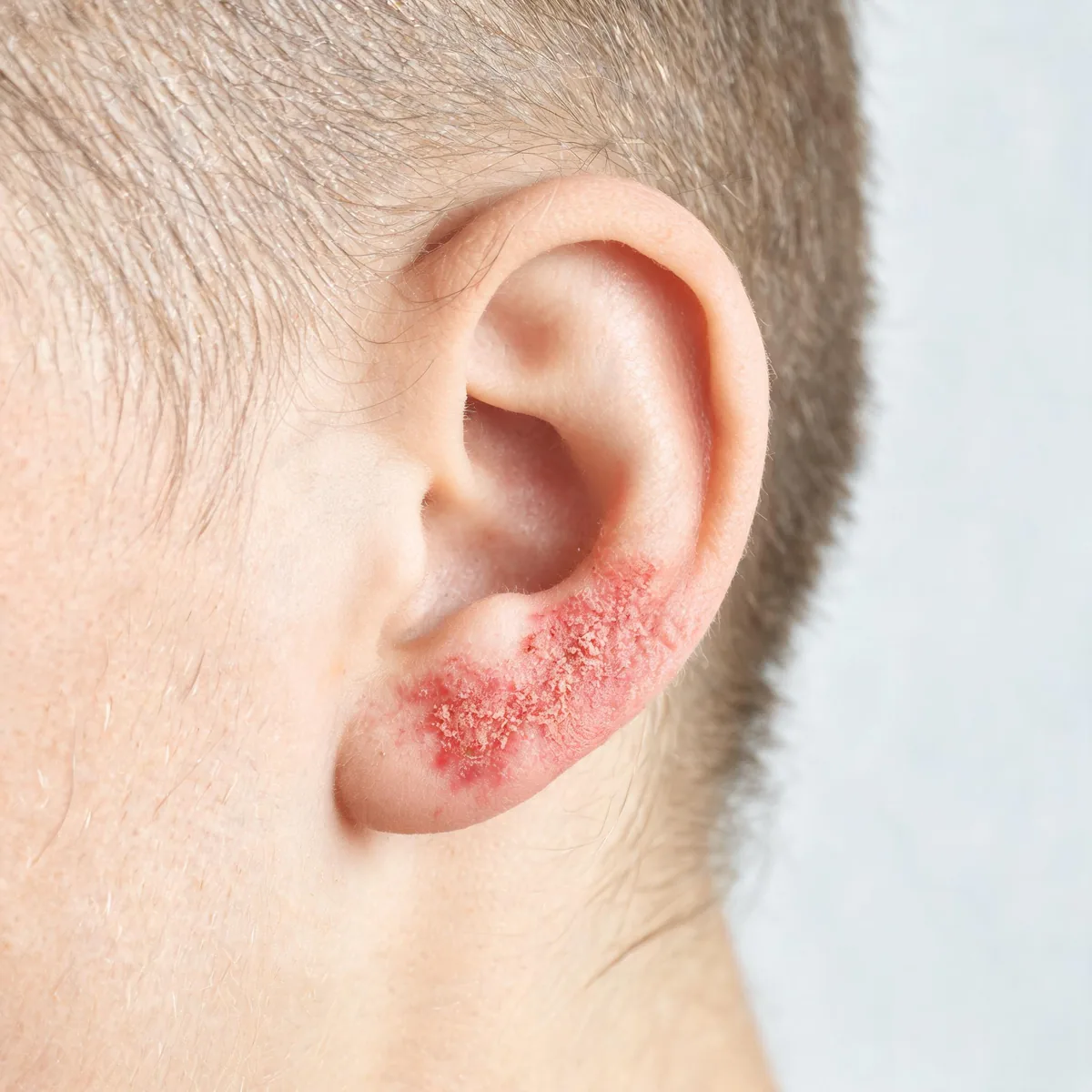
Understanding Ear eczema
The tradition describes ear eczema through the balance of body fluids: when they are disturbed, dampness rises and is trapped around the ear, and the delicate skin reacts.
Damp-Heat gives red swollen weeping ear skin with yellow sticky discharge, intense itch worse with heat, heaviness, a bitter taste and thirst.
Spleen deficiency with dampness gives persistent itch around the ear with less oozing, thickened rough skin, abdominal bloating, loose stools, fatigue and heaviness. That is the chronic, recurring pattern.
Blood deficiency with external wind gives dry flaky cracked skin around the ear with itch that comes and goes and worsens at night, a pale complexion and dizziness.
The two damp patterns are close relatives and are separated by force and by duration. Damp-Heat is acute and angry, usually after a stretch of rich, greasy or spicy food or a spell of hot humid weather, and the ear is red, swollen and wet. Spleen deficiency is the quiet version, where a constitutionally weak Spleen never quite clears fluid, so the skin thickens, itches steadily and oozes only a little, and the person feels bloated and tired.
Blood deficiency is a different mechanism altogether. It is not dampness that has dried but nourishment that has run out, so the skin cracks and scales, and the emptiness left behind stirs internal Wind that meets the Wind reaching the exposed ear. That is why the itch wanders, why it is worse at night, and why the skin looks damaged rather than inflamed. Reading which of these is dominant decides whether the ear is dried, drained or nourished.
Conventional view
Ear eczema, also called otitis externa eczematosa, is inflammation of the skin of the external ear and the canal. It causes itching, redness, scaling and sometimes weeping or crusting, and it may be part of atopic dermatitis, a contact reaction to earrings, shampoo or hair products, or seborrhoeic dermatitis. The diagnosis is usually made by looking, and treatment aims to calm inflammation and restore the skin barrier.
Conventional care is a topical corticosteroid to reduce inflammation and itch, with emollients to moisturise and protect. Antibiotic or antifungal cream is added if there is secondary infection, and known irritants such as certain metals, soaps or hair products are avoided.
Steroids and emollients calm a flare but do not change the internal tendency, so the rash often returns when the cream stops, and prolonged steroid use thins the delicate skin around the ear. TCM works on the dampness, Spleen weakness or Blood deficiency behind the flare, while topical care and ear review continue.
Selected PubMed records
Real PubMed records for the conventional discussion above, selected by condition name and title relevance. They are references, not a claim that any treatment is proven for this condition.
- [Ear eczema from the otologic-dermatologic viewpoint].. Monatsschrift fur Ohrenheilkunde und Laryngo-Rhinologie, 1966. PMID: 16114371.
How it connects
Ear eczema rarely appears in isolation. It often co-occurs with atopic dermatitis elsewhere on the body, allergic rhinitis and asthma, a cluster known as the atopic triad, and in TCM this grouping is not random: it reflects a shared internal environment of Dampness, Heat or deficiency. When Spleen Qi is weak it fails to transform fluids, so Dampness accumulates and can show as oozing ear eczema, nasal congestion and phlegm in the lungs; if Heat joins Dampness, the skin reddens and the nose and airways react. Blood deficiency links them too: Blood that fails to nourish the skin leaves it dry and open to Wind, while Lung Yin deficiency adds respiratory sensitivity. Treating the root pattern often improves all three at once.
How it is assessed
The practitioner examines the skin around and inside the ear, and asks about discharge and hearing.
What a practitioner looks for
- Moisture: weeping yellow discharge suggests Damp-Heat.
- Chronicity: thickened rough skin with less oozing suggests Spleen deficiency with dampness.
- Dryness: dry flaky cracked skin suggests Blood deficiency with wind.
- Red flags: severe ear pain, canal discharge, hearing change or swelling.
The practitioner looks first at the skin and asks how long it has behaved this way. An angry, wet, yellow-crusted patch points to Damp-Heat, and the tongue is expected to be red with a yellow greasy coat and the pulse slippery and rapid. A quieter rash that keeps returning, with thickened skin and a duller itch, points to Spleen Deficiency with Dampness, and there the questions turn to digestion, energy and bowels, with a pale puffy tongue, a thin white coat and a soft or weak pulse.
Where the eczema has lasted months or years and the skin is now dry, scaly and cracked, the reading moves to Blood Deficiency with External Wind, with a pale tongue carrying little coat and a thin pulse, and the practitioner looks as well for a dull complexion or dry hair. Because the ear sits next to the canal, the examination also checks for pain, discharge, hearing change or swelling, since those belong to a different problem and need medical review before any herb is chosen.
TCM patterns in Ear eczema
Three patterns are recognised around the ear. A red, swollen, weeping patch with a yellow sticky discharge and an itch that heat makes worse points to Damp-Heat, usually after greasy, fried or sweet food or in hot humid weather. Persistent itching with less oozing and skin that has slowly thickened and roughened, with bloating, loose stools and tiredness, points to Spleen Deficiency with Dampness. Dry, flaky, cracked skin with an itch that wanders and is worst at night, a pale complexion and brittle nails points to Blood Deficiency with External Wind. Each has its own tongue and pulse: red with a greasy yellow coat and a slippery rapid pulse for Damp-Heat, pale and puffy with a white coat for the Spleen, and pale and thin with a fine pulse for Blood deficiency. A damp weeping phase can turn dry and scaly later, so the pattern is read from the skin itself.
| Pattern | Key signs | The itch | Tongue | Main formula |
|---|---|---|---|---|
| Damp-Heat | Red swollen weeping ear | Intense itching worse with heat | Body: Red, often swollen with teeth marksCoat: Yellow, greasy and thick, usually in the middle and at the root | Not specified |
| Spleen Deficiency with Dampness | Less oozing than acute cases; Thickened rough skin | Persistent itching around the ear | Body: Pale and swollen, often with teeth marks along the edgesCoat: White, greasy and moist, thick in the middle | Not specified |
| Blood Deficiency with External Wind | Dry flaky cracked skin around the ear | Itching that comes and goes or shifts | Body: Pale and thin, sometimes slightly dryCoat: Thin, white and a little dry | Not specified |
Damp-Heat
Red swollen weeping ear skin with yellow discharge.
Dampness and Heat together make a sticky, angry environment. The combination usually builds from greasy, fried, spicy or sweet food, or from living in a hot humid climate, and because dampness is heavy it rises to the most delicate skin available, which is around and behind the ear. The result is a red, swollen, weeping patch with a yellow tacky discharge and an itch that heat makes worse.
The tongue is red with a yellow greasy coat, and the pulse is slippery and rapid. Greasy, fried and spicy food, alcohol, humid weather and scratching aggravate it, while cool dry air, light bland meals, gentle cleaning of the discharge and adequate rest settle it. Long Dan Xie Gan Tang is the formula named, with Ku Shen, Huang Lian and Jin Yin Hua as key herbs, and the points are Ermen (SJ-21), Hegu (LI-4), Sanyinjiao (SP-6) and Yanglingquan (GB-34).
Signs
- Red swollen weeping ear
- Yellow sticky discharge
- Intense itching worse with heat
- Heaviness with a bitter taste
Diet and lifestyle for this pattern: Avoid greasy, fried, spicy and sweet food that creates Dampness and Heat, and eat cooling, light food such as cucumber, mung beans and barley. Keep the ear dry and clean, resist scratching, and stay in a cool dry environment.
Spleen Deficiency with Dampness
Persistent itch with thickened rough skin and loose stools.
A Spleen that is weak cannot transform and transport fluid, so dampness builds up inside and then rises to stagnate in the skin around the ear. The inflammation is quieter than in Damp-Heat, but it persists: the skin gradually thickens and roughens, itches steadily and oozes only a little, and the person feels heavy, bloated and tired with loose stools. That is why the same patch can be present for months without becoming an angry flare.
The tongue is pale and swollen with teeth marks and a white greasy, moist coat, and the pulse is soggy and slow, sometimes slippery. Cold and raw food, large meals, greasy food, damp weather and overwork all worsen it, while warm drinks and soups, rest, a dry ventilated room, light meals and gentle daily movement help. Ling Gui Zhu Gan Tang and Shen Ling Bai Zhu San are the formulas named, with Fu Ling, Bai Zhu and Yi Yi Ren as key herbs, and the points are Zusanli (ST-36), Sanyinjiao (SP-6) and Tinggong (SI-19).
Signs
- Persistent itching around the ear
- Less oozing than acute cases
- Thickened rough skin
- Abdominal bloating with loose stools
- Fatigue and heaviness
Diet and lifestyle for this pattern: Eat warm cooked food such as soups and stews, and avoid raw, cold, greasy and dairy food that burdens the Spleen and generates Dampness. Gentle exercise such as walking moves Qi and Dampness, and keep the ear clean and dry without over-drying it.
Blood Deficiency with External Wind
Dry flaky cracked skin with a wandering night itch.
Blood that is insufficient cannot moisten the skin around the ear, so it becomes dry, flaky and cracked, and the emptiness left behind stirs up internal Wind. That Wind meets the external Wind that reaches the exposed skin, and the two together produce an itch that comes and goes, shifts position and is worst at night. Long-standing cases show skin that has lost its integrity rather than a fresh rash.
The tongue is pale and thin with a thin white, slightly dry coat, and the pulse is fine, wiry at the left middle position and floating at the right front. Dry windy weather, spicy or fried food, overwork and stress, draughts and scratching all make it worse, while moisturising, blood-nourishing food, a warm room out of the wind and rest help. Dang Gui Yin Zi is the formula named, with Dang Gui, He Shou Wu and Fang Feng among its herbs, and the points are Zusanli (ST-36), Sanyinjiao (SP-6), Taichong (LR-3), Ermen (SJ-21) and Tinggong (SI-19).
Signs
- Dry flaky cracked skin around the ear
- Itching that comes and goes or shifts
- Worse at night
- Pale complexion with dizziness
Diet and lifestyle for this pattern: Focus on moistening, blood-nourishing food such as black sesame, goji berries, red dates and bone broth, and avoid spicy, fried and drying food that consumes Blood and fluids. Protect the ears from wind and cold with a soft scarf or hat, moisturise with a plain fragrance-free balm, and protect rest to stop Blood being depleted further.
Treatment approach
How the tradition treats ear eczema, with the herbs, formulas and points used for it.
Principles
- Exclude ear canal infection first: pain, canal discharge or hearing loss needs medical review.
- Clear heat and drain dampness where the skin weeps and is red.
- Support the Spleen where the pattern is chronic and thickened.
- Nourish Blood where the skin is dry, flaky and itchy at night.
- Each pattern has its own direction. Damp-Heat is cleared and drained with bitter cooling herbs and points on the Gallbladder and Triple Burner channels; Spleen deficiency is supported with sweet warm herbs and points that tonify the Earth element; Blood deficiency is nourished and moistened while Wind is gently dispersed, using points that support the Liver and Spleen. A topical wash or ointment may be added for the skin itself, but the real work is internal, and the formula is changed as the ear dries or thickens.
Herbs used
Formulas
Acupoints
- SJ-21 (Ermen)
- LI-4 (Hegu)
- SP-6 (Sanyinjiao)
- GB-34 (Yanglingquan)
- ST-36 (Zusanli)
- SI-19 (Tinggong)
- LR-3 (Taichong)
What to expect
- Acute damp heat settles within one to two weeks.
- Chronic thickened eczema takes longer and tends to recur.
- Infection of the ear canal needs medical treatment.
- Weekly acupuncture with daily herbs or powders is the usual arrangement. Wet acute eczema often oozes and itches less within a few sessions, dry chronic eczema begins to feel less tight after three or four weeks, and a wash or ointment can be used between sessions. As the internal pattern shifts, flares become less frequent and less intense, though the skin may still react to a humid spell or a stressful month.
Safety and when to get help
Seek medical help urgently for
- Severe sudden ear pain.
- Discharge from the ear canal, or hearing loss.
- Swelling, redness and heat around the ear with fever.
For anything severe, sudden or spreading quickly, read when a skin problem needs urgent care.
Cautions
- Do not put oils or herbal drops into the ear canal without advice.
- Keep the area dry and avoid scratching.
- Persistent eczema around the ear should be examined.
Using this alongside conventional care
- TCM is described as complementary to conventional care: prescribed topical treatment and ear review continue alongside herbs.
- TCM can run alongside topical conventional care, and where a steroid cream is in use it should be tapered under the doctor's guidance rather than stopped suddenly as the skin improves. Most formulas for this condition carry little risk of interaction with common medicines, but blood thinners, immunosuppressants and liver problems need to be declared to both the TCM practitioner and the prescribing doctor, and a full medication list should come to the first appointment.
Diet and lifestyle
- Reduce greasy, fried and spicy food and excess sugar, favouring cooling light meals.
- Food should be easy to digest and should not create dampness or heat, so greasy, fried, spicy and heavily sweetened food, alcohol and excess dairy are reduced and lightly cooked vegetables, whole grains and moderate lean protein are favoured. For dry scaly patterns, add blood-nourishing food such as dark leafy greens, a little red meat, bone broth and black sesame. Warm water through the day keeps fluids moving and stops dampness settling. For Damp-Heat, cooling light food such as cucumber, mung beans and barley is preferred, while the Spleen pattern benefits from warm soups and stews and less raw and cold food.
If you're pregnant
Internal heat rises in pregnancy and can aggravate Damp-Heat, but Long Dan Xie Gan Tang is generally avoided because its bitter-cold nature may disrupt the pregnancy. Acupuncture is the safer first option, with points such as Hegu (LI-4) and Sanyinjiao (SP-6) used cautiously by an experienced practitioner. Blood Deficiency becomes more common as pregnancy advances, and a modified Dang Gui Yin Zi may be used under guidance, while a mild topical wash with Jin Yin Hua soothes the skin.
If you're breastfeeding
Bitter-cold herbs such as Huang Lian and Ku Shen enter milk and can loosen the infant's stools, so they are best avoided. Fu Ling, Bai Zhu and Yi Yi Ren are safer for Spleen deficiency and dampness, acupuncture does not affect milk, and Dang Gui Yin Zi may be used cautiously when Blood deficiency dominates.
If treating a child
Ear eczema is common in infants and young children and is often triggered by food allergy or by feeding that creates Damp-Heat or Spleen deficiency. The skin is delicate and the child cannot describe the symptoms, so the rash, tongue and behaviour carry the diagnosis. Doses are a third to a half of the adult dose, washes with Jin Yin Hua and Ku Shen calm redness and oozing, and needles are avoided in favour of acupressure or tui na at points such as Zusanli (ST-36) and Sanyinjiao (SP-6).
If treating an elderly patient
In older adults ear eczema tends to be chronic, dry and scaly, and the pattern is usually Blood Deficiency with External Wind rather than acute Damp-Heat. The skin is thinner and more fragile, so aggressive drying herbs are avoided, and Dang Gui Yin Zi suits the picture well. Doses are about two thirds of the adult amount, gentle acupuncture gives good itch relief, and multiple medications are checked for interaction.
Urgent-sign guidance is based on standard sources: NHS anaphylaxis, NHS cellulitis, NHS Stevens-Johnson syndrome, NHS melanoma.
Evidence
Evidence status
Compiled for this page from the classical and modern literature; not a systematic review, so treat it as a pointer to sources rather than clinical guidance.
Direct research on ear eczema is scarce; the evidence comes from atopic eczema. Systematic reviews suggest Chinese herbal medicine can reduce severity and improve quality of life, though trials are small and heterogeneous, and a 2013 review found improvement but could not reach firm conclusions because of that heterogeneity. Acupuncture has shown promise in randomised trials, particularly for itch intensity and sleep, including a 2012 trial.
The same reviews and trials underpin the herbal and acupuncture claims here, and both were carried out in atopic eczema rather than ear eczema. A 2013 systematic review found that Chinese herbal medicine improved symptoms and quality of life against placebo or conventional treatment, while noting that the included trials varied in quality and that heterogeneity prevented firm conclusions. A 2012 randomised trial found that acupuncture reduced itch intensity and improved quality of life compared with sham treatment, with the benefit persisting after the course ended. Neither settles how the formulas used for the Damp-Heat, Spleen deficiency and Blood deficiency patterns perform specifically.
Studies often cited
Herbal medicine improved symptoms, but heterogeneity between trials prevented firm conclusions. The review pooled randomised controlled trials of Chinese herbal medicine for atopic dermatitis and found improved clinical symptoms and quality of life compared with placebo or conventional treatment, while variable study quality and heterogeneity limited firm conclusions. Gu S, Yang AW, Xue CC, et al. Efficacy and safety of Chinese herbal medicine for atopic dermatitis: a systematic review. British Journal of Dermatology. 2013;169(4):794-803.
Acupuncture significantly decreased itch, with improved sleep in a randomised trial. The randomised controlled trial compared acupuncture with sham acupuncture in atopic eczema and found significantly reduced itch intensity and better quality of life, with effects noticeable after a few sessions and persisting during follow-up. Pfab F, Huss-Marp J, Gatti R, et al. Acupuncture in patients with atopic eczema: a randomized controlled trial. Allergy. 2012;67(4):566-573.
Classical record
Ear sores are due to wind-heat invading, following the channels into the ear, contending with blood and qi, thus causing sores on the ear.
- Zhu Bing Yuan Hou Lun (Treatise on the Origins and Symptoms of Diseases), Volume 35, ear sores. The Chinese original is not reproduced here: it could not be recovered reliably from the source record, and is not guessed.
旋耳瘡生於耳後縫間,由膽脾濕熱所致。
Ear eczema arises in the crease behind the ear and comes from damp-heat in the Gallbladder and Spleen.
Ear eczema in the crease behind the ear - Classical citation: Yi Zong Jin Jian (Golden Mirror of Medicine), volume on surgery, section on ear sores.
Common questions
Is ear eczema the same as an ear infection?
No. Eczema affects the skin around the ear; infection of the canal causes pain and discharge and needs different treatment.
Can I put oil in my ear?
Not without medical advice, especially if there is discharge or hearing change.
Why does it keep coming back?
The Spleen deficiency with dampness pattern describes chronic recurrence, so the digestive pattern needs treatment.
When should I see a doctor?
Ear pain, canal discharge, hearing loss, or swelling with fever.
Can Chinese herbs cure ear eczema permanently?
They can correct the imbalance that keeps it returning, which often brings long remissions: clearing Damp-Heat stops the cycle of acute flares, strengthening the Spleen stops dampness rebuilding, and nourishing Blood restores the skin's resilience. If the dietary and lifestyle triggers return, so can the eczema, so lasting freedom usually depends on keeping some of the habits learned in treatment.
How does acupuncture help ear eczema?
Local points around the ear such as Ermen (SJ-21) and Tinggong (SI-19) reduce inflammation and itch where the rash is, while distant points such as Hegu (LI-4) and Sanyinjiao (SP-6) treat the root pattern, whether that means clearing damp-heat, strengthening the Spleen or nourishing Blood. The intense itch usually settles within a few sessions.
Can I use TCM alongside my steroid cream?
Yes, and many people start that way. The herbs and acupuncture work on the internal pattern while the cream gives immediate relief, and as the pattern shifts most people need less cream. Tell both your TCM practitioner and your doctor what you are using, and never stop a prescribed medicine abruptly.
Is it safe to put herbal ointments inside the ear canal?
Only when a qualified practitioner who has examined the ear has prescribed it. The canal is sensitive and the eardrum can be damaged by the wrong substance, and most herbal ear preparations are meant for the outer ear and the skin just inside the opening. Pain, discharge or hearing loss needs medical review rather than drops.