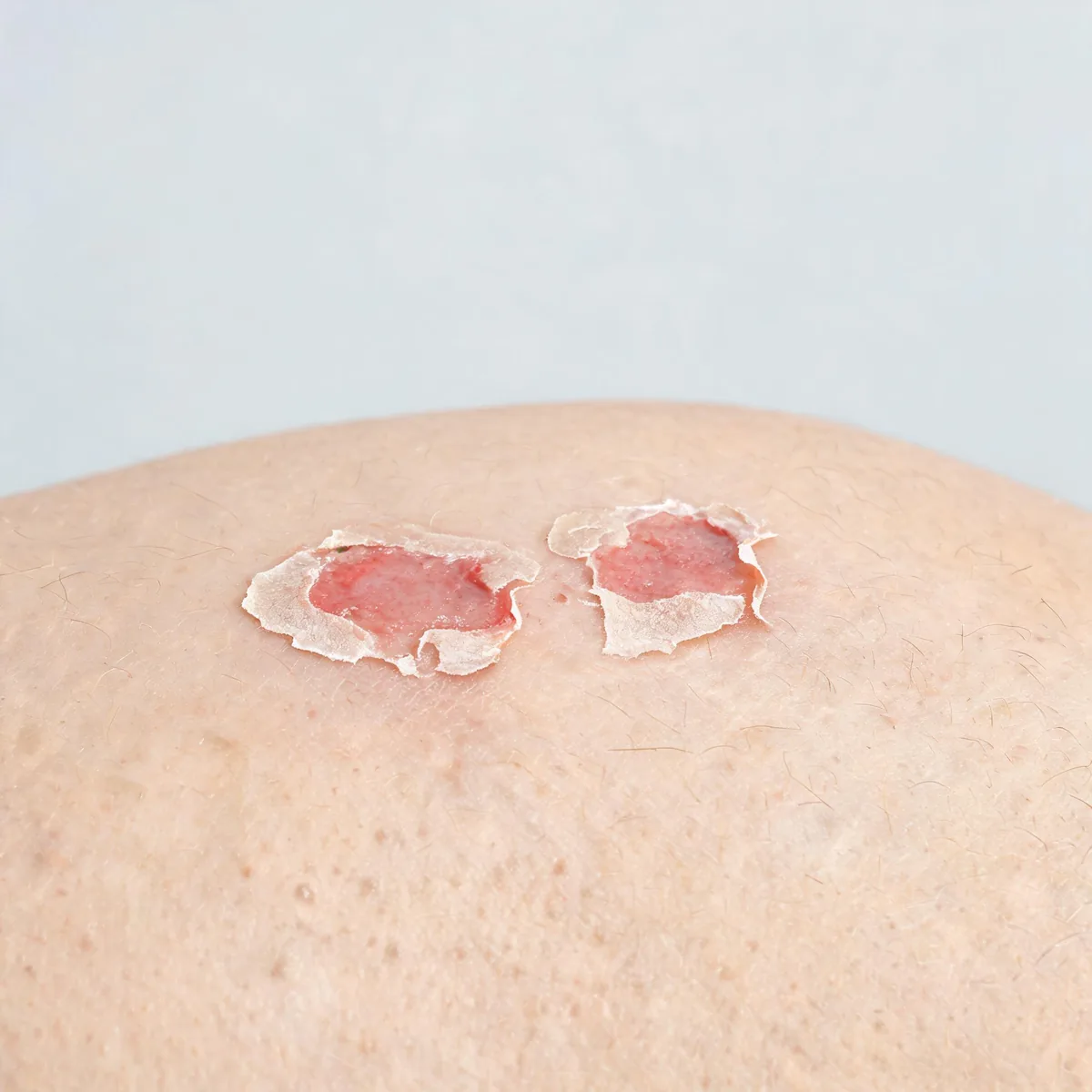
Understanding Pemphigus
A naming note recorded rather than resolved: the Chinese name 天疱疮 is also used on the Bullous Dermatitis page. This page covers pemphigus, which has its own page in the source, and both are kept.
The tradition describes pemphigus as a visible eruption of internal heat, dampness and toxin. The Heart governs fire and the Spleen transforms fluids, so emotional strain stirring Heart fire and poor diet weakening the Spleen both contribute.
Toxic-Heat gives large tense blisters that rupture quickly, leaving bright red burning erosions, with high fever, intense thirst and restlessness. Damp-Heat gives blisters that keep appearing with itching and heat, thirst without much desire to drink, a sticky bitter taste and red swollen skin.
Spleen deficiency with dampness gives flaccid loose blisters that rupture easily, with thick moist crusts and oozing, bloating, loose stools and heaviness. Qi and Yin deficiency describes the healing phase: dry scaly slow-healing skin with few or stopped blisters, deep fatigue, breathlessness on exertion and night sweats.
The distinction that matters clinically is between fire that is still burning and fluid that has already been consumed. A first flare with sudden fiery blisters and high fever is an emergency of excess heat and needs cooling at once. A slower picture of recurring itchy blisters, a greasy coat and mouth sores is Damp-Heat, in which Heart fire and Spleen dampness sustain one another and the disease smoulders rather than blazes.
As the weeks pass the emphasis turns to what the illness has taken out. Flaccid blisters that break easily, persistent oozing and thick crusts belong to a Spleen too weak to manage fluids, a waterlogged body that can no longer hold the skin together. After months of blistering the skin turns dry and repairs slowly and fatigue becomes overwhelming, which is Qi and Yin Deficiency and calls for gentle nourishment rather than more cold clearing. Recognising which of these is present decides both the formula and the safety of the patient.
Conventional view
Pemphigus is an autoimmune blistering disease in which antibodies attack the proteins that bind skin cells to one another, so the epidermis splits and blisters form. It is rare, it can involve mucous membranes such as the mouth, and without treatment it can be life-threatening through infection and fluid loss. Diagnosis rests on a skin biopsy with direct immunofluorescence and on blood tests for the specific antibodies.
Standard treatment is suppression of the immune attack. High-dose corticosteroids, usually prednisone, bring blistering under control, and steroid-sparing drugs such as azathioprine, mycophenolate mofetil or rituximab are added so the steroid dose can come down. Wound care, pain relief, infection prevention and attention to fluid and nutrition are part of the same plan, and the disease is followed by a dermatology team over years.
The shortcomings are those of long-term immunosuppression. Corticosteroids bring weight gain, bone loss, raised blood sugar and greater susceptibility to infection; immunosuppressants need regular blood monitoring and do not guarantee that tapering will not be followed by a flare. Conventional care also treats the disease as a single immune mechanism, where TCM separates a hot fiery flare from a slow damp exhausting form and adjusts treatment to the stage the patient is in.
Selected PubMed records
Real PubMed records for the conventional discussion above, selected by condition name and title relevance. They are references, not a claim that any treatment is proven for this condition.
- Updated S2K guidelines on the management of pemphigus vulgaris and foliaceus initiated by the european academy of dermatology and venereology (EADV).. Journal of the European Academy of Dermatology and Venereology : JEADV, 2020. PMID: 32830877.
- An Updated Review of Pemphigus Diseases.. Medicina (Kaunas, Lithuania), 2021. PMID: 34684117.
- Pemphigus vulgaris and mucous membrane pemphigoid: A systematic review of clinical manifestations, diagnosis, and treatment.. Journal of stomatology, oral and maxillofacial surgery, 2024. PMID: 38960026.
How it connects
Pemphigus often co-occurs with anxiety and insomnia because the intense Heat and toxin driving the blisters also disturb the Heart Shen. In the Toxic-Heat pattern blazing fire agitates the mind, causing restlessness, irritability and difficulty sleeping, and the Damp-Heat pattern, with Heart Fire plus Spleen Dampness, brings a heavy uneasy feeling that disrupts sleep and fuels anxious thoughts. Autoimmune conditions also cluster because they share a root in TCM, a constitution of latent Heat and Dampness that can flare in different organ systems: when Qi is weakened, one imbalance may show as pemphigus on the skin and another autoimmune disorder elsewhere. As the disease becomes chronic and drains Qi and Yin, fatigue and afternoon exhaustion deepen the anxiety and insomnia, so addressing the deficiency matters too. The links run in two directions. Anxiety and insomnia accompany pemphigus because the same heat and toxin that raise blisters also disturb the Heart spirit: in Toxic-Heat the mind is agitated and sleep is broken, and in Damp-Heat the Heart fire and Spleen dampness together leave a heavy unease that keeps sleep shallow. Other autoimmune conditions cluster for a similar reason, since a constitution carrying latent heat and dampness can express itself in more than one organ system, and treating the root may help both. Once the illness becomes chronic, the drain on Qi and Yin adds its own exhaustion, which deepens the anxiety rather than easing it.
How it is assessed
The practitioner assesses blistering, mucosal involvement and the systemic state, after specialist assessment.
What a practitioner looks for
- Blister type: tense rapidly rupturing blisters suggest Toxic-Heat.
- Mucosal involvement: mouth or throat blisters affect eating and swallowing and need urgent care.
- Chronicity: flaccid oozing blisters suggest Spleen deficiency with dampness.
- Red flags: widespread blistering, fever, or difficulty swallowing.
Because pemphigus can be life-threatening, the pattern is assessed only after specialist diagnosis and alongside medical treatment. Within that, the practitioner asks about the onset, and about what the lesions look like today: sudden, fiery and widespread on one hand, slow, flaccid and oozing on the other. Thirst, energy and digestion are asked about in detail, since the internal signs decide which of the four pictures is being dealt with.
Sudden eruption with bright red raw erosions, intense heat, thirst and irritability, a crimson tongue with a yellow coat and a rapid forceful pulse point to Toxic-Heat. Blisters arriving in waves with itching, thirst that is sticky and unpleasant, sores in the mouth and a sense of heaviness, together with a greasy yellow coat and a rapid slippery pulse, point to Damp-Heat, where Heart fire and Spleen dampness steam together.
Flaccid blisters that break at a touch, stubborn crusts, heaviness and fatigue, with a pale swollen tongue, a greasy white coat and a slow soft pulse, show a Spleen whose transforming work has failed. Where blistering has stopped but the skin is dry and peeling and the person is exhausted, with a pale dry tongue carrying little coat and a thready rapid pulse, the picture is Qi and Yin Deficiency and the resources of a long illness have been drained.
TCM patterns in Pemphigus
Four pictures are described, and they read best as stages of one illness rather than as separate diseases. The first question is whether blisters are still forming. If they are, the practitioner separates Toxic-Heat, where the eruption is sudden, fiery and joined by high fever and raging thirst, from Damp-Heat, where blisters come in waves, itch and ooze, and bring mouth sores, a sticky taste and heaviness. The tongue coat separates them: dry and yellow first, greasy and yellow second. Once blistering slows, the question is what the skin and body do instead. Flaccid blisters that break easily, thick moist crusts, bloating and loose stools belong to Spleen Deficiency with Dampness, with a pale swollen tongue and a greasy white coat. Dry scaly skin that heals slowly, deep fatigue and night sweats belong to Qi and Yin Deficiency, with a pale-red tongue that has lost its coat.
| Pattern | Key signs | The itch | Tongue | Main formula |
|---|---|---|---|---|
| Toxic-Heat | Large tense blisters that rupture quickly; Bright red burning erosions | Not specified | Body: Red, often with raised red pointsCoat: Yellow, dry, sometimes thick | Not specified |
| Damp-Heat | Red swollen skin | Blisters that keep appearing with itching and heat | Body: Red, often swollen with teeth marksCoat: Yellow, greasy and thick, usually in the middle and at the root | Not specified |
| Spleen Deficiency with Dampness | Flaccid loose blisters that rupture easily; Thick moist crusts and oozing | Not specified | Body: Pale and swollen, often with teeth marks along the edgesCoat: White, greasy and moist, thick in the middle | Not specified |
| Qi and Yin Deficiency | Skin dry scaly and slow to heal with few or stopped blisters | Not specified | Body: Red or pale-red, thin and dry, possibly crackedCoat: Thin or absent | Not specified |
Toxic-Heat
Large tense blisters with bright red erosions and fever.
Heat and toxin together blaze upward and outward until they reach the skin. There they produce large tense blisters that rupture quickly and leave bright red, burning erosions, while the same fire stirs the Heart and Lung and drives up fever, a craving for cold drinks, restlessness and irritability, with dark scanty urine and constipation. This is the most dangerous of the four pictures and the one that most needs medical control of the disease alongside herbal cooling.
The tongue is red with raised papillae and a dry yellow coat, and the pulse is rapid and forceful like a strong current. Spicy, fried and rich food, anger, hot weather and direct sun, and physical strain all stoke it, while a cool room, cold drinks, cooling food, rest and gentle cooling compresses calm it. Huang Lian Jie Du Tang drains fire and resolves toxin, with Shui Niu Jiao, Jin Yin Hua and Huang Lian, and the points are DU-14 Dazhui, LI-11 Quchi, SP-10 Xuehai and LI-4 Hegu.
Signs
- Large tense blisters that rupture quickly
- Bright red burning erosions
- High fever with intense thirst
- Restlessness with dark scanty urine
Diet and lifestyle for this pattern: Eat cooling, moistening food such as mung bean soup, watermelon, cucumber and pear, and avoid spicy, greasy or fried food, alcohol and coffee, which add Heat. Keep the environment cool, rest as much as possible, and protect the skin from sun and heat.
Damp-Heat
Recurring blisters with itching, heat and a sticky taste.
Here the problem sits between a Spleen that cannot transform fluids and a Heart fire that emotional strain keeps stirring. Dampness and heat join forces and rise as steam into the skin, so blisters keep appearing, itch and feel hot, lesions look red and swollen and may ooze, and erosions in the mouth make eating uncomfortable. Thirst is present but the person does not really want to drink, the taste is sticky or bitter, and the body feels heavy and sluggish.
The tongue is red with a yellow greasy coat that is hard to scrape off, and the pulse is soggy and rapid or simply rapid. Rich, fried and spicy food, alcohol, humid heat, anger and late nights all make it worse, while a cool dry environment, light meals, rest and gentle walking help. Er Miao San clears heat and dries dampness as a supporting formula, with Huang Qin, Zhi Zi, Yin Chen and Fu Ling, and the points are BL-15 Xinshu, BL-20 Pishu, SP-6 Sanyinjiao, PC-6 Neiguan and SP-9 Yinlingquan.
Signs
- Blisters that keep appearing with itching and heat
- Thirst with little desire to drink
- Sticky or bitter taste
- Red swollen skin
Diet and lifestyle for this pattern: Avoid greasy, fried, spicy and sweet food that creates Dampness and Heat, and favour light, easy meals with plenty of cooked vegetables, barley, mung beans and Job's tears. Drink warm water or mild herbal teas such as chrysanthemum or dandelion, keep the skin clean and dry in breathable cotton, and manage stress through gentle walking or meditation to keep Heart Fire from flaring.
Spleen Deficiency with Dampness
Flaccid oozing blisters with bloating and loose stools.
When the Spleen's transforming and transporting work fails, dampness gathers inside and rises to the skin, undermining its integrity. Blisters become loose and flaccid rather than tense and inflamed, they break easily, and the persistent oozing and thick moist crusts are the direct sign of a system too weak to dry out its own moisture. Bloating that follows a meal, stools that are loose or unformed, heaviness in the limbs and low energy follow the same logic.
The tongue is pale, swollen and marked by the teeth at its edges, with a greasy white coat, and the pulse is soggy and slow, often without force at the right Guan position. Cold, raw and greasy food, damp humid weather, irregular meals and mental fatigue all add to the load, while warm simple meals, a dry warm environment, moderate rest and gentle walking help. Wei Ling Tang dries dampness and strengthens the Spleen, with Shen Ling Bai Zhu San for gentler support, using Bai Zhu, Fu Ling and Ze Xie, and the points are BL-20 Pishu, ST-36 Zusanli, SP-9 Yinlingquan and SP-6 Sanyinjiao.
Signs
- Flaccid loose blisters that rupture easily
- Thick moist crusts and oozing
- Bloating worse after eating
- Loose stools with heaviness
Diet and lifestyle for this pattern: Eat warm, cooked, easy food such as congee, steamed vegetables and well-cooked grains, and avoid raw, cold, greasy, dairy and sugary items that produce Dampness. Gentle daily walking helps the Spleen move fluids, but avoid overexertion.
Qi and Yin Deficiency
Healing phase: dry scaly skin with deep fatigue.
After weeks or months of blistering the heat and dampness that drove the acute phase have gone quiet, yet they have left the skin parched, the energy low and repair sluggish. Without enough Qi to move Blood and enough Yin to moisten tissue, the skin stays dry and scaly and heals slowly while blisters are few or have stopped, and deep fatigue, breathlessness on exertion, night sweats and warmth in the palms and soles take over.
The tongue is pale-red or red, thin or bare, possibly cracked and dry, and the pulse is fine, weak and often rapid. Overexertion, stress and worry, spicy, fried and rich food, hot dry rooms and late nights all spend what little remains, while rest, gentle walking, moistening food and a cool environment rebuild it. Sheng Mai San nourishes Qi and Yin, with Xi Yang Shen and Mai Dong, and the points are KI-3 Taixi, ST-36 Zusanli and REN-6 Qihai.
Signs
- Skin dry scaly and slow to heal with few or stopped blisters
- Deep fatigue and lack of strength
- Shortness of breath worse with exertion
- Night sweats and warm palms
Diet and lifestyle for this pattern: Eat moistening, easy food such as rice congee, pear, steamed vegetables and a little good quality protein, and avoid spicy, fried and very dry food that depletes Yin further. Keep movement gentle such as walking or tai chi, and protect sleep, since resting deeply is how the body rebuilds Qi and Yin.
Treatment approach
How the tradition treats pemphigus, with the herbs, formulas and points used for it.
Principles
- Specialist medical treatment is essential: pemphigus is treated with corticosteroids and immunosuppression.
- Clear heat and resolve toxicity in the acute blistering picture.
- Drain dampness where blisters keep appearing and ooze.
- Support Qi and Yin in the healing phase once blistering is controlled.
- The two phases are not a sequence of stronger and weaker treatment but a change of direction: while blisters form, the aim is to clear and resolve; once they stop, the aim is to tonify and moisten, and applying the first approach in the second phase would deepen the depletion. Points are chosen distally, away from eroded skin, so treatment can continue through a flare.
Herbs used
Formulas
Acupoints
- DU-14 (Dazhui)
- LI-11 (Quchi)
- SP-10 (Xuehai)
- LI-4 (Hegu)
- BL-15 (Xinshu)
- BL-20 (Pishu)
- SP-6 (Sanyinjiao)
- PC-6 (Neiguan)
- SP-9 (Yinlingquan)
- ST-36 (Zusanli)
- KI-3 (Taixi)
- qihai-ren-6
What to expect
- Pemphigus is a chronic autoimmune disease requiring long-term medical management.
- Healing phases respond to supportive care; the acute disease needs hospital-level treatment.
- Widespread blistering risks infection and fluid loss and is life-threatening without treatment.
- Acute flares usually show less heat, pain and new blistering within two to four weeks, whereas deficiency pictures move slowly, with energy, skin strength and oozing improving over six to twelve weeks and sometimes longer. Because the disease itself is chronic and relapsing, treatment is judged by fewer and milder flares rather than by a single clear month, and the formula is revised as the pattern shifts.
Safety and when to get help
Seek medical help urgently for
- Widespread blistering with fever and chills.
- Rapidly spreading blisters over large areas.
- Blisters in the mouth or throat with difficulty swallowing or eating.
For anything severe, sudden or spreading quickly, read when a skin problem needs urgent care.
Cautions
- Do not stop corticosteroids or immunosuppressants abruptly.
- Do not burst blisters.
- Wound care and infection monitoring are part of specialist management.
Using this alongside conventional care
- This page is complementary only: specialist immunosuppressive treatment comes first, and any herbs must be agreed with the treating team.
- Herbs are used alongside corticosteroids, steroid-sparing immunosuppressants and wound care, never instead of them, and no dose is reduced without the dermatologist. Heat-clearing and blood-cooling herbs may complement the anti-inflammatory effect of steroids, but stopping steroids abruptly can be dangerous, so any taper is planned jointly and slowly. Sheng Di Huang and Huang Lian deserve attention where immunosuppressants are used or blood sugar is unstable, and blood-moving herbs are avoided in people on anticoagulants. Both the practitioner and the dermatologist should hold the full medication list.
Diet and lifestyle
- Soft nourishing food and adequate fluids and protein support healing; avoid spicy and greasy food.
- The general rule is to starve the heat and dampness that drive the blisters and to keep the digestion strong enough to repair the skin. Alcohol, coffee, fried and greasy food, sugar and dairy are reduced, and spicy dishes too, while cooling bland options such as mung bean soup, cucumber, winter melon, pear, celery and rice or millet congee are favoured, with plenty of room-temperature water. Where the picture is deficient, warm cooked meals replace raw and cold food, since a weak Spleen cannot transform cold; where oozing and heaviness dominate, Job's tears, barley and cooked vegetables help drain dampness. Soft, moistening food also makes eating easier when the mouth is eroded.
If you're pregnant
Pemphigus can worsen in pregnancy, when hormonal change and increased internal heat make the Toxic-Heat and Damp-Heat pictures more likely to flare. Herbs with a strong moving action on Blood, or any that are toxic, are avoided, and bitter-cold herbs such as Huang Lian are used only with care. Acupuncture is often preferred, but points such as LI-4 Hegu and SP-6 Sanyinjiao are left out in early pregnancy. Treatment is planned with a practitioner experienced in pregnancy care and agreed with the obstetric team.
If you're breastfeeding
A bitter-cold herb such as Huang Lian can pass into breast milk and cause diarrhoea in the infant, so it is avoided or kept to a minimal dose. Milder heat-clearing herbs such as Jin Yin Hua are preferred. Acupuncture manages symptoms safely without exposing the baby to any herb. The mother's own Qi and Yin are supported at the same time, which helps both her recovery and her milk supply.
If treating a child
Pemphigus is rare in children, and when it appears the Toxic-Heat picture is the most common, often after an infection. Doses are reduced by age and weight. Needling can be difficult with a young child, so acupressure or laser acupuncture may be used instead. Dehydration and secondary infection are watched closely, because a child's fluid reserve is small and skin loss is poorly tolerated.
If treating an elderly patient
In older adults the illness often settles into Qi and Yin Deficiency after a long course of disease or of steroid treatment. Treatment then aims at nourishing Yin and lifting Qi, with formulas such as Sheng Mai San. Doses are usually lower, interactions with a long medication list matter more, and acupuncture is useful for pain and fatigue with few side effects.
Urgent-sign guidance is based on standard sources: NHS anaphylaxis, NHS cellulitis, NHS Stevens-Johnson syndrome, NHS melanoma.
Evidence
Evidence status
Compiled for this page from the classical and modern literature; not a systematic review, so treat it as a pointer to sources rather than clinical guidance.
The evidence is guideline-level and mechanistic rather than large-trial evidence. A national TCM dermatology guideline sets out four main patterns for pemphigus with matching formulas, points and dietary advice, and a recent review summarises anti-inflammatory and immunomodulatory mechanisms for herbs such as Huang Qin, Huang Lian and Jin Yin Hua. Pemphigus is a serious blistering disease that requires specialist medical care; anything herbal belongs alongside that care and never instead of it.
Two sources carry the weight. A 2018 guideline from the dermatology branch of the China Association of Chinese Medicine sets out the four patterns with matching formulas, points and dietary advice, drawing on decades of clinical experience rather than on trials. A 2025 review in Frontiers in Immunology examines the pharmacology of herbal compounds used in the disease and describes anti-inflammatory, antioxidant and immunomodulatory activity, naming Huang Qin, Huang Lian and Jin Yin Hua as herbs of interest. Case series and small observational studies report fewer blisters and less reliance on steroids, but randomised trials are scarce, samples are small, and better designed studies are still needed.
Studies often cited
A national guideline describes four TCM patterns for pemphigus (Toxic-Heat, Damp-Heat, Spleen Deficiency with Dampness, and Qi and Yin Deficiency) with corresponding formulas, acupuncture points and dietary advice for each. China Association of Chinese Medicine Dermatology Branch. Chinese Medicine Guideline for Pemphigus. 2018.
A review of the pharmacology of herbal compounds used in pemphigus describes anti-inflammatory, antioxidant and immunomodulatory activity, and identifies herbs such as Huang Qin, Huang Lian and Jin Yin Hua as potentially useful for disease activity. Frontiers in Immunology. 2025;16:1629288. doi:10.3389/fimmu.2025.1629288
PubMed records for the TCM evidence
Real PubMed records for the TCM clinical evidence discussed above, selected by condition name and title relevance. They are references, not proof of benefit.
- Focus on pemphigus treatment publications: A bibliometric and visual analysis (1992-2022).. Heliyon, 2024. PMID: 38590872.
- Interventions for pemphigus vulgaris and pemphigus foliaceus.. The Cochrane database of systematic reviews, 2009. PMID: 19160272.
Classical record
Fire-red sores arise from blazing heart fire contending with spleen dampness; initially small like fox nuts, large like chess pieces, with burning fluid-filled blisters.
- Yi Zong Jin Jian (Golden Mirror of Medicine), chapter on blisters and sores.
火赤疮由心火炽,脾湿相搏而成,初起小如芡实,大如棋子,燎浆水疱。
Fire-red sores arise from blazing Heart fire contending with Spleen dampness; initially small like fox nuts and large like chess pieces, they present as burning fluid-filled blisters.
Yi Zong Jin Jian (Golden Mirror of Medicine), Tian Pao Chuang - Classical citation; the translation is our own.
Common questions
Is pemphigus dangerous?
Yes. It is a serious autoimmune blistering disease that can be life-threatening without treatment, and it needs specialist care.
Can herbs replace steroids?
No. Corticosteroids and immunosuppressants are central, and stopping them abruptly is dangerous.
What is the difference from bullous dermatitis?
Both use the name 天疱疮 in this source; pemphigus is the autoimmune disease specifically, and both pages record the overlap.
When is it urgent?
Widespread blistering, fever, or blisters in the mouth and throat affecting swallowing.
Can I have acupuncture with open blisters?
No needle goes near an active lesion; points are taken from the arms, legs and back instead, where they influence the organs and channels involved. This lets the practitioner work safely through a flare without touching blistered or eroded skin, and topical applications are only used where the treating team has cleared them.
How long until I see results?
Most people find that new blisters and itching begin to lessen within two to four weeks of consistent herbal and acupuncture treatment. Deeper stabilisation, especially in chronic or deficiency pictures, can take several months, since the aim is to correct the underlying imbalance rather than only to settle this flare.
Do the blisters return after treatment?
TCM aims to make relapses less frequent and less severe by working on the root imbalance rather than only suppressing the symptom, and many patients report longer remissions. Pemphigus is chronic, however, so herbs, diet and occasional acupuncture may be needed to hold the gain.
Can TCM be used with immunosuppressants?
Yes, it is often used alongside immunosuppressive therapy. Herbs and acupuncture may support resilience and ease side effects such as fatigue and poor digestion while addressing the underlying heat and dampness, but the practitioner needs the complete medication list and the dermatologist needs to know about every herb.