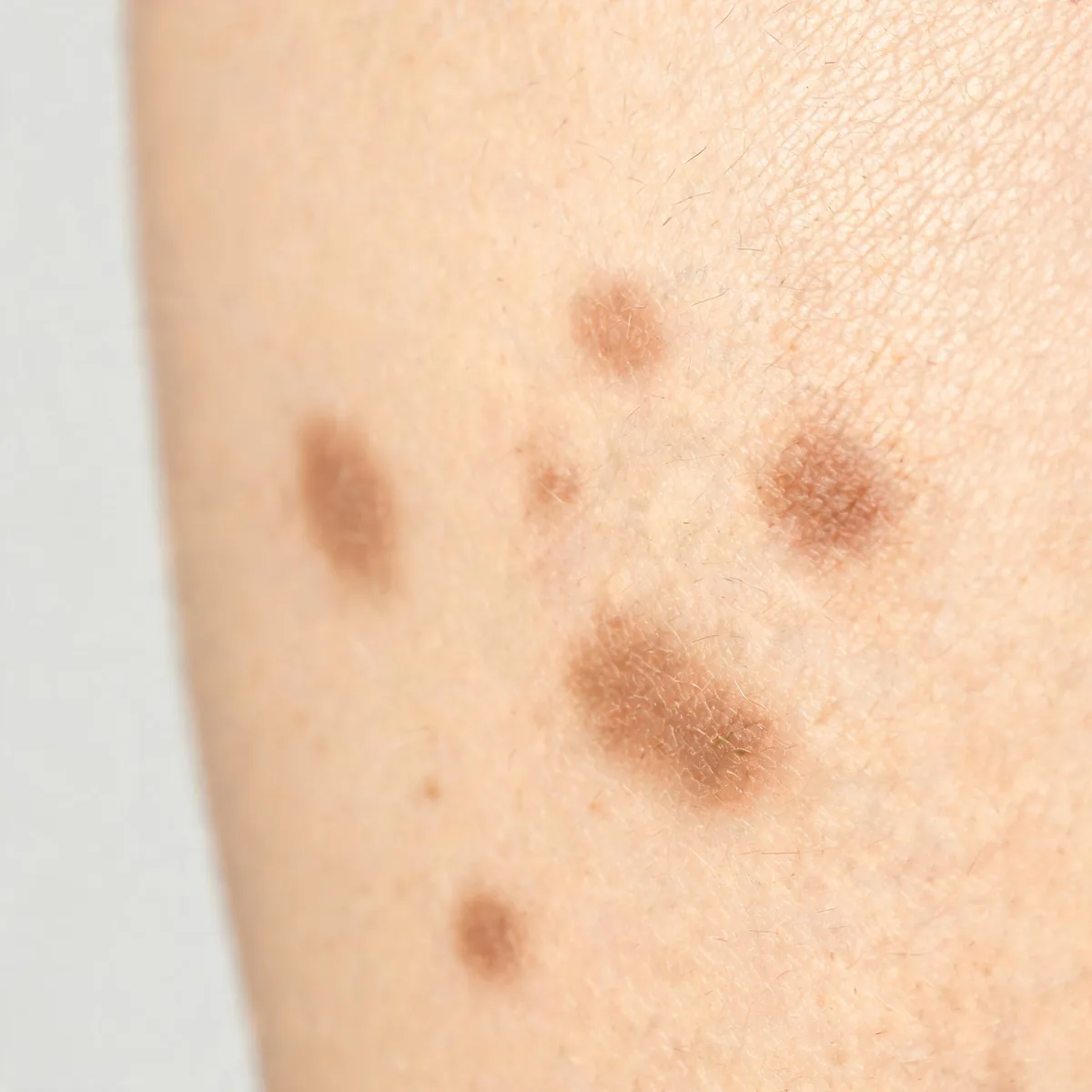
Understanding Macules
Note the overlap in the source: this page on macules covers flat facial dark spots, and the Melasma page covers the same territory from a different angle. Both are kept because the source treats them separately.
The face is described as a mirror of Qi and Blood. When they flow smoothly the complexion is clear; dark spots arise when Qi stagnates, Blood congeals, or the skin is not being nourished.
Liver Qi stagnation gives light to dark brown patches that worsen with stress, with irritability, chest tightness and sighing. Qi and Blood stagnation gives darker fixed macules with sharp borders and painful periods with clots.
Spleen deficiency with dampness gives macules on the nose, forehead and around the mouth with a pale dusty complexion, bloating and loose stools. Kidney and Liver Yin deficiency gives irregular dark brown macules with night sweats and low back soreness, and Kidney Yang deficiency gives dull dark macules with cold limbs and night urination.
The face is read as a mirror of Qi, Blood and the organs: when flow is smooth and the organs are balanced the complexion stays clear, and dark spots appear when Qi stagnates, Blood congeals or the skin is undernourished. The Liver, Spleen and Kidneys are the systems most involved.
Liver Qi stagnation from stress or held frustration impedes Blood and produces brownish or purplish patches that worsen with emotion, and if it persists it deepens into Qi and Blood stagnation with darker fixed patches. A weak Spleen fails to make clear Qi and Blood and instead generates Dampness that clogs the channels, giving pale dusty spots around the mouth and nose with fatigue and bloating. Kidney Yin deficiency, common with age, overwork or menopause, lets a subtle deficiency heat darken the complexion, while Kidney Yang deficiency leaves a weak warming fire that congeals Blood into dull dark spots with cold limbs.
Conventional view
Western dermatology most often classifies facial dark spots as melasma, symmetrical brownish patches on the cheeks, forehead and upper lip, or as solar lentigines from sun damage. They come from overproduction of melanin by pigment cells, triggered by ultraviolet radiation, hormonal shifts such as pregnancy or birth control, and genetic predisposition, and diagnosis is usually made by visual examination.
Conventional management starts with strict sun protection and topical lightening creams containing hydroquinone, azelaic acid or kojic acid, with chemical peels, microdermabrasion or laser treatment for resistant cases and off-label oral tranexamic acid in selected patients. These can reduce the appearance of spots, but recurrence is common while the underlying triggers persist.
Topical and procedural treatment lightens pigment without addressing why the overproduction began, melasma is notorious for returning with further sun or hormonal change, and lightening agents can irritate while lasers are costly and not always effective. The conventional approach also applies the same protocol whether the spots are driven by stress, digestion or ageing, without the constitutional distinctions that guide TCM.
Selected PubMed records
Real PubMed records for the conventional discussion above, selected by condition name and title relevance. They are references, not a claim that any treatment is proven for this condition.
- The terminology of skin disorders. Primary Care, 2000. PMID: 10815043.
How it is assessed
The practitioner examines the macules and the constitutional picture behind them.
What a practitioner looks for
- Borders: sharp borders with fixed colour suggest stagnation; soft irregular patches suggest deficiency.
- Stress relation: patches that darken with stress suggest Liver Qi stagnation.
- Digestive signs: bloating and loose stools support Spleen deficiency with dampness.
- Red flags: a spot that changes, bleeds or itches persistently needs dermatological review.
The practitioner first reads the macules themselves, their colour, border and position, then confirms the pattern with the tongue and pulse. Brown patches that flare with stress, especially on the cheeks and forehead, point to Liver Qi stagnation, with a red tongue with a thin coat and a wiry pulse like a guitar string.
Darker, sharply bordered purplish patches point to Qi and Blood stagnation, with a dusky or purplish tongue and a deep thin or wiry pulse, often in someone with a long history of held stress. Pale dusty spots around the nose, mouth and forehead point to Spleen deficiency with Dampness, with a pale tongue with a thin greasy coat, a soft slow pulse, and questions about bloating, loose stools and tiredness after meals.
Irregular dark brown patches with hot flushes, night sweats, dizziness or tinnitus suggest Kidney and Liver Yin deficiency, common around menopause, with a red thin tongue with little coating and a deep thin pulse. Dull dark patches in a person who is always cold, with low back soreness and a pale puffy tongue, point to Kidney Yang deficiency, with a deep weak pulse; this is less common but needs warming and strengthening rather than cooling or moving.
TCM patterns in Macules
Facial macules are treated by pattern, because the same brown patches can come from several different roots. Liver Qi stagnation gives brownish patches that flare with stress and improve when the emotions settle. Qi and Blood stagnation gives darker, sharply bordered patches with fixed stabbing pain and painful periods. Spleen deficiency with Dampness gives pale dusty spots with fatigue, bloating and loose stools. Kidney and Liver Yin deficiency gives irregular patches with night sweats, dizziness and dry eyes, especially around menopause. Kidney Yang deficiency gives dull dark patches with cold limbs and low back weakness. These patterns mix, and one person may carry more than one at once, which is why the tongue and pulse matter as much as the complexion. The self-check above is a way into that differentiation, not a diagnosis.
| Pattern | Key signs | The itch | Tongue | Main formula |
|---|---|---|---|---|
| Liver Qi Stagnation | Not specified | Not specified | Body: Normal or slightly dark, with red or purple sidesCoat: Thin white | Not specified |
| Qi And Blood Stagnation | Stabbing or distending chest and rib pain; Painful periods with dark clots | Not specified | Body: Purple or dark, with stasis spots; sublingual veins dark and distendedCoat: Thin white | Not specified |
| Spleen Deficiency with Dampness | Not specified | Not specified | Body: Pale and swollen, often with teeth marks along the edgesCoat: White, greasy and moist, thick in the middle | Not specified |
| Kidney and Liver Yin Deficiency | Not specified | Not specified | Body: Red, thin and dry, often crackedCoat: Little or none; the tongue may look peeled | Not specified |
| Kidney Yang Deficiency | Dull dark-coloured macules | Not specified | Body: Pale, puffy and tender with teeth marksCoat: White and wet | Not specified |
Liver Qi Stagnation
Brown facial patches that worsen with stress.
Held stress, frustration or unexpressed emotion makes Liver Qi sluggish, and the stagnant flow allows Blood to pool in the small vessels of the face as brownish patches. The tension also generates Heat that rises to the face, darkening the spots and making them more visible.
The tongue is normal or slightly dark with red or slightly purple sides and a thin white coat, and the pulse is wiry. Stress and anger, greasy or spicy food, alcohol, overwork and premenstrual shifts aggravate it, while stress reduction, gentle movement, chrysanthemum or rose tea, a warm compress on the abdomen and deep breathing ease it. Treatment soothes the Liver and moves Qi, with Jia Wei Xiao Yao San as the standard formula and herbs such as Chai Hu, Xiang Fu and Bai Shao.
Signs
- Light to dark brown facial patches worse with stress
- Irritability or mood swings
- Chest and rib-side tightness
- Frequent sighing
Diet and lifestyle for this pattern: Make stress reduction a priority with daily gentle movement such as walking, yoga or tai chi, and sip chrysanthemum or rose tea to soothe the Liver. Eat plenty of leafy greens and avoid greasy, spicy or highly processed food that can clog Qi flow, and use deep breathing when tension rises to keep energy moving.
Qi And Blood Stagnation
Dark fixed macules with sharp borders and painful periods.
When Liver Qi stays stuck over time, Blood stops moving and congeals. The stasis blocks nourishment to the face and leaves dark, fixed patches with sharp borders, and the person may feel stabbing or distending chest and rib pain and pass painful periods with dark clots.
The tongue is purple or dark with stasis spots, distended sublingual veins and a thin white coat, and the pulse is wiry and choppy. Emotional stress, cold or raw food, inactivity and cold exposure aggravate it, while warmth, gentle walking, stress reduction and warm cooked food help. Treatment invigorates Blood and dispels stasis, with Xue Fu Zhu Yu Tang as the standard formula and herbs such as Dang Gui, Chuan Xiong and Tao Ren.
Signs
- Dark fixed macules with sharp borders
- Stabbing or distending chest and rib pain
- Painful periods with dark clots
- Irritability and emotional tension
Diet and lifestyle for this pattern: Choose warm, cooked food and add spices such as ginger and turmeric to move Blood gently. Avoid cold, raw and greasy food that can congeal circulation, keep moving daily with walking or yoga, and manage stress with deep breathing or meditation so stagnation does not deepen.
Spleen Deficiency with Dampness
Macules on nose, forehead and mouth with a sallow complexion.
The Spleen transforms food into the Qi and Blood that nourish the skin. When digestion is weak it produces Dampness instead, a heavy sticky byproduct that clogs the channels carrying nourishment upward, so pale dusty patches appear around the nose and mouth where the Spleen meridian influences the complexion.
The tongue is pale and swollen with teeth marks and a white greasy moist coating, and the pulse is soggy and slow, soft and weak at the right guan. Cold raw food, dairy, greasy meals, overeating, humid weather and inactivity aggravate it, while warm cooked meals, gentle exercise, a dry warm environment, rest after meals and small frequent meals help. Treatment strengthens the Spleen and drains Dampness, with Shen Ling Bai Zhu San as the standard formula and herbs such as Bai Zhu, Fu Ling and Yi Yi Ren.
Signs
- Macules on nose, forehead and around the mouth
- Pale dusty or sallow complexion
- Bloating with loose stools and poor appetite
- Heaviness in body and limbs
Diet and lifestyle for this pattern: Eat warm, cooked food such as soups, stews and congee, and avoid cold, raw and greasy food as well as dairy and sugar, which create Dampness. Gentle daily walking helps the Spleen transform Dampness, and keep the abdomen warm without overeating.
Kidney and Liver Yin Deficiency
Irregular dark brown macules with night sweats.
Kidney and Liver Yin nourish the skin at depth. When they run low from overwork, chronic stress or the changes around menopause, the face loses that deep nourishment and a deficiency heat rises, darkening the complexion into irregular brown patches alongside night sweats, dizziness and heat in the palms and soles.
The tongue is red and thin with cracks and little or no coating, and the pulse is fine, rapid and often wiry, weak at the left kidney and liver positions. Late nights, heating food, stress and hot dry environments aggravate it, while sleep, cooling moistening food, gentle exercise such as tai chi and calm surroundings help. Treatment nourishes Kidney and Liver Yin, with Liu Wei Di Huang Wan as the standard formula and herbs such as Shu Di Huang and Shan Zhu Yu.
Signs
- Irregular dark brown macules
- Dizziness and ringing in the ears
- Night sweats with hot palms and soles
- Sore weak lower back and knees
Diet and lifestyle for this pattern: Prioritise deep sleep and avoid late nights, since Yin repairs itself at night. Eat cooling, moistening food such as black sesame, goji berries, mulberries, pear and cucumber, cut back on coffee, alcohol and spicy or fried food that dries Yin, keep movement gentle without overheating, and shield the face from strong sun, which intensifies deficiency heat on the skin.
Kidney Yang Deficiency
Dull dark macules with cold limbs and night urination.
Kidney Yang is the body's warming fire. When it is weak the body cannot warm and move Qi and Blood upward, the face becomes poorly nourished, and cold congeals Blood into dull dark patches; the person feels cold, especially in the lower back and legs, and urinates frequently at night.
The tongue is pale, puffy and tender with teeth marks and a wet white coating, and the pulse is deep, slow and weak, especially at the kidney positions. Cold weather, overwork, cold raw food, prolonged standing and excessive sexual activity aggravate it, while warmth on the lower back, rest, warm cooked food, gentle walking and keeping the feet warm help. Treatment warms and tonifies Kidney Yang, with You Gui Wan as the standard formula and herbs such as Zhi Fu Zi, Rou Gui and Shu Di Huang.
Signs
- Dull dark-coloured macules
- Feeling cold, especially lower back and legs
- Frequent urination at night
- Fatigue with sore weak lower back
Diet and lifestyle for this pattern: Eat warming food such as lamb, ginger, walnuts and black beans, and avoid cold drinks, raw salad and icy food. Keep the lower back and feet warm, walk gently or practise tai chi to circulate Qi and Blood without exhaustion, and put rest ahead of overwork.
Treatment approach
How the tradition treats macules, with the herbs, formulas and points used for it.
Principles
- Move Liver Qi where patches darken with stress.
- Move Blood and resolve stasis where macules are dark and border is sharp.
- Strengthen the Spleen and drain dampness where the complexion is sallow and digestion is loose.
- Nourish Yin or warm Yang where the pattern is constitutional, and protect from sun.
- Treatment always harmonises the organs while addressing the face locally. The common thread is to move stagnant Qi and Blood, resolve Dampness or nourish deficiency so that the face receives nourishment and pigment fades naturally, with the emphasis shifting from soothing the Liver and moving Qi, to invigorating Blood, to strengthening the Spleen, to nourishing Yin or warming Yang according to the pattern.
Herbs used
Formulas
Acupoints
- LR-3 (Taichong)
- LI-4 (Hegu)
- SP-6 (Sanyinjiao)
- SP-10 (Xuehai)
- BL-17 (Geshu)
- ST-36 (Zusanli)
- SP-9 (Yinlingquan)
- BL-20 (Pishu)
- KI-3 (Taixi)
- BL-23 (Shenshu)
- DU-4 (Mingmen)
- guanyuan-ren-4
What to expect
- The tradition describes gradual improvement over months.
- Pigment change is slow and may not clear completely.
- A spot that changes, bleeds or itches needs dermatological review first.
- Change is gradual: energy, digestion or mood often improve first, visible lightening of the spots typically follows four to six weeks for excess patterns and eight to twelve weeks for deficiency patterns. Consistency with herbs and sessions matters more than any single week, and the formula is reviewed every two to four weeks as the pattern shifts.
Safety and when to get help
Seek medical help urgently for
- A spot that changes colour, size or shape, or becomes raised or bleeds.
- A persistent itchy spot that does not heal.
- Signs of infection or a rapidly enlarging lesion.
For anything severe, sudden or spreading quickly, read when a skin problem needs urgent care.
Cautions
- Any changing mole needs dermatological assessment before herbal treatment.
- Sun protection is essential during treatment.
- Pregnancy requires practitioner review before internal herbs.
Using this alongside conventional care
- TCM is described as complementary to conventional care: prescribed topical lightening treatment and sun protection continue alongside herbs.
- TCM can complement conventional dermatological treatment. Tell the practitioner about topical hydroquinone or retinoids so herbs that increase photosensitivity or irritation are avoided, and note that oral tranexamic acid combined with Blood-moving herbs such as Dang Gui and Chuan Xiong may add to circulatory effects, so the prescribing doctor should monitor for clotting risk. Both clinicians should know the full list of treatments.
Diet and lifestyle
- Favour cooked whole grains, dark leafy greens and blood-nourishing foods.
- Favour foods that nourish the Spleen and Liver, such as cooked whole grains, dark leafy greens, goji berries, black sesame and mung beans, and reduce greasy, fried and sugary food that creates Dampness and Heat. Spicy food can aggravate Liver Heat and is best minimised, warm water and gentle teas such as chrysanthemum or rose support Qi flow, and sun protection is essential because UV exposure drives melanin production whatever the pattern.
If you're pregnant
Macules often appear or worsen in pregnancy, a condition known as chloasma or the mask of pregnancy, because hormonal shifts increase melanin production and sun exposure darkens it further. The patches usually fade after delivery, so a conservative approach through pregnancy is sensible.
Strong Blood-moving and aggressive pigment-clearing herbs are avoided, and gentle Yin- and Blood-nourishing herbs are used only under professional guidance. Acupuncture, gentle topical care and strict sun protection with a hat and mineral sunscreen are the safer mainstays, and a practitioner experienced in pregnancy care should be consulted before any internal formula.
If you're breastfeeding
After childbirth Blood and Qi are often depleted, which can intensify macules rooted in deficiency patterns. Breastfeeding mothers benefit from gentle nourishing herbs that support Yin and Blood without affecting milk supply or the infant, such as Shu Di Huang, Gou Qi Zi and Shan Zhu Yu, while aggressive Qi-moving or Blood-invigorating herbs are best avoided because they may alter milk quality or quantity.
Acupuncture is commonly used during breastfeeding, although trial evidence is limited, and local facial treatments such as gentle gua sha or herbal masks can support circulation without systemic risk. Any formula should be prescribed by a practitioner who can balance the mother's needs with infant safety.
If treating a child
Macules are uncommon in children, and when they appear they are rarely the hormonally driven melasma seen in adults. A weak Spleen with Dampness or a constitutional Kidney deficiency is more likely, with paler, less defined patches.
Because children's physiology is still developing, treatment relies on gentle dietary adjustment and paediatric tuina rather than strong herbal formulas. Persistent brown patches in a child warrant thorough evaluation to rule out genetic or metabolic conditions.
If treating an elderly patient
In older adults macules almost always reflect deficiency, most often Kidney Yin or Kidney Yang deficiency, and the patches tend to be darker, duller and more stubborn. Treatment must be gentle and sustained, with lower doses around two-thirds of the adult amount and a longer timeline for visible change.
Acupuncture is an excellent choice because it avoids herb-drug interactions with the multiple medicines many older patients take. Sun protection, warm easily digested food and gentle daily movement are especially important to support dwindling reserves.
Urgent-sign guidance is based on standard sources: NHS anaphylaxis, NHS cellulitis, NHS Stevens-Johnson syndrome, NHS melanoma.
Evidence
Evidence status
Compiled for this page from the classical and modern literature; not a systematic review, so treat it as a pointer to sources rather than clinical guidance.
Evidence is growing but dominated by Chinese-language studies. Systematic reviews and meta-analyses of randomised trials found that oral and topical Chinese herbal medicine significantly reduced melasma area and severity compared with placebo or hydroquinone, and acupuncture and facial cupping show promise in small trials with fewer side effects than bleaching agents. Methodological limits are common: small samples, absent blinding and short follow-up.
Studies often cited
Oral and topical herbal medicine significantly reduced melasma area and severity versus placebo or hydroquinone. Systematic reviews and meta-analyses (as recorded in the source)
Promise in small trials with fewer side effects than topical bleaching agents. Small trials (as recorded in the source)
Classical record
Dark facial macules occur when Water is insufficient to control Fire and Blood is too weak to nourish the flesh, causing Fire to dry and condense into blackish patches.
- Wai Ke Zheng Zong (Orthodox Manual of External Medicine), Volume 11, section on facial macules. The Chinese original is not reproduced here: it could not be recovered reliably from the source record, and is not guessed.
面皯者,谓面上有皯黯,如尘垢,由风邪客于皮肤,痰饮渍于脏腑,故令面生皯黯也。
Facial macules are darkish spots on the face, like dust or dirt. They arise when Wind pathogens lodge in the skin and Phlegm-Fluids soak the Zang-Fu organs, causing dark patches to appear on the face.
Zhu Bing Yuan Hou Lun (Treatise on the Causes and Symptoms of Diseases), Chapter on Facial Diseases - Classical citation; the translation is our own.
Common questions
What is the difference between macules and melasma?
The source treats them as separate pages even though both describe flat facial pigment. This page covers flat spots generally; the Melasma page covers the specific patterned form.
Can herbs fade dark spots?
The tradition describes treating the underlying Qi, Blood or deficiency pattern, with slow improvement over months. It does not promise clearance.
Why does stress make them darker?
Liver Qi stagnation is described as darkening patches during emotional strain.
When should I get a spot checked?
Any spot that changes colour, size or shape, becomes raised, or bleeds or itches persistently.