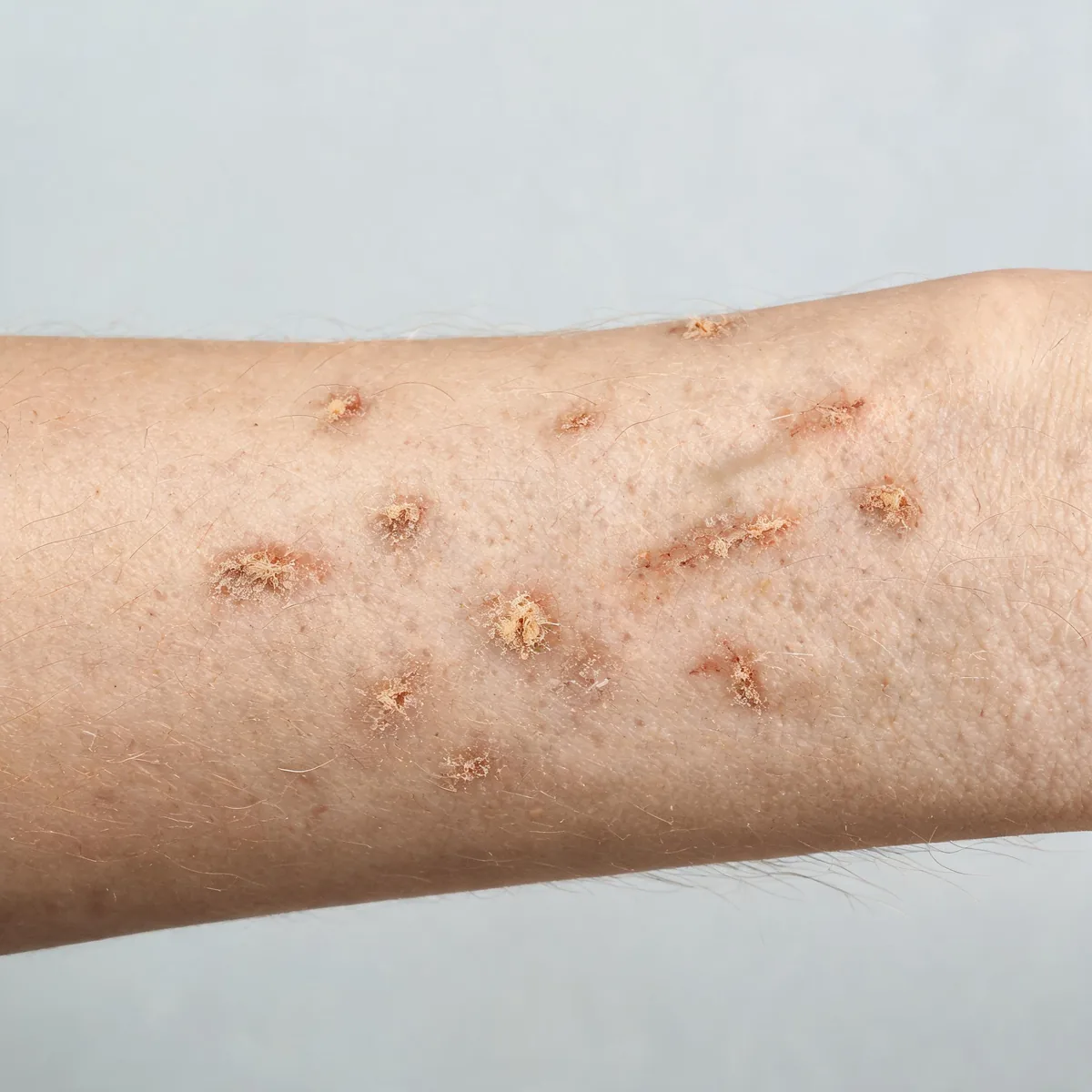
Understanding HIV associated pruritus
The tradition describes pruritus in HIV as a sign of deeper internal disharmony, most often involving the Blood, Spleen and Liver. The skin is read as an extension of the internal environment.
Blood deficiency with external wind gives itching that shifts and comes and goes, with dry flaky skin, worse at night, an aversion to drafts and a pale complexion. Qi and Blood deficiency gives a persistent low-grade generalised itch worse with exertion or at night, with profound fatigue, pallor, dizziness and palpitations.
Qi and Yin deficiency gives intermittent itch worse at night with dry finely scaling skin, dry mouth with little desire to drink, night sweats and warm palms. Damp-Heat gives red weeping burning lesions or vesicles with heaviness, chest stuffiness, a sticky bitter taste and loose stools.
Blood Stagnation gives purplish dusky lesions with fixed stabbing pain and itch worse at night, with dark lips and nails. Wind-Heat gives sudden red raised wheals with fever, sore throat, thirst and headache - the acute surface pattern that can also be a drug reaction.
What makes the picture move is the state of the defensive Qi. In HIV the outer layer of defence is often thin, so wind and heat from outside find it easier to settle on the skin, and a change of medication or a passing infection can be enough to start a sudden crop of red, raised wheals. Inside, the same weakness lets dampness gather when the Spleen cannot transform fluids, and lets Liver Qi knot when stress or long illness goes on too long. Deficiency and excess therefore sit side by side, and the pattern that matters most is the one currently driving the itch.
This is also why the description of the itch is treated as a finding rather than a complaint. Its quality, its timing and what settles it separate the patterns: dryness and night-time worsening belong to Blood, heaviness and oozing to Dampness, a fixed stabbing quality to stagnation, and a sudden arrival on the surface to wind. Two people with the same diagnosis can therefore need quite different prescriptions, and one person can need a different one at different stages.
Conventional view
Conventional assessment of itching in HIV starts with causes rather than with the itch itself. Dry skin is common and easily overlooked; eczema, seborrhoeic dermatitis, fungal infection and scabies all occur more often; and a long list of medicines, antiretrovirals among them, can provoke a rash. Where the cause is not obvious, blood tests for liver and kidney function, and sometimes a skin biopsy, are used to rule out systemic disease.
Treatment follows the presumed cause. Emollients and antihistamines are the usual first steps, antifungal, antibacterial or antiviral treatment is added when an infection is found, and topical or systemic corticosteroids are used for inflammatory rashes. If a drug is suspected the regimen may be changed, and light therapy may be tried where the itch is widespread and will not settle.
The limits are real. Antihistamines are drying, steroids carry long-term risks, and many people continue to itch after the visible rash has improved, because the deeper imbalance that leaves the skin vulnerable has not been addressed. Conventional care also treats itching as one problem with one cause, where TCM separates the dry pale skin of a Blood deficiency from the red weeping lesions of Damp-Heat and treats them differently.
Selected PubMed records
Real PubMed records for the conventional discussion above, selected by condition name and title relevance. They are references, not a claim that any treatment is proven for this condition.
- HIV-associated pruritus.. Clinics in dermatology, 1991. PMID: 1933720.
- HIV-associated pruritus: etiology and management.. American journal of clinical dermatology, 2003. PMID: 12627993.
- Pharmacological interventions for pruritus in adult palliative care patients.. The Cochrane database of systematic reviews, 2016. PMID: 27849111.
How it is assessed
The practitioner establishes the HIV care context first, then the pattern.
What a practitioner looks for
- Medication timing: a new rash after starting or changing antiretrovirals needs urgent review.
- Dryness: dry shifting itch suggests Blood deficiency with wind.
- Fatigue: persistent itch with profound fatigue suggests Qi and Blood deficiency.
- Red flags: blistering, mucosal involvement, fever or rapid spread.
The examination starts with the skin and works inward. Dry, scaly, pale skin that itches more at night and improves when moisturised points to Blood failing to nourish the surface, with external Wind taking advantage of the weakness; a pale tongue and a fine pulse that is wiry in the Liver position confirm it. Where the itch is persistent but mild and the person is exhausted, pale and subject to palpitations, the practitioner reads Qi and Blood Deficiency instead, with a pale tongue and a weak or thready pulse.
A different set of questions arises when the itch is intermittent, the mouth and throat are dry, the appetite is poor, there are night sweats and the tongue is pale with very little coat. That is Qi and Yin Deficiency, common after long illness or prolonged medication, and the pulse is thready, perhaps rapid, perhaps weak. Where lesions are red, moist and hot, with a heavy feeling and a thick greasy yellow coat on a red tongue, the reading is Damp-Heat and the pulse is slippery and quick; this is the most inflammatory of the pictures and the one most likely to flare in humid weather.
Two further pictures complete the assessment. Purplish, dusky or thick dry plaques with a stabbing itch, a dark tongue with spots and a choppy or wiry pulse point to Blood Stagnation, which resists ordinary anti-itch measures and belongs to longer-standing disease. A sudden crop of red wheals after a new drug or an infection, with a red tongue tip, a thin yellow coat and a floating rapid pulse, is acute Wind-Heat. Because a drug reaction can look exactly like that last pattern, any widespread rash needs medical review before it is treated as a pattern at all.
TCM patterns in HIV associated pruritus
Six pictures are described, and the useful question is which one dominates now. Two are deficiency of what moistens and nourishes the skin: Blood Deficiency with External Wind, where dryness and a shifting itch appear together, and Qi and Blood Deficiency, where a constant mild itch sits alongside exhaustion. Qi and Yin Deficiency lies close to both, adding dryness of mouth and throat, night sweats and a thready quick pulse. The other three are patterns of excess or obstruction: Damp-Heat with red, weeping, burning lesions, heaviness and a greasy yellow coat; Blood Stagnation with dusky thick plaques and a fixed stabbing itch; and Wind-Heat, the sudden surface eruption of red wheals that arrives with a sore throat or a new medicine. In HIV the deficiency patterns usually underlie the excess ones, so the flare is settled first and the root is built afterwards.
| Pattern | Key signs | The itch | Tongue | Main formula |
|---|---|---|---|---|
| Blood Deficiency with External Wind | Dry flaky or rough skin | Itching that shifts location and comes and goes | Body: Pale and thin, sometimes slightly dryCoat: Thin, white and a little dry | Not specified |
| Qi and Blood Deficiency | Not specified | Persistent low-grade generalised itch | Body: Pale, possibly thin or with teeth marksCoat: Thin white | Not specified |
| Qi and Yin Deficiency | Dry skin with fine scaling; Dry mouth and throat with little desire to drink | Intermittent itching worse at night | Body: Red or pale-red, thin and dry, possibly crackedCoat: Thin or absent | Not specified |
| Damp-Heat | Red weeping burning lesions or vesicles | Not specified | Body: Red, often swollen with teeth marksCoat: Yellow, greasy and thick, usually in the middle and at the root | Not specified |
| Blood Stagnation | Purplish or dusky skin lesions | Fixed stabbing pain at the itch site | Body: Purple, dusky or with dark stasis spots; sublingual veins dark and distendedCoat: Often thin white; a yellow coat would suggest Heat as the cause | Not specified |
| Wind-Heat | Sudden onset of red raised wheals; Sore red throat with thirst | Not specified | Body: Red at the tip and edgesCoat: Thin yellow or white turning yellow | Not specified |
Blood Deficiency with External Wind
Shifting dry itch worse at night with a pale complexion.
Long-standing HIV quietly uses up Blood, and Blood is what keeps the skin supple. Once the surface is undernourished it becomes dry and scaly, and that dryness is itself a form of internal Wind, so the itch moves about rather than staying in one place. A weakened exterior also lets external Wind in, which is why a draft or a dry room can start an attack and why the itch is always worse at night, when Yin should be at its fullest and the deficiency is felt most.
The tongue is pale and thin with a thin white, slightly dry coat, and the pulse is fine, wiry in the Liver position and often floating at the right front. Cold, dry weather, drafts, spicy and drying food, overwork and heavy periods all make it worse, while moisturising the skin, blood-nourishing food, warmth, rest and gentle movement calm it. Dang Gui Yin Zi is the classical choice, with Dang Gui, Fang Feng and Ji Li, and the points are SP-10 Xuehai, SP-6 Sanyinjiao, LI-11 Quchi and DU-16 Fengfu.
Signs
- Itching that shifts location and comes and goes
- Dry flaky or rough skin
- Worse at night
- Aversion to wind and drafts
- Pale or sallow complexion
Diet and lifestyle for this pattern: Eat blood-nourishing food such as dark leafy greens, bone broth, eggs and moderate amounts of red meat, and avoid drying, spicy or fried food while limiting alcohol. Keep the skin well moisturised, protect it from wind and draughts, and keep daily movement gentle such as tai chi or walking so Blood flows without draining reserves.
Qi and Blood Deficiency
Persistent generalised itch with profound fatigue.
Qi and Blood warm, hold and moisten everything the body is made of. When the Spleen is too weak to manufacture enough of either, the skin loses its nourishment and turns dry, pale and papery, and the itch becomes constant but mild rather than sharp. Blood also anchors the mind, so the same emptiness brings dizziness, palpitations, poor appetite and a fatigue that no amount of sleep seems to touch.
The tongue is pale and perhaps thin, its coat thin and white, and the pulse is fine and weak without force. Raw and cold food and drinks, overwork, sweating and worry all empty the Spleen further, while warm cooked food, proper rest, moxibustion and gentle exercise rebuild it. Gui Pi Tang strengthens the Spleen and nourishes Heart Blood, Shi Quan Da Bu Tang warms and tonifies both when coldness is marked, and the points are ST-36 Zusanli, SP-6 Sanyinjiao and SP-10 Xuehai, with moxibustion on ST-36.
Signs
- Persistent low-grade generalised itch
- Worse with exertion or at night
- Profound fatigue and weakness
- Pale sallow complexion with palpitations
Diet and lifestyle for this pattern: Focus on warm, easy, nourishing food such as bone broth, congee with goji berries and red dates, and gently cooked dark leafy greens. Avoid raw cold food and overwork, and prefer gentle walking and regular rest to intense exercise, which depletes Qi further.
Qi and Yin Deficiency
Night itch with dry scaling skin and night sweats.
Chronic infection and years of medication wear down two things at once: the Qi that pushes and warms, and the Yin fluids that cool and moisten. Qi too weak to nourish the surface and Yin too dry to keep it soft leave skin that scales finely and itches in spells, mostly at night. The small amount of empty heat that rises from the lack of Yin produces night sweats and a faint warmth in the palms and soles, and it makes the itch more noticeable whenever the body is at rest.
The tongue is pale-red or pale with a thin or absent coat, sometimes cracked and dry, and the pulse is fine and weak, perhaps slightly rapid. Overwork, late nights, spicy and fried food and stress burn through what remains, while rest, moistening food such as pear and congee, gentle movement and cool humid air restore it. Yi Wei Tang nourishes Stomach Yin and lifts Qi, with Tai Zi Shen, Mai Dong and Shi Hu, and the points are ST-36 Zusanli, SP-6 Sanyinjiao, KI-3 Taixi and SP-10 Xuehai.
Signs
- Intermittent itching worse at night
- Dry skin with fine scaling
- Dry mouth and throat with little desire to drink
- Night sweats and warm palms
Diet and lifestyle for this pattern: Eat small, frequent, easy meals such as congee, soups and steamed vegetables, and include moistening food such as pear, honey and lily bulb. Avoid spicy, fried and drying food that consumes Yin, rest and avoid overwork, and use gentle practice such as tai chi or qigong to conserve Qi.
Damp-Heat
Red weeping lesions with heaviness and a sticky taste.
When fluids are not transformed properly, Dampness gathers, and it combines easily with Heat from medication, secondary infection or a rich greasy diet. This mixture stews inside and then erupts into lesions that are red, weepy and hot, and that itch intensely. The sticky heaviness of Dampness is why the itch clings and worsens in humid weather, and why it comes with a heavy body, chest stuffiness, a sticky or bitter taste, loose incomplete stools and dark scanty urine.
The tongue body is red, its coat yellow and greasy and thickest at the centre and root, sometimes swollen with teeth marks, and the pulse is soggy and rapid or slippery and rapid. Hot humid weather, greasy fried or spicy food, alcohol, frustration and a sedentary life all feed it, while cool dry weather, light meals, cooling food such as cucumber and mung bean, and gentle movement ease it. Bi Xie Shen Shi Tang is the primary formula, with Ku Shen, Huang Bo, Bi Xie and Fu Ling, and the points are SP-9 Yinlingquan, SP-10 Xuehai, LI-11 Quchi and ST-36 Zusanli.
Signs
- Red weeping burning lesions or vesicles
- Body heavy and sluggish
- Chest stuffiness with sticky or bitter taste
- Loose stools
Diet and lifestyle for this pattern: Avoid greasy, fried, spicy and sugary food as well as alcohol and dairy, which all generate Dampness and Heat. Favour cooling, light food such as cucumber, mung beans, celery and barley, keep living spaces cool and dry, wear loose breathable cotton, and move gently such as walking or qigong while avoiding hot humid weather.
Blood Stagnation
Purplish lesions with fixed pain and night itch.
In chronic HIV, long illness and weak Qi slow the movement of Blood until it becomes sluggish and then stuck. Stagnant Blood cannot nourish the skin, so it grows rough, dry and scaly, and the congestion itself creates small local obstructions and pockets of heat, which produce a deep itch that is fixed and stabbing rather than wandering. The dusky or purplish colour of the lesions is the visible trace of that stasis.
The tongue is purple or dusky with stasis spots, the sublingual veins are dark and distended and the coat is thin and white, while the pulse is choppy, as if a knife were scraping bamboo, or wiry. Cold, inactivity, greasy heavy or iced food and frustration all thicken the stasis, while warmth on the skin, gentle movement, warming blood-nourishing food and stress reduction loosen it. Xue Fu Zhu Yu Tang invigorates Blood and disperses stasis, with Dan Shen, Tao Ren and Hong Hua, and the points are SP-10 Xuehai, BL-17 Geshu and LR-3 Taichong.
Signs
- Purplish or dusky skin lesions
- Fixed stabbing pain at the itch site
- Itching worse at night
- Dark lips, nails or complexion
Diet and lifestyle for this pattern: Eat warming, blood-moving food such as turmeric, ginger, black vinegar and a little red meat or bone broth. Gentle daily walking, stretching or tai chi keeps Blood flowing, cold drinks and raw food congeal circulation, and managing stress with breathing or quiet time stops emotional strain tightening the Liver Qi.
Wind-Heat
Sudden red raised wheals with fever and sore throat.
This is the acute surface pattern. Wind-Heat arrives from outside and meets the defensive Qi on the surface, and the Heat inflames the skin so that red raised wheals appear suddenly and itch fiercely. Because the defensive Qi in HIV is already thin, the body struggles to throw the pathogen off, and the episode is often set going by a new allergen, a drug reaction or an infection, which is why it brings a sore throat, mild fever, thirst and a distending headache with it.
The tongue tip and edges are red, the coat thin and yellow, and the pulse floats and is rapid. Spicy, fried and drying food, alcohol, wind and drafts, hot rooms and worry all stir it up, while cool compresses, mint or chrysanthemum tea, rest in a cool room and avoiding the trigger settle it. Xiao Feng San disperses Wind, clears Heat, drains Dampness and stops the itch, with Jing Jie, Fang Feng, Chan Tui and Shi Gao, and the points are LI-11 Quchi, LI-4 Hegu, SP-10 Xuehai and DU-14 Dazhui.
Signs
- Sudden onset of red raised wheals
- Fever with mild chills
- Sore red throat with thirst
- Headache with a distending quality
Diet and lifestyle for this pattern: Drink cooling teas such as chrysanthemum or mint, and avoid spicy, greasy and allergenic food. Keep the skin cool in loose clothing, avoid hot showers, walk gently so defensive Qi is supported without heavy sweating, and do not scratch, using a cold compress instead.
Treatment approach
How the tradition treats hiv associated pruritus, with the herbs, formulas and points used for it.
Principles
- HIV care and antiretroviral treatment are the foundation; any new rash on medication needs urgent review.
- Nourish Blood and Qi where the itch is dry, shifting and associated with fatigue.
- Clear damp heat where lesions weep and burn.
- Move Blood where lesions are purplish with fixed night pain.
- Because the deficiency usually sits underneath the flare, treatment is staged: settle the active Damp-Heat or Wind-Heat first, then nourish Blood, Qi and Yin once the skin is calmer, so the clearing herbs do not further drain an already depleted body. Antiretroviral care continues throughout, and a new rash is reviewed medically before any pattern is treated.
Herbs used
Formulas
- Dang Gui Yin Zi
- Gui Pi Tang
- Shi Quan Da Bu Tang
- Yi Wei Tang
- Bi Xie Shen Shi Tang
- Xue Fu Zhu Yu Tang
- Xiao Feng San
Acupoints
- SP-10 (Xuehai)
- SP-6 (Sanyinjiao)
- LI-11 (Quchi)
- DU-16 (Fengfu)
- ST-36 (Zusanli)
- KI-3 (Taixi)
- SP-9 (Yinlingquan)
- BL-17 (Geshu)
- LR-3 (Taichong)
- LI-4 (Hegu)
- DU-14 (Dazhui)
What to expect
- The tradition describes improvement over weeks with constitutional treatment.
- Itch may persist while the underlying HIV-related cause remains.
- New or worsening rashes need medical review rather than assumed pattern treatment.
- Excess pictures usually settle within one to three weeks, while deficiency pictures need six to twelve weeks before the change is convincing, because Blood, Qi and Yin have to be rebuilt rather than switched off. Progress rarely runs in a straight line: flares follow infections, new medicines, poor sleep and stress, so treatment is adjusted rather than restarted.
Safety and when to get help
Seek medical help urgently for
- Widespread rapidly spreading rash with blisters or peeling skin.
- Rash with fever, mucosal sores, or feeling very unwell.
- Any new rash after starting or changing HIV medication.
For anything severe, sudden or spreading quickly, read when a skin problem needs urgent care.
Cautions
- HIV care and antiretroviral treatment must continue unchanged.
- New skin lesions need medical review to exclude infection and drug reaction.
- Some herbs interact with antiretrovirals; discuss everything with the treating team.
Using this alongside conventional care
- This page is complementary: HIV treatment continues, and any herb use must be agreed with the treating team because of interaction risk.
- Herbs are used alongside antiretroviral therapy, antihistamines and topical treatment, and never as a replacement for any of them. Nothing is stopped or adjusted without the HIV specialist, because interrupting antiretroviral treatment carries its own risks. Blood-moving herbs such as Dan Shen and Dang Gui deserve caution with anticoagulants, and the treating doctor should know that herbs are being taken so liver and kidney function can be watched. A practitioner used to this population will choose formulas intended for long-term use beside existing prescriptions.
Diet and lifestyle
- Favour nourishing cooked food and adequate protein, and avoid excessive alcohol.
- The general principle is to keep the digestion warm and unburdened and to avoid what manufactures Dampness and Heat. Fried and greasy food is reduced, along with alcohol, sugary food, dairy and anything highly spiced, particularly where they leave a heavy or phlegmy feeling, while rice congee, soups, steamed vegetables and modest amounts of good protein support the Spleen and build Blood. Chinese yam, lotus seed and Job's tears are used to strengthen digestion and drain Dampness without drying the skin, and room-temperature water is preferred to iced drinks, which slow the Spleen.
If you're pregnant
Pregnancy calls for more caution than usual. Herbs that strongly move Blood, drain downwards or are toxic are avoided. Where the Blood Deficiency with External Wind picture dominates, Dang Gui Yin Zi is an option provided Dang Gui stays at a moderate dose, since the formula nourishes rather than forcefully moves, and Fang Feng is gentle enough to dispel Wind. Formulas built on Tao Ren and Hong Hua, such as Xue Fu Zhu Yu Tang, are not used. Bitter-cold Damp-Heat formulas give way to milder damp-draining herbs such as Fu Ling, and acupuncture, often the safest first choice, leaves out points such as SP-6 Sanyinjiao before 37 weeks. The obstetric team is kept informed.
If you're breastfeeding
Most gentle nourishing herbs are acceptable during lactation, though bitter-cold ones can pass into milk and cause loose stools or colic. For Damp-Heat it is better to rely on mild damp-draining herbs such as Fu Ling, or on acupuncture, which exposes the baby to nothing at all. Qi and Blood tonics such as Gui Pi Tang or Dang Gui Yin Zi are generally well tolerated and may help the mother's own energy. Any change in the baby's digestion or skin is reported, and close contact with the prescribing practitioner is kept.
If treating a child
In children with HIV the picture is often Damp-Heat, or a deficiency of Qi and Blood, but it is harder to read because a young child cannot describe the itch. Practitioners rely on observed scratching, the look of the lesions, disturbed sleep, and the tongue and pulse. Doses are reduced to about a quarter to a half of the adult amount by weight, and acupuncture may give way to paediatric tuina or acupressure on points such as ST-36 Zusanli and SP-10 Xuehai. Sessions are shorter and the aim is gentle support of the Spleen and Stomach, since a child's digestion is still maturing.
If treating an elderly patient
Older patients almost always present with pronounced deficiency, most often a deficiency of both Qi and Blood, or of Qi and Yin, on thinner, drier skin that heals slowly. Doses are usually reduced to about two thirds of the standard adult amount so a weakened Spleen is not overwhelmed, and bitter-cold Damp-Heat formulas, where they are needed at all, are used briefly and lightly because they can damage Spleen Yang. Many older patients take several medicines besides antiretroviral therapy, so interactions are screened carefully. Acupuncture is often better tolerated than herbs, and progress is slower, so the emphasis is on sustained gentle nourishment with formulas such as Shi Quan Da Bu Tang alongside diet and moxibustion.
Urgent-sign guidance is based on standard sources: NHS anaphylaxis, NHS cellulitis, NHS Stevens-Johnson syndrome, NHS melanoma.
Evidence
Evidence status
Compiled for this page from the classical and modern literature; not a systematic review, so treat it as a pointer to sources rather than clinical guidance.
Evidence is limited. Much of the guidance comes from expert consensus and large observational studies rather than randomised trials: a 2019 expert consensus by Chinese HIV and TCM specialists set out pattern differentiation and treatment protocols, and a cross-sectional study of over 1,200 HIV/AIDS patients documented itching as a common symptom and identified the predominant patterns. Small clinical trials exist but are not large or rigorous.
The strongest documents are a 2019 expert consensus produced by Chinese HIV and TCM specialists, which sets out pattern differentiation and treatment protocols from clinical experience rather than trials, and a cross-sectional study of more than 1,200 people living with HIV or AIDS that recorded itching as a frequent symptom and identified the patterns most often seen. Small clinical trials exist but are neither large nor rigorous, and much of the literature is published in Chinese, so the evidence is best read as supportive rather than conclusive.
Studies often cited
Outlines pattern differentiation and treatment protocols, drawing on decades of clinical experience rather than trials. 2019 expert consensus (as recorded in the source)
Documented itching as a common symptom and identified the predominant TCM patterns. Observational study (as recorded in the source)
PubMed records for the TCM evidence
Real PubMed records for the TCM clinical evidence discussed above, selected by condition name and title relevance. They are references, not proof of benefit.
- [A research of Chinese medicine diagnosis and treatment standard procedure for patients with HIV associated pruritus based on experts' questionnaires].. Zhongguo Zhong xi yi jie he za zhi Zhongguo Zhongxiyi jiehe zazhi = Chinese journal of integrated traditional and Western medicine, 2013. PMID: 24063207.
Classical record
When blood dryness generates wind, the skin becomes dry and itches uncontrollably. Treatment should nourish blood and moisten dryness, and dispel wind to stop itching.
- Yi Zong Jin Jian (Golden Mirror of Medicine), skin diseases section. The Chinese original is not reproduced here: it could not be recovered reliably from the source record, and is not guessed.
Common questions
Can herbs treat HIV-related itch?
Only as support and only with the treating team aware. HIV care comes first, and new rashes need medical review.
Why does itch happen in HIV?
The classical literature reads it as Blood, Spleen and Liver depletion; conventionally it relates to dry skin, eczema, drug reactions and HIV-related skin disease.
Is a new rash dangerous?
It can be a drug reaction. Widespread blistering or mucosal involvement is an emergency.
Are herbs safe with antiretrovirals?
Not all are; interactions are possible, so every herb must be discussed with the treating team.