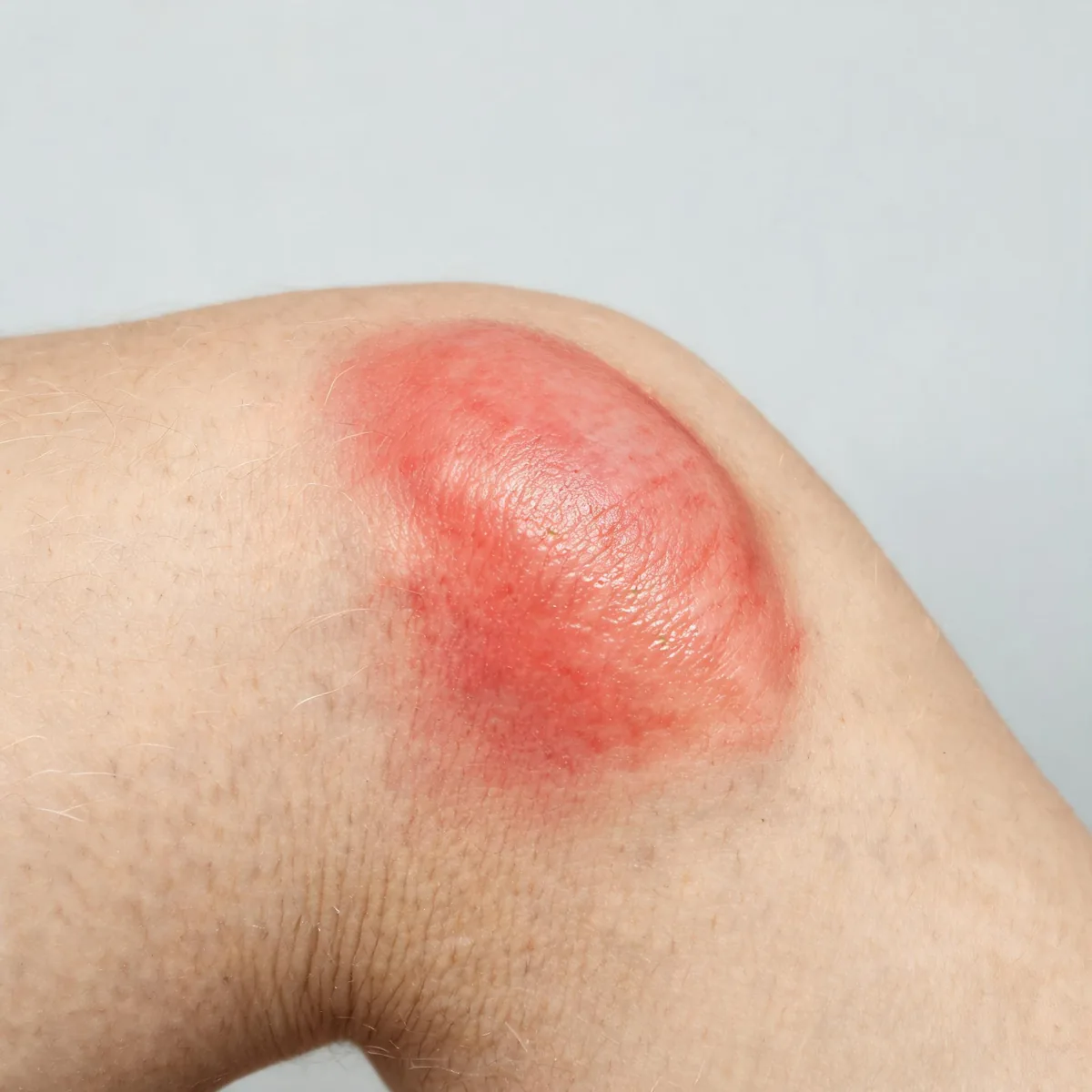
Understanding Red elbow
The tradition describes a red swollen elbow as a local manifestation of deeper imbalance. The elbow is a crossroads for the Large Intestine, Triple Burner and Lung channels.
Toxic-Heat stagnation gives throbbing severe pain with a bright red hot swollen elbow, thick yellow purulent discharge, high fever, intense thirst and restlessness. That is an abscess and needs medical care.
Liver and Gallbladder damp heat gives heavy distended swelling with thick yellow pus that drains slowly, a bitter taste, an aversion to rich food and a yellow greasy coating - a damp pattern that lingers.
Blood Stagnation gives fixed stabbing pain, worse at night, with dark purplish discolouration and a dark purple tongue with stasis spots. Qi and Blood deficiency gives mild dull pain, very slow healing with pale or greyish skin around the wound and thin watery pus without much odour - a deficiency picture where healing has stalled.
The pattern is decided by the character of the swelling rather than by its size. A bright, hot, throbbing carbuncle belongs to Toxic-Heat; a heavy, boggy one that drains thick pus slowly belongs to Damp-Heat rooted in the Liver and Gallbladder; a dark, hard lesion with a fixed stab that worsens at night belongs to Blood Stagnation; and a pale sore that will not close, in a tired person, belongs to Qi and Blood Deficiency. The strategies differ so much that giving the wrong one can worsen the picture.
The elbow is a meeting point for three channels, those of the Large Intestine, the Triple Burner and the Lung, so a lesion there can reflect trouble in any of them. Wind-heat arriving from outside, heat generated by diet or emotion, and heat left over from an injury all converge on the same small area of skin, and the result is a red, tight, painful swelling that may suppurate.
Conventional view
In Western medicine a red, swollen and painful elbow usually means a bacterial skin infection, either cellulitis spreading through the tissue or an abscess with a collection of pus. Bacteria enter through a break in the skin, and the site becomes red, warm, swollen and tender, sometimes with visible pus. Diagnosis is mostly clinical, with imaging or culture when a deep collection or an unusual organism is suspected.
Standard treatment is antibiotics, given by mouth or into a vein, together with warm compresses and elevation of the arm. If an abscess has formed it is incised and drained, and pain relief and anti-inflammatory drugs are used for comfort. Review checks that the redness is retreating and the wound is closing.
Antibiotics deal with the bacteria but not with the reasons the elbow was vulnerable in the first place, such as poor local circulation, a weakened immune response, or an internal tendency to dampness and heat, so infections can recur. Drainage can be painful and may leave a scar. The pattern approach is aimed at the terrain, alongside rather than instead of this care.
Selected PubMed records
Real PubMed records for the conventional discussion above, selected by condition name and title relevance. They are references, not a claim that any treatment is proven for this condition.
- Treatment strategies for simple elbow dislocation - a systematic review.. BMC musculoskeletal disorders, 2024. PMID: 38365699.
How it connects
The four patterns describe a sequence as much as a set of types. An acute red elbow usually begins as Toxic-Heat; as pus collects and the swelling turns boggy, Damp-Heat can take over; if it lingers, the discolouration of Blood Stagnation appears; and prolonged inflammation can leave Qi and Blood depleted, which is why healing stalls. Reading the strongest feature, rather than listing every symptom, keeps the picture usable, and checking the tongue and pulse gives the practitioner evidence that self-observation cannot. Rapid swelling, spreading redness or fever should be assessed medically, and an abscess should never be drained at home.
How it is assessed
The practitioner assesses the stage, the discharge and the systemic response.
What a practitioner looks for
- Pus: a throbbing abscess with fever suggests Toxic-Heat stagnation.
- Drainage: thick pus draining slowly with heaviness suggests Liver and Gallbladder damp heat.
- Colour: dark purplish swelling with fixed night pain suggests Blood stagnation.
- Red flags: red streaks up the arm, high fever, or spreading swelling.
A sudden, hot, bright swelling with severe pain and yellow pus suggests Toxic-Heat, and the practitioner will ask how fast it appeared and whether fever or thirst is present. A red tongue with a yellow coat, and a pulse that is rapid and slippery, fit that reading. Speed matters here, because this pattern can progress quickly and a spreading edge or systemic symptoms need medical review.
A boggy, heavy swelling that drains thick pus slowly points to Damp-Heat, and the questions turn to heaviness, a bitter taste and sluggish digestion. Where the lesion followed an injury or a half-resolved infection, the practitioner looks for a dusky colour, a fixed stabbing pain, a dark or spotted tongue and a choppy pulse. Repeated slow-healing sores with a pale rim and a tired, puffy tongue suggest a deficiency behind the local problem, and the questions then cover appetite, energy and the healing time of past lesions.
TCM patterns in Red elbow
Four patterns describe a red elbow, and they follow the way the lesion behaves over time. Toxic-Heat Stagnation is the acute, angry stage, with a bright red, hot, swollen joint, severe throbbing pain, fever, thirst and thick yellow pus. Liver and Gallbladder Damp-Heat gives a heavy, distended swelling, pus that drains slowly, a bitter taste, an aversion to rich food and a yellow greasy coating, and it tends to drag on. Blood Stagnation is the dark, hard version, usually after injury or an infection never fully cleared, with fixed stabbing pain that is worse at night and a purplish tongue. Qi and Blood Deficiency is the quiet, chronic picture, where the sore is pale, the pus thin and watery, healing stalls and the person is tired and pale. Most elbows move through more than one of these, so the reading is a snapshot, not a fixed label, and the formula is revised as the signs shift.
| Pattern | Key signs | The itch | Tongue | Main formula |
|---|---|---|---|---|
| Toxic-Heat Stagnation | Throbbing severe pain; Bright red hot swollen elbow | Not specified | Body: Deep red or crimson with raised red pointsCoat: Thick, dry and yellow | Not specified |
| Liver and Gallbladder Damp-Heat | Heavy distended swelling at the elbow | Not specified | Body: Red, with redder sidesCoat: Thick, yellow and greasy | Not specified |
| Blood Stagnation | Fixed stabbing pain; Pain worse at night | Not specified | Body: Purple, dusky or with dark stasis spots; sublingual veins dark and distendedCoat: Often thin white; a yellow coat would suggest Heat as the cause | Not specified |
| Qi and Blood Deficiency | Mild dull pain rather than sharp or throbbing; Very slow healing with pale or greyish skin | Not specified | Body: Pale, possibly thin or with teeth marksCoat: Thin white | Not specified |
Toxic-Heat Stagnation
Throbbing elbow abscess with bright redness and fever.
When wind-heat enters from outside, or heat builds internally from food, frustration or an injury, it can gather in the elbow channels and become toxic. The Qi and blood there are obstructed, pressure builds, and the tissue eventually breaks down into pus. The whole area becomes bright red, hot and swollen, and the pain beats with the pulse.
The tongue body is deep red or crimson, the papillae raised and the coat thick, dry and yellow, and the pulse is rapid, forceful and overflowing, sometimes slippery on the right guan and wiry and rapid on the left. Fever, intense thirst and restlessness go with it, and heat, alcohol, stress or leaning on the joint all make it worse. Xian Fang Huo Ming Yin is the primary formula named, with Huang Lian Jie Du Tang for stronger fever, and Jin Yin Hua, Lian Qiao and Huang Lian as the key herbs. Quchi (LI-11), Hegu (LI-4), Dazhui (DU-14) and Xuehai (SP-10) are the points.
Signs
- Throbbing severe pain
- Bright red hot swollen elbow
- Thick yellow purulent discharge
- High fever with intense thirst
- Restlessness and irritability
Diet and lifestyle for this pattern: Eat plenty of cooling, detoxifying food such as mung bean soup, watermelon, cucumber and chrysanthemum tea, and strictly avoid alcohol, spicy food, fried food and coffee, which add Heat. Keep the elbow clean and elevated, never squeeze the abscess, rest the joint and avoid repetitive strain.
Liver and Gallbladder Damp-Heat
Heavy swelling with slow-draining pus and a bitter taste.
When the Liver and Gallbladder cannot process fluids and heat properly, dampness and heat accumulate together and can spill into the channels and settle at the joint. Dampness gives the swelling its heavy, distended quality and makes the pus thick and slow to drain, while heat keeps the skin red, warm and painful. The result is deeper and more stubborn than a simple hot abscess.
The tongue is red and redder at the sides, with a thick greasy yellow coat, while the pulse is wiry, slippery and rapid. A bitter taste, a dislike of rich food, heaviness in the limbs and a yellow coating are the confirming signs, and rich meals, alcohol, humid weather and stress all feed it. Long Dan Xie Gan Tang is the formula named, with Huang Qin, Zhi Zi and Ze Xie clearing heat and leaching out dampness, and Quchi (LI-11), Xuehai (SP-10) and Taichong (LR-3) as the points.
Signs
- Heavy distended swelling at the elbow
- Thick yellow pus that drains slowly
- Bitter taste with aversion to rich food
- Yellow greasy coating
Diet and lifestyle for this pattern: Avoid greasy, fried, spicy and very sweet food as well as alcohol, which all create Damp-Heat. Eat light, cooling meals with plenty of lightly cooked vegetables, drink fluids such as chrysanthemum tea or dandelion tea to drain Dampness gently, keep the elbow clean and rested, and maintain regular bowel movements to help clear Heat.
Blood Stagnation
Dark purplish swelling with fixed night pain.
The tongue is purple or dusky, sometimes with stasis spots and dark distended veins underneath, and the pulse is choppy or wiry. Cold weather, stress, inactivity and repeated pressure all aggravate it, while warmth and gentle movement ease it. Tao Hong Si Wu Tang is the formula named, with Tao Ren, Hong Hua, Chuan Xiong and Dang Gui moving blood while nourishing it, and Xuehai (SP-10), Quchi (LI-11), Zhouliao (LI-12) and Taichong (LR-3) are the points.
An injury, or an infection that never fully settled, can leave the flow of Qi and Blood around the joint congested. The stagnation hardens into a fixed obstruction, so the swelling becomes dark and hard and the pain turns into a deep stab instead of a throb. Because blood is not moving, the colour changes, and the pain worsens at night when circulation naturally slows.
Signs
- Fixed stabbing pain
- Pain worse at night
- Dark purplish discolouration
- Dark purple tongue with stasis spots
Diet and lifestyle for this pattern: Keep the elbow warm and out of cold. Gentle regular movement such as slow stretching helps blood move, while heavy lifting and repetitive strain work against it. Eat warming food such as ginger and turmeric, and steer clear of icy drinks and raw salad that can congeal blood.
Qi and Blood Deficiency
Slow-healing pale elbow with thin watery pus.
When Qi and Blood are depleted, the body cannot mount a strong response or build new tissue. A low-grade infection or a leftover toxin is never fully cleared, so the sore becomes chronic: the wound is pale, the discharge is thin and watery, and it closes very slowly if at all. The pain is mild because the reactive inflammation is weak.
The tongue is pale, perhaps thin or marked by teeth, with a thin white coating, and the pulse is fine and weak, especially on the right guan. Fatigue, a poor appetite, spontaneous sweating and a sallow complexion go with it, and overwork, skipped meals and cold weather make it worse. Tuo Li Xiao Du San is the formula named, with Huang Qi, Dang Gui and Dang Shen rebuilding the body while gently clearing what remains, and Zusanli (ST-36), Sanyinjiao (SP-6) and Quchi (LI-11) are the points.
Signs
- Mild dull pain rather than sharp or throbbing
- Very slow healing with pale or greyish skin
- Thin watery pus without much odour
- Fatigue with pale complexion
Diet and lifestyle for this pattern: Prioritise gentle, nourishing food such as bone broth, congee with lean protein and cooked dark leafy greens, and avoid raw, cold or greasy food that taxes the Spleen. Rest well, keep the elbow clean and protected, and avoid aggressive scrubbing or harsh antiseptics that can weaken the local tissue further.
Treatment approach
How the tradition treats red elbow, with the herbs, formulas and points used for it.
Principles
- Medical drainage and antibiotics where an abscess or spreading infection is present.
- Clear heat and resolve toxicity in the acute suppurating phase.
- Drain dampness where pus drains slowly and the arm feels heavy.
- Support Qi and Blood where healing has stalled with thin watery discharge.
- The order of work matters. Clearing comes first while heat and toxin are active, moving blood is added once the lump has become hard and dark, and tonification is introduced only after the acute phase has passed, since nourishing too early can prolong the discharge. Where the pattern is mixed, cooling and supporting herbs are combined in a ratio that shifts as the elbow settles.
Herbs used
Formulas
- Xian Fang Huo Ming Yin
- Huang Lian Jie Du Tang
- Long Dan Xie Gan Tang
- Tao Hong Si Wu Tang
- Tuo Li Xiao Du San
Acupoints
- LI-11 (Quchi)
- LI-4 (Hegu)
- DU-14 (Dazhui)
- SP-10 (Xuehai)
- LR-3 (Taichong)
- LI-12 (Zhouliao)
- ST-36 (Zusanli)
- SP-6 (Sanyinjiao)
What to expect
- Drained abscesses usually settle within one to two weeks with medical care.
- Deficiency patterns heal slowly over weeks.
- Spreading infection needs urgent treatment.
- Acute heat usually settles within days and resolves in one to two weeks, damp and stagnant pictures often need two to four weeks, and chronic deficiency can take four to eight weeks of steady treatment. As the lesion clears it may discharge, which is part of resolution rather than a setback, and the practitioner will watch the wound and adjust the formula as the signs change.
Safety and when to get help
Seek medical help urgently for
- Spreading redness or red streaks moving up the arm.
- High fever, chills or feeling very unwell.
- Severe throbbing pain with a tense swelling that needs drainage.
For anything severe, sudden or spreading quickly, read when a skin problem needs urgent care.
Cautions
- Do not squeeze or lance the swelling at home.
- Diabetes makes arm infections more serious.
- Persistent discharge needs medical review.
Using this alongside conventional care
- This page is complementary: drainage and antibiotics come first where indicated, with herbs supporting the pattern alongside.
- Herbs and acupuncture can run alongside antibiotics and drainage, but the elbow should not wait: rapidly spreading redness, fever or severe pain needs medical care first. Cooling herbs may add to prescribed medicines in ways that are not fully documented, so the doctor should be told what is being taken. Blood-moving herbs such as Dang Gui and Chuan Xiong are the specific concern for anyone on anticoagulants, and a planned procedure is a reason to discuss pausing them beforehand.
Diet and lifestyle
- Avoid spicy, greasy and fried food and alcohol while the infection is active.
- Cooling, light meals suit the hot and damp patterns: mung bean soup, cucumber, watermelon, plenty of lightly cooked vegetables, and chrysanthemum or dandelion tea to help drain dampness. Alcohol, coffee, fried food, spicy dishes and rich sweet food work against treatment and should be reduced while the elbow is active. A stagnant lesion benefits from warmth, ginger and turmeric, with iced drinks and raw salads limited, and a deficiency picture needs nourishment instead: bone broth, dark leafy greens cooked through and congee with lean protein, eaten at regular times.
If you're pregnant
Pregnancy directs Qi and Blood towards the fetus, which can leave the mother more prone to Damp-Heat and to Blood Deficiency, so a red elbow may present differently. Herbs that move strongly or cool aggressively, Da Huang and Mang Xiao among them, are not used, and milder heat-clearing herbs such as Lian Qiao and Jin Yin Hua are preferred. Points traditionally avoided in pregnancy, including Hegu (LI-4) and any lower abdominal or sacral point, along with Sanyinjiao (SP-6), are omitted, while cool compresses and gentle cleansing remain safe local measures.
If you're breastfeeding
Bitter-cold herbs such as Huang Lian and Huang Qin can pass into breast milk and cause diarrhoea or digestive upset in the infant, so milder options such as Lian Qiao and Jin Yin Hua are used where the pattern is Toxic-Heat. Topical washes and acupuncture are usually safe and reduce local swelling without systemic exposure. Keeping fluids up and eating light, cooling food supports recovery while milk supply is maintained.
If treating a child
In children a red elbow usually follows an external wind-heat invasion or a scratch that became infected, and the Toxic-Heat pattern dominates, moving quickly with high fever and marked redness. Because a child cannot describe the sensation, the practitioner relies on inspecting the joint, taking the temperature and asking about thirst. Doses are scaled to age and body weight, usually a quarter to a half of an adult amount, acupressure at Hegu (LI-4) and Quchi (LI-11) can replace needling, and cool compresses keep the area clean.
If treating an elderly patient
In older patients the lesion more often reflects Qi and Blood Deficiency, so it looks less red and hot, the pus is thin and watery, the tongue appears pale and the pulse feels weak, and healing is slow. Treatment supports the capacity to heal, using a formula such as Tuo Li Xiao Du San that nourishes while gently clearing what is left of the toxin. Sanyinjiao (SP-6) and Zusanli (ST-36) are needled with mild stimulation, and strong purgative or cooling herbs are avoided because they can further deplete an already weak patient.
Urgent-sign guidance is based on standard sources: NHS anaphylaxis, NHS cellulitis, NHS Stevens-Johnson syndrome, NHS melanoma.
Evidence
Evidence status
Compiled for this page from the classical and modern literature; not a systematic review, so treat it as a pointer to sources rather than clinical guidance.
There are no clinical studies recorded for this condition, so the evidence is classical rather than trial-based. The traditional texts attribute an elbow carbuncle to wind-heat contending in the Triple Burner and Large Intestine channels, which is the reasoning behind the treatment approach. A red, hot, swollen elbow can also indicate infection or gout and needs medical assessment before it is treated as a pattern.
Classical record
Elbow carbuncle is caused by wind-heat contending in the Triple Burner and Large Intestine channels.
- Wai Ke Zheng Zong (Orthodox Manual of External Medicine), chapter on abscesses and sores.
肘痈生于肘尖上,由心肺积热而成,初起如粟,渐大如桃,坚硬色赤,焮热疼痛。
An elbow carbuncle grows on the tip of the elbow and forms from accumulated heat in the Heart and Lung. It starts the size of a millet grain and swells to that of a peach, hard, red, burning hot and painful.
Yi Zong Jin Jian, volume on surgical diseases, elbow carbuncle - Classical citation: source, from the surgical volume of the Yi Zong Jin Jian.
Common questions
Does a red elbow need antibiotics?
If there is spreading redness, red streaks or fever, yes - that needs medical treatment promptly.
Can herbs draw out the pus?
The tradition describes clearing heat and toxicity, but an abscess usually needs professional drainage.
Why does it keep discharging?
Thick slow-draining pus is described as a damp pattern; persistent discharge needs medical review.
When is it urgent?
Red streaks up the arm, high fever, or rapidly spreading swelling.