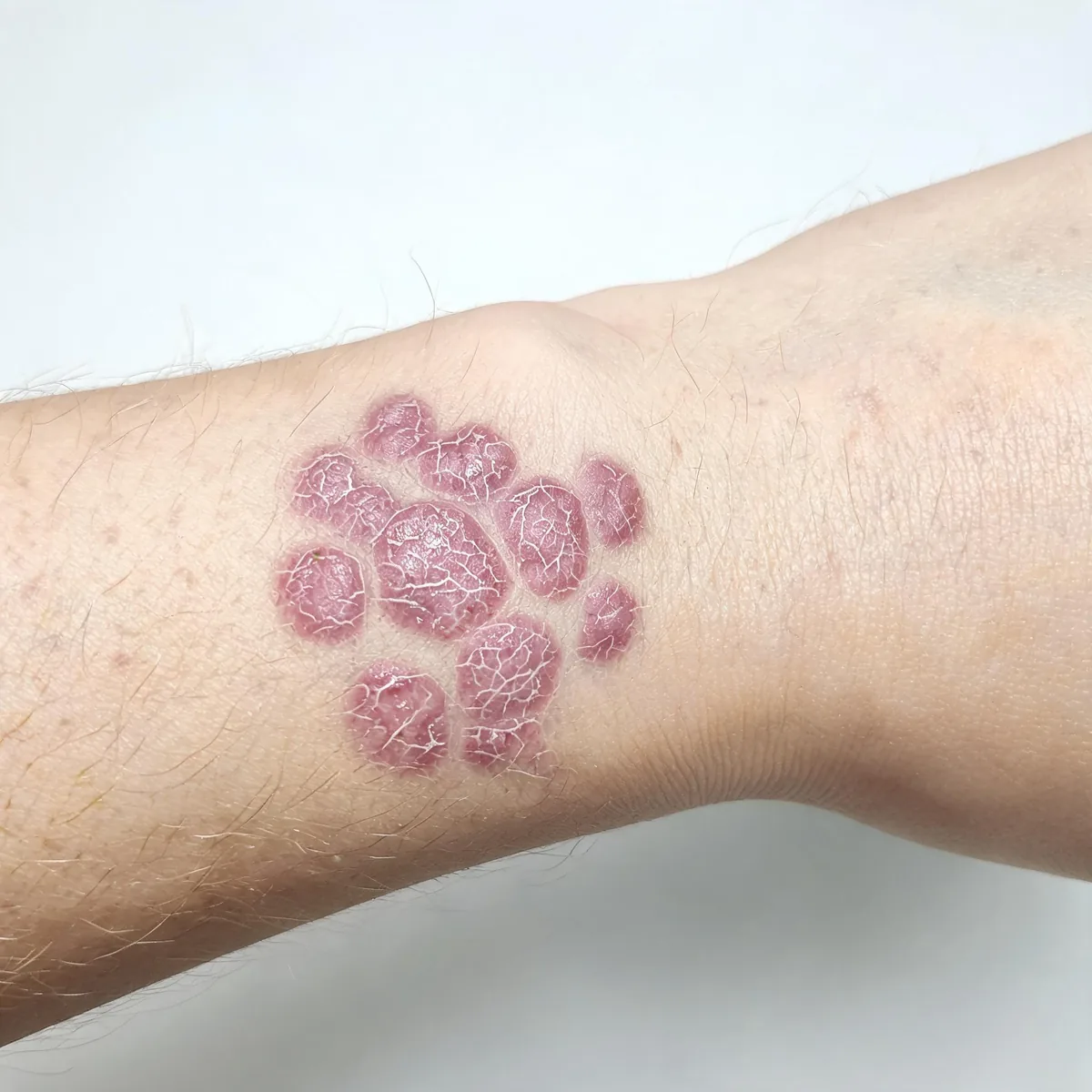
Understanding Lichen planus
The classical literature names lichen planus Purpura Wind, where pathogenic factors disturb the Blood and cause it to leak from the vessels or form inflammatory papules.
Heat in the Blood gives bright red or purplish papules with burning itch, sudden onset and a feeling of heat. Empty-Heat from Yin deficiency gives recurrent purplish-red patches with night sweats, dry mouth and five-palm heat.
Qi not controlling Blood gives pale or dull purple spots that come and go, with constant fatigue, poor appetite and loose stools. Damp-Heat in the Liver channel gives painful burning oral erosions, a bitter taste, a yellow greasy coating and sometimes genital lesions.
The classical literature treats oral and genital involvement within the same framework, which matters because those forms need medical monitoring.
Purpura Wind is the old name for this eruption, and it points at the mechanism: something is disturbing the Blood and pushing it where it should not go. What varies is the underlying fault. Excess Heat, Yin that has run low, Qi too weak to hold Blood, or Dampness mixed with Heat can each produce the same clinical label, and each is treated differently.
Two influences shape the picture. Heat that enters the Blood level, from an infection, an emotional shock or a run of spicy and greasy meals, agitates the Blood and drives it outward, so papules appear quickly and burn. Depletion works the other way: overwork, long illness or the ageing process uses up Yin and Blood, empty heat rises, and the rash is duller, drier and worse at night. The Liver channel passes through the mouth and genitals, which is why Damp-Heat settling there shows as erosive lesions in those places.
Conventional view
Lichen planus is a chronic inflammatory disorder of skin and mucous membranes. Skin lesions are purplish, flat-topped and very itchy, favouring the wrists, ankles and lower back, while mucosal disease shows as white lacy patches or painful erosions in the mouth. The cause remains unclear, though an autoimmune reaction against skin or mucosal cells is thought to be central. Diagnosis is usually clinical, sometimes confirmed by biopsy.
Conventional care aims at control rather than cure. Potent topical corticosteroids come first for itch and for flattening lesions; widespread or severe disease may need oral corticosteroids, retinoids or immunosuppressants. Light therapy is used where skin involvement resists other measures, and oral lesions are often managed with steroid rinses or gels.
The shortfall is that suppression does not change whatever drives the condition, so flares commonly follow when treatment stops, and long courses of corticosteroids bring thinning of the skin, weight gain and bone loss. Conventional practice also treats every case as one disease, whereas pattern differentiation separates heat, depletion, weakness and damp-heat, which allows treatment to be matched to the person rather than to the label.
Selected PubMed records
Real PubMed records for the conventional discussion above, selected by condition name and title relevance. They are references, not a claim that any treatment is proven for this condition.
- Worldwide prevalence of oral lichen planus: A systematic review and meta-analysis.. Oral diseases, 2021. PMID: 32144836.
- An Evidence-Based Update on the Potential for Malignancy of Oral Lichen Planus and Related Conditions: A Systematic Review and Meta-Analysis.. Cancers, 2024. PMID: 38339358.
- Treatment of oral lichen planus. Systematic review and therapeutic guide.. Medicina clinica, 2017. PMID: 28756997.
How it connects
Lichen planus often appears alongside other conditions that share its core patterns of Heat, Dampness or Yin deficiency. From a TCM perspective it is not unusual to have lichen planus together with psoriasis, eczema or autoimmune thyroid disorders, because all can involve Blood Heat or Yin deficiency. When the Liver channel is affected, emotional stress, irritability or even depression may accompany the skin lesions, reflecting the same Liver Qi stagnation and Heat that drive the oral and genital erosions. These co-occurrences are different outward expressions of one internal imbalance, so treating the root pattern often improves the skin and the associated symptoms together.
How it is assessed
The practitioner examines the papules, the mouth and genital skin, and the constitutional picture.
What a practitioner looks for
- Colour and onset: bright red or purple papules with sudden spread suggest Heat in the Blood.
- Recurrence: recurrent purplish patches with night sweats suggest Empty-Heat from Yin deficiency.
- Oral and genital lesions: burning erosions with a bitter taste suggest Damp-Heat in the Liver channel.
- Fatigue pattern: pale spots that come and go with tiredness suggest Qi failing to control Blood.
The consultation opens with the rash's history: when it began, how fast it spread, what colour the papules are and whether they burn, itch or neither. The tongue and pulse then confirm the internal picture. Bright red or purplish-red papules that appeared suddenly and burn suggest Heat in the Blood, and the person may also feel feverish and unusually thirsty, with a red tongue, a yellow coat and a rapid forceful pulse.
A rash that has dragged on for months, duller in colour and fading in and out, points to Empty-Heat from Yin Deficiency. The practitioner asks whether the mouth is dry at night, whether the palms and soles feel hot, and whether there are night sweats. Here the tongue is red, the coat almost gone and the pulse thin and rapid. Pale purplish spots that never quite clear, alongside marked tiredness and a poor appetite, suggest Qi not controlling Blood, with a pale puffy tongue, tooth marks and a weak, deep pulse. Erosive and painful lesions, particularly in the mouth, raise Damp-Heat in the Liver Channel, where a bitter taste, fullness under the ribs, a thick greasy yellow coat and a wiry slippery pulse are typical.
TCM patterns in Lichen planus
Four patterns explain the same eruption, and the shade of the lesions, how quickly they arrive and where they sit do most of the separating. Heat in the Blood is the acute excess pattern: bright red or purplish-red papules that appear suddenly, spread quickly and burn, with thirst for cold drinks and a feeling of heat. Empty-Heat from Yin Deficiency is its chronic counterpart, with duller recurrent patches, night sweats, a dry mouth and heat in the palms and soles. Qi not controlling Blood gives pale or dull purplish spots that come and go, alongside fatigue, a poor appetite and loose stools, because the Spleen cannot keep Blood where it belongs. Damp-Heat in the Liver Channel produces painful, erosive lesions in the mouth or genitals, a bitter taste and a thick yellow greasy tongue coat. Patterns often overlap, with heat damaging Yin over time.
| Pattern | Key signs | The itch | Tongue | Main formula |
|---|---|---|---|---|
| Heat in the Blood | Bright red or purplish papules | Burning and itching | Body: Deep red, often with red points or pricklesCoat: Thin, yellow and dry | Not specified |
| Empty-Heat caused by Yin Deficiency | Recurrent purplish-red patches; Dry mouth and throat at night | Not specified | Body: Red, thin and dry, often crackedCoat: Little or none; the tongue may look peeled | Not specified |
| Qi not controlling Blood | Not specified | Not specified | Body: Pale and puffy with teeth marksCoat: Thin white | Not specified |
| Damp-Heat in the Liver Channel | Painful burning oral erosions | Genital itching or lesions | Body: Red, with redder sides and edgesCoat: Yellow and greasy, thicker at the centre and root | Not specified |
Heat in the Blood
Bright red or purple papules with burning itch and sudden spread.
Excess Heat that has reached the Blood level stirs the Blood and forces it out of the vessels, which is why the papules are bright red to purple and appear in a rush. The same Heat scorches the skin, so the lesions burn and itch hard, and it dries the fluids, leaving thirst and a general dryness. Because the pathogen is deep and forceful, the eruption comes on quickly and spreads.
The tongue body is red with red spots or prickles under a thin yellow dry coat, and the pulse is rapid, often wiry or slippery, and forceful. Spicy and fried food, alcohol, coffee, anger, saunas and late nights all feed it, while cold compresses, cooling food and drink, a cool room and gentle movement calm it. The formula is Xi Jiao Di Huang Tang, which cools the Blood level and stops the leaking, often with Yin Qiao San for an acute eruption, using Shui Niu Jiao, Sheng Di Huang, Mu Dan Pi and Chi Shao. Points include Xuehai (SP-10), Geshu (BL-17), Quchi (LI-11) and Dazhui (DU-14).
Signs
- Bright red or purplish papules
- Burning and itching
- Sudden onset with rapid spread
- Thirst for cold drinks
- Feeling of heat worse at night
Diet and lifestyle for this pattern: Avoid spicy, greasy and fried food as well as alcohol and coffee, which add Heat. Eat more cooling food such as cucumber, watermelon, mung beans and leafy greens, keep the skin cool and avoid hot showers or saunas, and keep exercise gentle such as walking or yoga so Qi moves without overheating.
Empty-Heat caused by Yin Deficiency
Recurrent purplish patches with night sweats.
Yin is the cooling and moistening half of the body's resources, and once it is depleted there is nothing to anchor the interior, so a low-grade heat rises and disturbs the Blood. That heat drives Blood out through the vessel walls and produces the recurrent purplish-red patches of this pattern, while the lack of moisture explains the dryness and the night sweats. It is a picture of depletion, so the lesions return rather than resolving for good.
The tongue is red and thin, cracked and all but bare of coating, and the pulse is fine and rapid. Spicy and greasy food, late nights, stress, overheating and alcohol all stir the empty fire, while cooling and hydrating food, adequate rest, moisturising the skin and gentle exercise such as yoga help to settle it. Zhi Bai Di Huang Wan nourishes Kidney Yin and subdues the false heat, and Da Bu Yin Wan is used when night sweats and a dry mouth are pronounced, with Sheng Di Huang, Mu Dan Pi and Zhi Mu. Taixi (KI-3), Sanyinjiao (SP-6) and Xuehai (SP-10) are the usual points.
Signs
- Recurrent purplish-red patches
- Night sweats
- Dry mouth and throat at night
- Heat in palms, soles and chest
- Low-grade afternoon heat
Diet and lifestyle for this pattern: Eat cooling, moistening food such as pear, cucumber, tofu and black sesame, and avoid spicy, fried and drying food that worsens Heat. Stay hydrated, keep movement gentle such as tai chi or restorative yoga to nourish Yin without overheating, and rest rather than staying up late, which depletes Yin further.
Qi not controlling Blood
Pale spots that come and go with fatigue.
Blood is held inside the vessels by the Spleen's Qi, and when that Qi is too weak for the job, Blood leaks out and pools under the skin as purplish spots. The cause is shortage of Qi and nourishment rather than an excess, so the spots stay pale, the course runs long and the flares arrive when the person is most run down.
The tongue is pale and puffy with teeth marks and a thin white coat, and the pulse is fine and weak, most of all at the right Guan. Overwork, worry, cold raw food and heavy meals drain the Spleen further, while rest, warm cooked meals such as congee, gentle daily walking and less mental strain rebuild it. Gui Pi Tang strengthens Spleen Qi, nourishes Blood and stops the bleeding, and Bu Zhong Yi Qi Tang is chosen when exhaustion and a bearing-down feeling dominate, with Huang Qi, Dang Shen and Bai Zhu. Zusanli (ST-36), Sanyinjiao (SP-6) and Pishu (BL-20) support the Spleen.
Signs
- Pale or dull-purple spots that come and go
- Constant fatigue
- Poor appetite with loose stools
- Shortness of breath and reluctance to speak
Diet and lifestyle for this pattern: Eat warm, cooked, easy meals such as congee, soups and stews, and avoid raw, cold or greasy food that taxes the Spleen. Rest well and keep exercise gentle, with a daily walk ideal, and do not push through exhaustion.
Damp-Heat in the Liver Channel
Painful burning oral erosions with a bitter taste and genital lesions.
The Liver channel passes through the genitals and the inner mouth, so Dampness and Heat that gather in it flare along that route and surface as painful, erosive patches in those sites. Rich greasy food, alcohol and long-standing frustration generate the Damp-Heat. Dampness is what makes the lesions sticky and stubborn, while the heat is what keeps them red and inflamed and leaves a bitter taste in the mouth.
The tongue body is red with redder sides, its fur thick, yellow and greasy, densest at the centre and root, and the pulse is wiry, slippery and rapid. Spicy and fried food, alcohol, anger, humid weather and lost sleep aggravate it, while cool light meals, bitter foods such as dandelion and bitter melon, relaxation and gentle exercise ease it. Long Dan Xie Gan Tang clears the channel and drains Damp-Heat downward, led by Long Dan Cao, and the points are Taichong (LR-3), Fenglong (ST-40) and Yinlingquan (SP-9).
Signs
- Painful burning oral erosions
- Bitter taste in the mouth
- Thick yellow greasy coating
- Genital itching or lesions
- Irritability with dark scanty urine
Diet and lifestyle for this pattern: Eat plenty of cooling, Dampness-resolving food such as mung beans, celery, cucumber and bitter greens, and avoid alcohol, coffee, spicy dishes, fried food and dairy. Gentle exercise such as walking or yoga moves Qi and clears Dampness, and manage emotional stress with relaxation, since frustration directly fuels Liver Heat.
Treatment approach
How the tradition treats lichen planus, with the herbs, formulas and points used for it.
Principles
- Cool the Blood and stop the leak where papules are bright and spreading.
- Nourish Yin where the pattern is recurrent Empty-Heat.
- Strengthen Qi where containment is failing and fatigue is prominent.
- Clear Liver channel damp heat where the mouth or genitals are involved.
- The root and branch strategy is to stop the Blood leaving its vessels while correcting why it left. Where Heat is the driver, the formula cools the Blood level and purges fire, which is why Xi Jiao Di Huang Tang is chosen; where Yin has failed, the aim shifts to nourishing Yin and subduing empty heat, using Zhi Bai Di Huang Wan or Da Bu Yin Wan. A weak Spleen is treated by boosting Qi so it can hold Blood, with Gui Pi Tang or Bu Zhong Yi Qi Tang, and Damp-Heat in the channel is drained with Long Dan Xie Gan Tang. Because Heat damages Yin and deficiency allows Heat to flare, most courses are adjusted as the balance moves.
Herbs used
Formulas
- Zhi Bai Di Huang Wan
- Da Bu Yin Wan
- Gui Pi Tang
- Bu Zhong Yi Qi Tang
- Long Dan Xie Gan Tang
Acupoints
- SP-10 (Xuehai)
- BL-17 (Geshu)
- SP-6 (Sanyinjiao)
- ST-36 (Zusanli)
- LI-11 (Quchi)
- DU-14 (Dazhui)
- KI-3 (Taixi)
- qihai-ren-6
- BL-20 (Pishu)
- LR-3 (Taichong)
- ST-40 (Fenglong)
- SP-9 (Yinlingquan)
What to expect
- The tradition describes improvement over weeks to months, with oral lesions often the slowest.
- Recurrence is common, particularly with stress and fatigue.
- Oral lichen planus needs ongoing medical monitoring.
- Fading is gradual: new lesions usually stop forming first, then existing spots flatten and lose colour over weeks rather than days, and acute heat-driven cases clear faster than the deficiency-based ones. Long remissions are common once the pattern has been corrected, but major stress, illness or a return to a heating diet can bring a flare, and a short course usually settles it again.
Safety and when to get help
Seek medical help urgently for
- Sudden widespread blistering or peeling skin.
- Difficulty breathing or swallowing, especially with oral lesions.
- Severe pain, ulceration or bleeding from oral or genital lesions.
For anything severe, sudden or spreading quickly, read when a skin problem needs urgent care.
Cautions
- Oral lichen planus needs medical monitoring because of a small malignant potential.
- Do not stop prescribed topical or systemic treatment abruptly.
- Genital lesions need medical assessment.
Using this alongside conventional care
- TCM is described as complementary to conventional care: prescribed topical treatment continues, and oral lesions need ongoing medical review.
- Herbal medicine can be taken alongside topical steroids, antihistamines and, with supervision, systemic medication, and coordination is what makes that safe. Some herbs that cool the Blood also damp down inflammation mildly, so anyone on immunosuppressants needs monitoring by their doctor, and prescribed drugs should never be stopped abruptly. Bring a full list of medicines and supplements to the consultation, keep the dermatologist informed about the herbs, and treat blistering, breathing or swallowing difficulty as a medical emergency rather than something to manage at home.
Diet and lifestyle
- Avoid spicy peppers and fried food, and reduce alcohol and sugar.
- The principle across all four patterns is to remove what makes Heat and Dampness and to protect the Spleen. Cut back on peppers, fried food, fatty meat, alcohol and sugar, and build meals around cooling, mostly plant foods such as pear, watermelon, cucumber, mung beans, celery and leafy greens. With oral lesions, keep food soft, mild and at a moderate temperature, since acid and roughness irritate the mucosa. Smaller, more frequent meals suit anyone whose digestion is weak, and warm cooked food is easier on a deficient Spleen than raw salads.
If you're pregnant
Blood volume and metabolic heat both rise in pregnancy, so a heat pattern in the Blood can flare. Herbs that strongly cool or invigorate the Blood, Chi Shao and Mu Dan Pi among them, are handled cautiously because of a possible risk to the fetus. The usual approach is to adapt Xi Jiao Di Huang Tang rather than give it as written, cutting back those two and adding fetal-calming additions such as Tu Si Zi or Xu Duan. Empty heat is handled with Zhi Bo Di Huang Wan, generally regarded as safe, and Gui Pi Tang fits the pattern where Qi fails to hold Blood.
Bitter-cold draining formulas such as Long Dan Xie Gan Tang are usually left out during pregnancy, because they can injure the Spleen and Stomach. Acupuncture makes a good alternative, with points selected away from the lower abdomen and the lumbosacral region.
If you're breastfeeding
Very bitter, very cold medicinals such as Long Dan Cao, and large doses of Huang Qin, are avoided during nursing because they enter breast milk and can produce diarrhoea or an unsettled gut in the infant. Gentler cooling options such as Jin Yin Hua and Sheng Di Huang are preferred. Gui Pi Tang is usually well tolerated in this period, and so is Zhi Bo Di Huang Wan; neither troubles the baby.
Acupuncture suits this period well: nothing reaches the infant, and it regulates Qi and Blood effectively. Point choices follow the underlying pattern and also support milk supply, with Sanyinjiao (SP-6) and Zusanli (ST-36) often added to nourish Qi and Blood.
If treating a child
This is an uncommon diagnosis in childhood, and when it does occur the picture is often acute, with strong heat in the Blood or Damp-Heat. Lesions may be brighter and more scattered, and fever or thirst can accompany them. Gentle cooling and detoxifying herbs are used well below the adult dose, usually between a quarter and a half according to age and weight, scaled down from the Xi Jiao Di Huang Tang model.
A child cannot always say whether the skin burns or itches, so the practitioner leans on the tongue and pulse and on parents' reports of sleep and behaviour. Where needles frighten a child, acupressure or paediatric tui na takes their place. Diet is central, and taking out spicy, greasy and sugary food often reduces flares noticeably.
If treating an elderly patient
In later life the disease is usually long-standing, resting either on Yin deficiency with empty heat or on Qi that no longer holds Blood. Lesions are duller, dry and slow to heal. Treatment therefore nourishes Yin and boosts Qi, drawing on Gui Pi Tang or Zhi Bo Di Huang Wan in moderate doses, usually about two thirds of the standard adult amount, so that weaker digestion is not overwhelmed.
Polypharmacy is common, so interactions need careful checking; Dang Gui, for example, can potentiate anticoagulants. Acupuncture is often the preferred route because it carries no interaction risk. Expect a longer timeline, with the emphasis moving away from clearing pathogens and towards strengthening the constitution and preventing relapse.
Urgent-sign guidance is based on standard sources: NHS anaphylaxis, NHS cellulitis, NHS Stevens-Johnson syndrome, NHS melanoma.
Evidence
Evidence status
Compiled for this page from the classical and modern literature; not a systematic review, so treat it as a pointer to sources rather than clinical guidance.
Evidence is growing but limited. Systematic reviews and meta-analyses of randomised trials suggest oral and topical Chinese herbal medicine can reduce lesion size and pain in oral lichen planus more effectively than placebo or conventional treatment alone, but the studies are often small, unblinded and published in Chinese. Acupuncture shows moderate benefit for pain and quality of life in oral lichen planus, with a few well-designed trials. Ongoing monitoring of oral lesions remains necessary.
The picture differs by site. For oral lichen planus there are systematic reviews and meta-analyses of randomised trials suggesting that oral and topical Chinese herbal medicine reduces lesion size and pain better than placebo or conventional treatment alone, and acupuncture has given moderate relief of pain and improved quality of life, with a few well-designed trials outperforming sham needling. Cutaneous disease has been studied far less. Most of the trials are small, blinding is weak and many appear in Chinese-language journals, so the results are encouraging but not yet generalisable.
Studies often cited
Oral and topical herbal medicine reduced lesion size and pain more than placebo or conventional treatment alone, with methodological limits. Systematic reviews and meta-analyses (as recorded in the source)
Moderate benefit for pain relief and quality of life, supported by a few well-designed randomised trials. Randomised controlled trials (as recorded in the source)
PubMed records for the TCM evidence
Real PubMed records for the TCM clinical evidence discussed above, selected by condition name and title relevance. They are references, not proof of benefit.
- Efficacy and safety of traditional Chinese medicine combined with immunomodulators in treating erosive oral lichen planus: A network meta-analysis of randomized controlled trials.. Medicine, 2025. PMID: 41029064.
- Efficacy and safety of traditional Chinese medicine for erosive oral lichen planus: A protocol for systematic review and meta analysis.. Medicine, 2020. PMID: 33235110.
Classical record
Lichen planus (purple spot wind) is caused by blood heat contracting wind, stagnating in the skin, and producing purple patches shaped like brocade patterns.
- Yi Zong Jin Jian, Wai Ke Xin Fa Yao Jue, Volume 74. The Chinese original is not reproduced here: it could not be recovered reliably from the source record, and is not guessed.
夫紫斑者,由风热客于腠理,与血气相搏,致令血涩,壅遏不行,故成紫斑也。
Purple patches form when wind-heat lodges in the interstices of the skin and wrestles with the Blood and Qi, so that the Blood runs sluggishly and is held back instead of moving.
Zhu Bing Yuan Hou Lun on purple spots - Classical citation: Zhu Bing Yuan Hou Lun (Treatise on Causes and Symptoms of Diseases), Volume 31, section on purple patches.
Common questions
Can TCM help oral lichen planus?
The classical literature treats it as Liver channel damp heat and describes gradual improvement. The mouth should still be monitored medically because of a small malignant potential.
Why is it called Purpura Wind?
Because the tradition reads the eruption as wind-disturbed Blood leaking from the vessels, hence purpura with a wind-like sudden spread.
Is it contagious?
No. It is described as an internal disturbance of the Blood, not an infection.
When should I seek urgent care?
Blistering or peeling skin, or difficulty breathing or swallowing.
Can TCM cure Lichen Planus?
Many people see their lesions clear completely and stay clear, particularly when the right pattern is identified early. The target is the internal imbalance behind the eruption rather than the eruption alone, so that it does not come back. Some need a short refresher course after major stress or a dietary lapse, but the condition can usually be kept under good control.
How long does it take for the rash to go away?
Itching and the arrival of new spots usually settle within two to three weeks. Existing lesions take longer, with significant clearing commonly taking six to twelve weeks, and acute heat-driven rashes clear sooner than the chronic, deficiency-driven kind.
Can I use TCM alongside steroid creams?
Yes. Herbs and acupuncture can be combined with topical corticosteroids, and over time they may reduce how much of the steroid is needed. Tell your dermatologist and your herbalist about everything each is prescribing, so that the two plans are coordinated rather than conflicting.
Will it come back after treatment?
The intention is durable balance, so a relapse is less likely than after treatment that only suppresses the surface. Prolonged stress, a return to a strongly heating diet or a serious illness can still provoke a flare, and when that happens a short course of treatment usually settles it quickly.