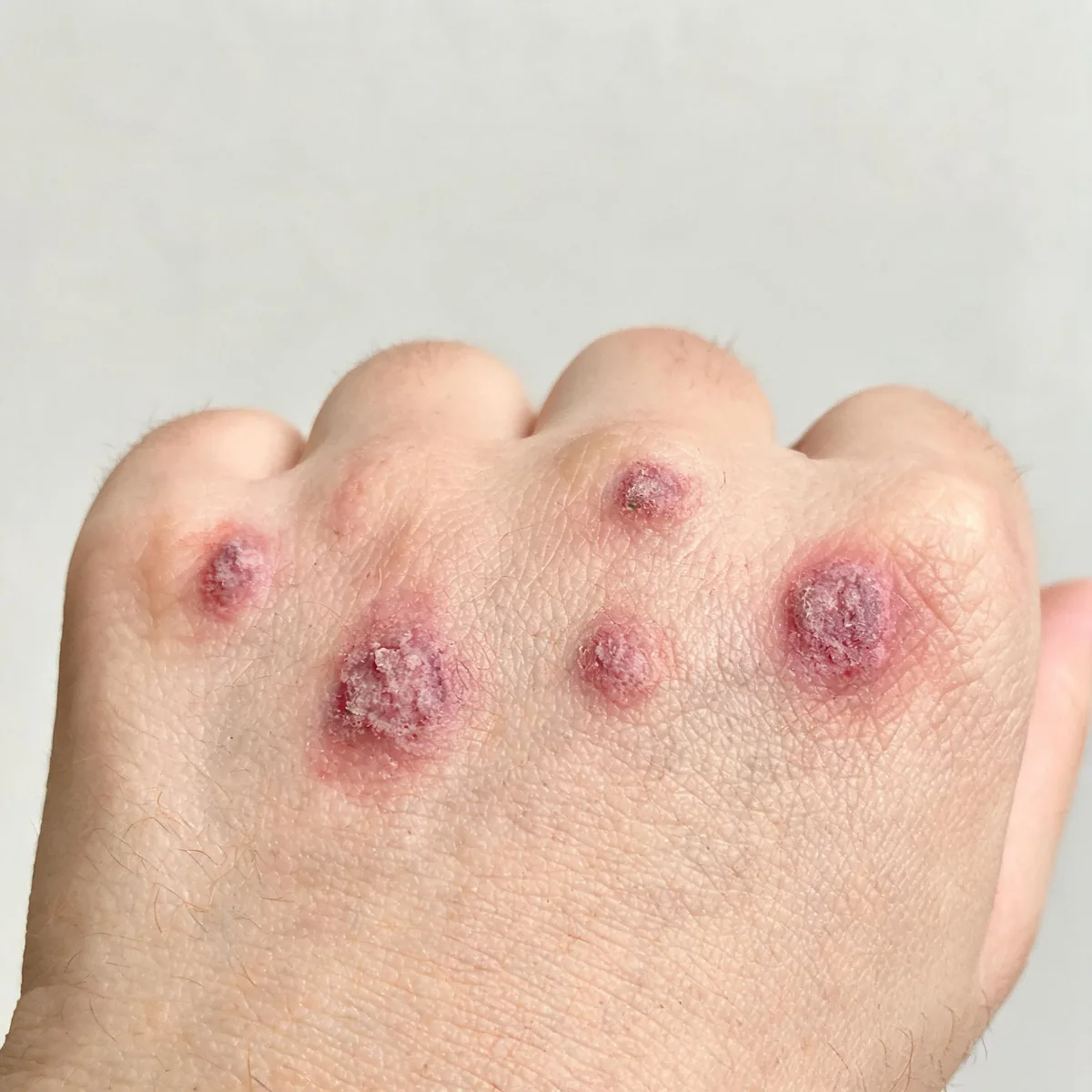
Understanding Dermatomyositis
The tradition describes dermatomyositis as an invasion of external pathogens, most often Heat-Toxin or Wind-Damp, lodging in the skin, muscles and channels.
The skin is governed by the Lungs and the muscles by the Spleen. When those systems are already weakened by overwork or diet, the pathogen settles and produces both the rash and the muscle weakness.
Toxic-Heat gives the characteristic picture: purple-red rash on the eyelids, raised scaly papules over the knuckles, with burning muscles and intense thirst. Wind-Damp gives heaviness, morning stiffness, weeping rashes and wandering pain that worsens in damp weather.
Blood stagnation gives fixed boring muscle pain with purplish mottled skin, worse at night. Qi and Blood deficiency gives progressive weakness and atrophy with pale skin and fatigue, and Kidney and Liver Yin deficiency gives weakness with night sweats, low back soreness and dry mouth.
The mapping is anatomical before it is anything else. Skin and body hair belong to the Lungs, the flesh and muscles to the Spleen, the sinews to the Liver, and the bones and marrow to the Kidneys, so an illness that produces both a rash and weak muscles is read as an attack that has reached two territories at once. What allows the attack is a prior weakness: overwork, poor food or sustained emotional strain leaves defensive Qi unable to hold the surface, and the pathogen settles where resistance is thinnest.
The picture then evolves, and the evolution is the diagnostic key. Heat-toxin and Wind-Damp dominate early, one giving a bright burning rash with rapid onset, the other a weepy rash with heavy stiff limbs that worsens in humid weather. If the illness lingers, the vessels themselves are damaged and blood stagnates, producing fixed stabbing pain and purplish mottling that is worse at night. Prolonged struggle then depletes the Spleen, so Qi and Blood run short and the muscles waste; in the longest cases the Kidney and Liver stores of Yin are consumed, leaving dry atrophic skin, night sweats and heat felt in the bones.
Conventional view
Dermatomyositis is an uncommon autoimmune condition in which muscle and skin become inflamed together. The hallmarks are weakness that progresses in the hips, shoulders and thighs, together with a purplish-red rash over the eyelids and knuckles, and on other skin exposed to the sun. Fatigue, difficulty swallowing and lung involvement can also occur. Diagnosis draws on blood tests for muscle enzymes such as creatine kinase, together with electromyography, MRI, and a biopsy of muscle or skin where needed.
Conventional treatment suppresses the immune attack. High-dose corticosteroids such as prednisone come first, usually together with a steroid-sparing drug, methotrexate, azathioprine or mycophenolate mofetil among them. Severe or resistant cases may be given intravenous immunoglobulin or a biologic such as rituximab, and physical therapy is used throughout to preserve function. Because adult-onset disease can accompany an underlying cancer, screening for malignancy is part of good care.
Corticosteroids and immunosuppressants can be life-saving in an acute flare, but the long-term cost is significant. Prolonged steroid use brings thinning bones, weight gain, diabetes and muscle wasting, which are close to the symptoms being treated; immunosuppression raises infection risk and does not guarantee freedom from relapse. The conventional approach treats every case as the same inflammatory process, leaving the constitutional imbalance that TCM would identify untouched. Difficulty standing or lifting the arms, choking on food or drink, and breathlessness are all emergencies and need medical assessment rather than herbs.
Selected PubMed records
Real PubMed records for the conventional discussion above, selected by condition name and title relevance. They are references, not a claim that any treatment is proven for this condition.
- Dermatomyositis: Clinical features and pathogenesis.. Journal of the American Academy of Dermatology, 2020. PMID: 31279808.
How it connects
Dermatomyositis rarely travels alone: it often appears alongside other autoimmune conditions such as lupus or Sjogren's syndrome, and joint pain is a frequent companion. In TCM this clustering makes sense, because one underlying imbalance, typically latent Heat toxin with deficiency of Qi and Blood, can show in several organ systems at once. The Heat toxin that attacks skin and muscles can settle in the joints and cause pain and swelling, while the failure of defensive Qi to distinguish self from non-self allows more than one autoimmune process to flare. Treating the root pattern rather than each disease separately is one of the strengths of TCM in these complex cases.
How it is assessed
The practitioner looks at the rash pattern, the muscles, and the person strength.
What a practitioner looks for
- Rash: eyelid heliotrope and knuckle papules point to Toxic-Heat.
- Muscle pattern: heaviness and morning stiffness suggest Wind-Damp; fixed boring pain suggests stagnation; progressive weakness suggests deficiency.
- Constitutional signs: thirst and heat indicate toxicity; night sweats and low back soreness indicate Yin deficiency.
- Red flags: difficulty standing, lifting the arms, or swallowing needs urgent medical care.
The rash is examined first, then the quality of the muscle complaint, because the two together separate the excess patterns from each other. Lesions that are bright red, hot, burning and quick to appear point to Toxic-Heat, with a red tongue, a yellow coat and a rapid forceful pulse. A rash that looks moist or weepy, with muscles that feel heavy and stiff instead of hot, points to Wind-Damp, where the coat is greasy and the pulse slippery or soft, suggesting that wind and dampness have entered the channels and are restricting movement.
Longer-standing disease is read from the colour of the skin and the strength of the muscle. Purplish lesions with pain that is fixed and stabbing suggest Blood Stagnation, confirmed by a dark tongue carrying purple spots, with a choppy or wiry pulse. Wasting muscles, dry pale skin, a pale tongue with a thin white coat and a thin weak pulse suggest Qi and Blood Deficiency. Night sweats, soreness in the lower back and knees, atrophic skin, a red tongue with little coating and a fine rapid pulse point deeper still, to Kidney and Liver Yin Deficiency.
TCM patterns in Dermatomyositis
Five patterns are described, and the order in which they appear matters as much as the list itself. Toxic-Heat and Wind-Damp are the acute pictures: one brings a purple-red eyelid rash, knuckle papules and burning muscles with thirst, the other brings heaviness, morning stiffness, weeping rashes and pain that wanders with the weather. Blood Stagnation is the consequence of lingering disease, with fixed boring pain and purplish mottled skin that is worse at night. Qi and Blood Deficiency follows depletion, giving progressive weakness and wasting with pale dry skin, and Kidney and Liver Yin Deficiency is the deepest picture, with night sweats, lower back soreness, dry mouth and atrophic skin. The rash, the quality of the muscle symptom, the systemic signs and the tongue and pulse are what separate them, and most people show more than one at a time.
| Pattern | Key signs | The itch | Tongue | Main formula |
|---|---|---|---|---|
| Toxic-Heat | Purple-red heliotrope rash on eyelids; Raised scaly Gottron papules on knuckles | Not specified | Body: Red, often with raised red pointsCoat: Yellow, dry, sometimes thick | Not specified |
| Wind-Damp | Moist or weeping skin rashes; Wandering muscle or joint pain | Not specified | Body: Normal or slightly pale, possibly swollenCoat: White and greasy | Not specified |
| Blood Stagnation | Fixed stabbing or boring muscle pain; Pain worse at night | Not specified | Body: Purple, dusky or with dark stasis spots; sublingual veins dark and distendedCoat: Often thin white; a yellow coat would suggest Heat as the cause | Not specified |
| Qi and Blood Deficiency | Dry pale or sallow skin | Not specified | Body: Pale, possibly thin or with teeth marksCoat: Thin white | Not specified |
| Kidney and Liver Yin Deficiency | Dry mouth and throat | Not specified | Body: Red, thin and dry, often crackedCoat: Little or none; the tongue may look peeled | Not specified |
Toxic-Heat
The acute picture: heliotrope eyelid rash and knuckle papules with burning.
Heat-toxin reaches dermatomyositis either from outside as an external pathogen, or from inside when heat accumulates through stress and diet. It floods the blood and attacks skin and muscle together, which is why the purple-red heliotrope rash over the eyelids and the raised scaly papules over the knuckles appear at the same time as burning in the muscles. The heat damages the small collaterals, so pain and inflammation follow, and it consumes fluids, so thirst, dryness and restlessness follow too.
The tongue is red with raised prickly papillae and a dry yellow coat, and the pulse is rapid and forceful, often slippery and full. Sun exposure, spicy or heavy food, alcohol, frustration and overexertion all add heat and provoke a flare, while a cool room, cooling food and drink, shade and loose clothing settle it. Qing Ying Tang is the formula named here, with Shui Niu Jiao, Jin Yin Hua, Mu Dan Pi and Lian Qiao, and the points are Quchi (LI-11), Hegu (LI-4), Xuehai (SP-10), Taichong (LR-3) and Dazhui (DU-14).
Signs
- Purple-red heliotrope rash on eyelids
- Raised scaly Gottron papules on knuckles
- Burning sensation in muscles and skin
- Intense thirst for cold drinks
- Restlessness and irritability
Diet and lifestyle for this pattern: Avoid sun exposure completely, since UV light can trigger flares. Eat cooling food such as cucumber, watermelon, mung beans and chrysanthemum tea, strictly avoid spicy, greasy and fried food and alcohol that add Heat, and rest during acute flares so the body can clear the toxin.
Wind-Damp
Heaviness with morning stiffness, weeping rashes and wandering pain.
Wind and dampness come from outside and settle when protective Qi is too weak to hold the surface, lodging in the channels that run through skin and muscle. Wind explains why pain wanders and symptoms change, dampness explains the heaviness, swelling and moist weeping rash, and together they obstruct the movement of Qi and Blood so the limbs feel stiff, especially on waking. Weather does the rest: damp and cold days deepen the obstruction, and warmth and dryness ease it.
The tongue is normal or slightly pale with a white greasy coat, and the pulse floats and feels soggy, which the classical literature reads as wind-damp on the exterior. Greasy or heavy food and long periods of stillness add to the problem by burdening the Spleen, while warm light meals, gentle daily movement and a dry environment help resolve it. Juan Bi Tang is the formula, with Fang Feng and Yi Yi Ren, and the points are Fengchi (GB-20), Yinlingquan (SP-9) and Zusanli (ST-36).
Signs
- Heaviness and soreness in limbs
- Muscle stiffness, especially in the morning
- Moist or weeping skin rashes
- Wandering muscle or joint pain
- Worse in damp weather
Diet and lifestyle for this pattern: Avoid cold, raw and greasy food that creates Dampness, and favour warm cooked meals with aromatic spices such as ginger and cardamom. Keep the body warm and dry, stay out of damp environments, and let gentle daily movement such as walking or stretching circulate Qi and dispel Dampness.
Blood Stagnation
Fixed boring muscle pain with purplish mottled skin.
As the illness lingers, either the earlier heat damages the vessels or long-standing Qi stagnation leaves blood unable to move through the fine collaterals that feed skin and muscle. Blood pools and congeals, so pain becomes fixed, stabbing or boring rather than wandering, the skin turns purplish or mottled, and hard tender spots form in the muscles. Because the stasis prevents fresh blood from arriving, the ache persists and deepens even after the original heat has gone.
The tongue is dark purple with stasis spots and the veins beneath it are distended and dark, while the pulse is choppy or wiry. Cold, immobility, stress and night-time stillness all slow the flow and worsen the pain, while warm compresses, gentle movement and light massage relieve it. Shen Tong Zhu Yu Tang is the formula, built around Tao Ren, Hong Hua, Chuan Xiong and Di Long, and the points are Geshu (BL-17), Xuehai (SP-10), Yanglingquan (GB-34) and Taichong (LR-3).
Signs
- Fixed stabbing or boring muscle pain
- Pain worse at night
- Purplish or dark mottled skin
- Muscle stiffness with tender hard spots
Diet and lifestyle for this pattern: Keep the body warm and avoid cold raw food that can congeal Blood. Gentle daily walking or tai chi keeps circulation flowing without straining the muscles, and a little turmeric, ginger or cinnamon in cooking gently warms the Blood.
Qi and Blood Deficiency
Progressive weakness and atrophy with pale skin and fatigue.
Once the acute inflammation settles, the cost of the preceding months becomes visible. The struggle against heat and toxin has drained Qi and Blood, and the Spleen, which makes both from food, is too weak to replace them. Without that nourishment the muscles thin and weaken, the skin loses its colour and turns dry or sallow, the lips and nail beds pale, and everyday exertion brings breathlessness, spontaneous sweating and loose stools.
The tongue is pale, sometimes thin or indented by teeth along its edges and thinly coated in white; the pulse is fine and weak, emptiest at the right middle position that corresponds to the Spleen. Overexertion, skipped meals, cold and sweat-inducing exercise all drain the deficiency further, while rest, warm light meals, bone broths and gentle movement rebuild it. Ba Zhen Tang is the formula, with Dang Gui, Huang Qi and Bai Zhu, and the points are Zusanli (ST-36), Sanyinjiao (SP-6) and Pishu (BL-20).
Signs
- Progressive muscle weakness and atrophy
- Dry pale or sallow skin
- Pale lips and nail beds
- Persistent fatigue with breathlessness
- Poor appetite with loose stools
Diet and lifestyle for this pattern: Focus on warm, cooked, easily digested food such as congees, stews and bone broth, with small amounts of good quality protein, eggs and dark leafy greens. Gentle movement such as walking or tai chi supports Qi without depleting it, and consistent sleep plus regular meals matter as much as the food itself.
Kidney and Liver Yin Deficiency
Weakness with night sweats and low back soreness.
A chronic inflammatory illness eventually exhausts the body's supply of cooling and moistening fluids, and the Kidneys and Liver suffer first because they govern bones, tendons and blood. With their Yin depleted, the skin loses nourishment and becomes atrophic and dry, the muscles thin, and a deep unsettled heat rises in the palms, soles and chest. Night sweats, dryness of mouth and throat, soreness in the lower back and knees, and a thin frame follow the same logic.
The tongue is red, thin and cracked with little or no coating and a dry surface, and the pulse is fine, rapid and wiry, weakest at the left position for the Kidney. Overwork, late nights, stress, spicy or drying food and hot dry weather consume Yin further, while rest, early bedtimes, cooling moistening food and gentle movement conserve it. Liu Wei Di Huang Wan and Da Bu Yin Wan are the formulas, with Shu Di Huang, Shan Zhu Yu and Gui Ban, and the points are Taixi (KI-3), Shenshu (BL-23), Ganshu (BL-18) and Sanyinjiao (SP-6).
Signs
- Muscle weakness with atrophy
- Night sweats
- Heat in palms, soles and chest
- Lower back and knee soreness
- Dry mouth and throat
Diet and lifestyle for this pattern: Emphasise moistening, cooling food such as pear, black sesame, goji berries and millet, and avoid spicy, fried and drying food that consumes Yin. Gentle restorative movement such as tai chi or qigong helps preserve energy, and early bedtimes matter, with less overwork and screen time.
Treatment approach
How the tradition treats dermatomyositis, with the herbs, formulas and points used for it.
Principles
- Clear Heat-Toxin in the acute skin and muscle picture.
- Dispel Wind-Damp where the picture is heavy, stiff and weather-sensitive.
- Nourish Qi, Blood, and Yin in longer-standing disease.
- Coordinate with medical treatment: corticosteroids and immunosuppression are central, and lung or swallowing involvement is serious.
- The strategy is described as two-pronged: clear the pathogen that is actively causing damage, then strengthen the deficiency that let it in. During a flare that means cooling heat, dispelling dampness or moving blood, and the classical literature uses the example of strong cooling herbs, with Shui Niu Jiao and Jin Yin Hua among them, at the start, followed by a formula such as Ba Zhen Tang once the heat has cleared and the muscles need rebuilding. The formula therefore changes over months rather than staying fixed, and the points follow the same rule, chosen on the limbs at a distance from the rash so that inflamed skin is not needled directly.
Herbs used
Formulas
Acupoints
- LI-11 (Quchi)
- LI-4 (Hegu)
- SP-10 (Xuehai)
- LR-3 (Taichong)
- DU-14 (Dazhui)
- GB-20 (Fengchi)
- SP-9 (Yinlingquan)
- ST-36 (Zusanli)
- BL-17 (Geshu)
- GB-34 (Yanglingquan)
- SP-6 (Sanyinjiao)
- BL-20 (Pishu)
- KI-3 (Taixi)
- BL-23 (Shenshu)
- BL-18 (Ganshu)
What to expect
- The tradition describes skin and muscle symptoms improving over months with combined care.
- Muscle strength recovers slowly and may not return fully.
- Underlying malignancy is screened for, since it can accompany adult dermatomyositis.
- Improvement is slow and uneven. Weekly acupuncture with a daily decoction or granule formula is the usual starting rhythm, and the first weeks bring small shifts - less soreness, a little more energy, a less angry rash - rather than visible strength. The classical literature puts lasting change at two to three months for the excess patterns and four to six months or longer for the deficiency patterns, and describes symptoms briefly intensifying as toxins are cleared, which is a reaction to expect rather than a sign of failure.
Safety and when to get help
Seek medical help urgently for
- Sudden severe muscle weakness making standing or lifting the arms difficult.
- Difficulty swallowing or choking on food or liquids.
- Breathlessness or chest pain.
For anything severe, sudden or spreading quickly, read when a skin problem needs urgent care.
Cautions
- Do not stop corticosteroids or immunosuppressants abruptly.
- Sunscreen is important because the rash is photosensitive.
- Adult-onset disease needs cancer screening as part of medical care.
Using this alongside conventional care
- TCM is described as complementary to conventional care: prescribed immunosuppressive treatment continues, with herbs used carefully alongside and discussed with the treating team.
- Herbs and acupuncture are described as working alongside corticosteroids and immunosuppressants, not instead of them, and many patients start treatment while still taking both. The rheumatologist or neurologist remains the person who adjusts those drugs, and any taper happens under their guidance once symptoms allow. Two cautions are named: herbs used for Blood Stagnation, such as Dang Gui and Chuan Xiong, have mild blood-thinning effects that matter if anticoagulants are in use, and some heat-clearing herbs interact with medicines metabolised by the liver. A complete prescription list should go to every consultation.
Diet and lifestyle
- Favour warm cooked easily digestible food, and avoid highly processed food.
- Diet is framed as support rather than treatment: it reduces inflammation and protects the Spleen's ability to make Qi and Blood. Warm cooked food such as rice congee, bone broth and steamed vegetables is the base, with cooling heat-clearing food - mung beans, chrysanthemum tea, pear and cucumber - added during active inflammation, and gently nourishing food such as chicken soup, eggs and leafy greens once the deficiency phase begins. Raw, cold and iced food weakens the Spleen, spicy, greasy and deep-fried items create damp-heat, and alcohol and smoking are strongly discouraged. Where the pattern is Toxic-Heat, the cooling foods and strict sun avoidance matter most; where Wind-Damp dominates, warm meals with ginger and cardamom counter the heaviness; where Yin is depleted, moistening foods such as pear, black sesame, goji berries and millet replace the drying ones.
If you're pregnant
Pregnancy requires the formula to be adjusted rather than simply continued. Herbs that move blood strongly - Tao Ren, Hong Hua and Chuan Xiong - are described as contraindicated, since they can set off uterine contractions, and Di Long and other potent blood-invigorating substances are avoided for the same reason. Where the Toxic-Heat pattern needs treating, the Qing Ying Tang prescription can be adjusted, taking out Dan Shen and reducing the cooling herbs so that the mother's Qi is not chilled.
Acupuncture is often the safer first line, with Quchi (LI-11), Zusanli (ST-36) and Hegu (LI-4) used cautiously, with points over the lower abdomen or sacrum avoided. As pregnancy advances, signs of Qi and Blood Deficiency may become more pronounced, and small doses of Dang Gui and Huang Qi can support it, but only under a practitioner experienced in pregnancy care.
If you're breastfeeding
Some herbs pass into breast milk, so the concern here is the infant rather than the mother. Bitter-cold herbs such as Huang Lian and Huang Qin can loosen a baby's stools or upset its digestion if used in quantity, so milder alternatives such as Jin Yin Hua and Lian Qiao are preferred where heat needs clearing. Huang Qi and Dang Gui are usually well tolerated and can support a mother whose Qi and Blood are depleted.
Acupuncture is widely used during breastfeeding, although trial evidence in this group is limited. If Blood Stagnation needs strong stasis-resolving herbs, the classical literature suggests pausing breastfeeding temporarily, because those herbs can affect an infant's delicate digestion.
If treating a child
Juvenile dermatomyositis is a distinct condition, and Toxic-Heat and Wind-Damp dominate in children, whose yang nature tends to bring higher fever and a fiercer rash. Diagnosis leans heavily on observation, because a young child cannot always put pain or weakness into words: a child who suddenly gives up running or climbing may be showing the first sign of muscle involvement.
Doses are cut to about a quarter to a half of the adult amount according to age and weight, and Qing Ying Tang can be used with monitoring for how its cooling nature affects the Spleen. Acupressure or paediatric tuina often stands in for needling in younger children. Clearing heat-toxin early is described as important for preventing lasting damage to muscle and skin.
If treating an elderly patient
Onset is more insidious in older adults and the deficiency patterns dominate, especially Kidney and Liver Yin Deficiency and Qi and Blood Deficiency. Wasting and weakness are easily mistaken for ordinary ageing or sarcopenia, which delays recognition. Treatment is gentle, with doses around two thirds of the adult amount and tonifying formulas such as Liu Wei Di Huang Wan or Ba Zhen Tang as the foundation, and small amounts of herbs that clear heat or move blood are added where needed.
Polypharmacy is a significant risk, so every medication is reviewed for interactions with herbs. Acupuncture is well tolerated with shorter needle retention, and moxibustion is singled out for its warming and strengthening effect on the Spleen and Kidneys. Recovery is slower, and the aim is preserved function and quality of life rather than a rapid correction.
Urgent-sign guidance is based on standard sources: NHS anaphylaxis, NHS cellulitis, NHS Stevens-Johnson syndrome, NHS melanoma.
Evidence
Evidence status
Compiled for this page from the classical and modern literature; not a systematic review, so treat it as a pointer to sources rather than clinical guidance.
Evidence is still emerging: mostly case series, observational studies and small Chinese randomised trials, which report improvements in muscle strength, rash and quality of life when herbs and acupuncture are used alongside conventional immunosuppression. Quality is limited by small samples and methodological problems, and a 2019 preclinical study found Qing Ying Tang improved microcirculatory disturbance in an animal model of the disease.
The published work is mostly case series, observational studies and small Chinese randomised trials, and it reports improvement in muscle strength, rash and quality of life when herbs and acupuncture accompany immunosuppression. Sample sizes are small and methods often weak, so the results are pointers rather than proof. The one mechanistic study quoted is preclinical: Qing Ying Tang, the Toxic-Heat formula, raised capillary perfusion and lowered inflammatory adhesion molecules in a mouse model of endotoxaemia, which offers a plausible route for its effect on the microcirculation but says nothing about patients. Direct clinical evidence in dermatomyositis remains scarce.
Studies often cited
Case series, observational studies and small randomised trials report improvements in muscle strength, skin rash and quality of life. Chinese case series and small trials (as recorded in the source)
Improved microcirculatory disturbance in an animal model; preclinical, not evidence in patients. The preclinical work tested Qing Ying Tang in a mouse model of endotoxaemia and found improved capillary perfusion and reduced inflammatory adhesion molecules, suggesting a mechanism for easing the vascular damage seen in inflammatory conditions. Chen Y, Liu J, Wang H, et al. Post-treatment with Qing-Ying-Tang relieves lipopolysaccharide-induced cerebral microcirculation disturbance in mice. Frontiers in Physiology. 2019;10:1320. https://doi.org/10.3389/fphys.2019.01320
In 32 patients, adding pattern-based Chinese herbal medicine to standard corticosteroid therapy produced a larger improvement in muscle strength and in rash scores after 12 weeks than Western medicine alone, with fewer adverse effects reported. The study added pattern-based herbal medicine to standard corticosteroid treatment in 32 patients and found greater improvement in muscle strength and skin rash scores after twelve weeks than Western medicine alone, with fewer adverse effects. Wang L, Li M, Zhang X. Clinical observation on 32 cases of dermatomyositis treated with integrated Chinese and Western medicine. Chinese Journal of Integrated Traditional and Western Medicine. 2008;28(5):452-455.
PubMed records for the TCM evidence
Real PubMed records for the TCM clinical evidence discussed above, selected by condition name and title relevance. They are references, not proof of benefit.
- Anti-melanoma differentiation-associated gene 5 antibody-positive dermatomyositis complicated with macrophage activation syndrome.. Therapeutic advances in chronic disease, 2022. PMID: 35586303.
- Identification of common genes and biomarkers between Dermatomyositis and rheumatoid arthritis through integrated bioinformatics.. PloS one, 2026. PMID: 41637423.
Classical record
Wind, cold and dampness, the three Qi, arrive together and combine to form Bi syndrome. When wind predominates it is called migratory Bi; when cold predominates, painful Bi; when dampness predominates, fixed Bi.
- Huang Di Nei Jing Su Wen, chapter 43, Discussion on Bi Syndrome. The Chinese original is not reproduced here: it could not be recovered reliably from the source record, and is not guessed.
肺主身之皮毛,心主身之血脉,肝主身之筋膜,脾主身之肌肉,肾主身之骨髓。故肺热叶焦,则皮毛虚弱急薄,著则生痿躄也。
The Lungs are in charge of skin and body hair, the Heart of the blood vessels, the Liver of the sinews and membranes, the Spleen of the flesh and muscles, and the Kidneys of bones and marrow. Heat scorching the Lungs therefore leaves the skin and hair thin and weak, and if it persists the result is flaccidity with inability to walk.
Huang Di Nei Jing Su Wen, chapter 44, discussion on Wei syndrome - Classical citation: Huang Di Nei Jing Su Wen, chapter 44, discussion on Wei syndrome.
Common questions
Can herbs replace steroids?
No. Corticosteroids and immunosuppressants are the treatment for dermatomyositis, and stopping them abruptly is dangerous. Herbs are complementary.
Why is swallowing a concern?
The muscles of swallowing can be involved, which risks aspiration. Difficulty swallowing needs urgent medical assessment.
Will my strength come back?
The tradition describes slow recovery with combined care; complete recovery is not guaranteed.
Should I avoid the sun?
Yes. The rash is photosensitive, and sun protection is advised in both frameworks.
How long does it take to see results with TCM?
The classical literature gives four to eight weeks for acute excess patterns such as Toxic-Heat, with weekly acupuncture and daily herbs, and three to six months where the deficiency has deeply depleted the body's reserves. Blood Stagnation usually falls between the two. The tongue and pulse are reassessed at each visit, and the formula is adjusted as the picture shifts rather than kept the same throughout.
What foods should I avoid if I have dermatomyositis?
Spicy, greasy and fried food, alcohol and excess sugar are the ones the classical literature names, because they create heat and dampness and can aggravate the rash. Cold and raw food is also limited, since it weakens the Spleen's ability to make the Qi and Blood needed for repair. Warm, cooked, easily digestible meals such as congee, soup and stew are the foundation.
Will my skin rash go away completely with TCM?
The tradition describes the heliotrope rash and Gottron's papules fading as the underlying pattern is corrected, often quickly where heat is being cleared and more slowly in chronic deficiency cases as Yin and Blood are restored. Complete resolution is described as possible but dependent on the pattern, how long the illness has run and how consistent treatment is. Sun protection remains part of the answer either way.
Is TCM safe for children with juvenile dermatomyositis?
The tradition describes it as safe when prescribed by a qualified paediatric practitioner, with doses adjusted for age and weight and acupuncture replaced by fewer, gentler points or by acupressure. It is framed as a complement to conventional paediatric care rather than a substitute, and any reduction in steroid dose remains a decision for the treating team.