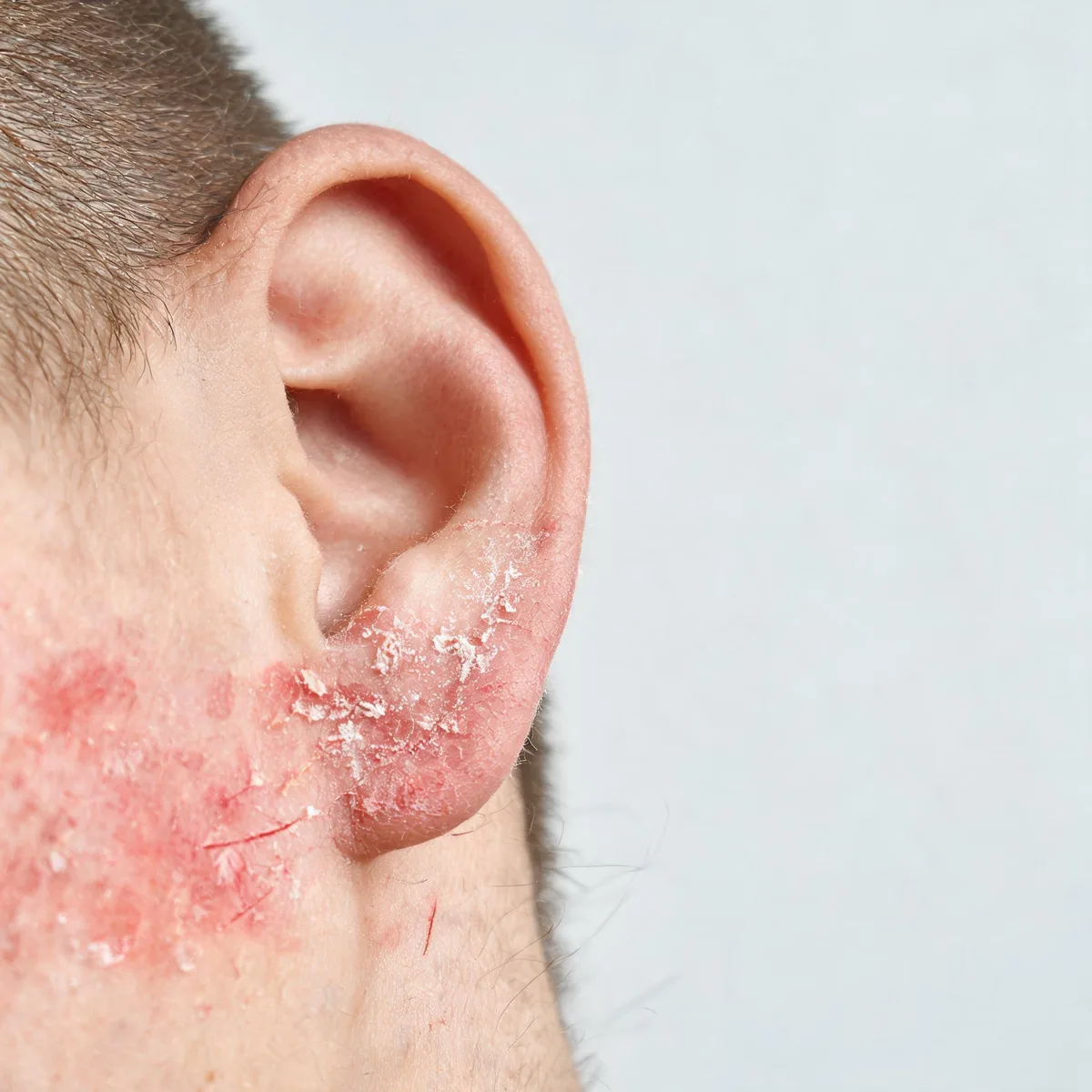
Understanding Itchy ears
The tradition describes the ear as a junction where several channels meet, most importantly the Kidney, Liver and Gallbladder.
The Kidney opens into the ear, and its essence keeps the ear moist and cool. The Liver and Gallbladder channels run through and around the ear. That is why the same itch can come from damp heat in the Gallbladder, from Wind-Heat, from Blood deficiency, or from Kidney Yin deficiency with Empty-Heat.
Liver and Gallbladder damp heat gives ear redness and swelling with yellow sticky discharge or crusting, a bitter taste, irritability and rib-side fullness. Wind-Heat gives sudden ear itch with mild fever, aversion to drafts, a sore red throat and thirst.
Blood deficiency with external wind gives dry scaly skin inside the ear with itch worse at night, dizziness and a pale complexion. Kidney Yin deficiency with Empty-Heat gives itch that worsens at night with dry scaly ear skin, tinnitus and lower back soreness.
What separates the patterns is how the itch feels and what travels with it. A moist, hot, swollen ear that discharges and crusts speaks of Damp-Heat rising along the Gallbladder channel. A dry, flaky, crawling itch with a pale complexion and brittle nails speaks of Blood deficiency and internal Wind. A deep nagging itch with tinnitus, a sore lower back and night sweats speaks of Kidney Yin failing to anchor Yang, so that empty heat drifts upward.
Two channels explain the geography. The Gallbladder channel climbs the side of the neck and loops around the ear, so Damp-Heat held in the Liver or Gallbladder reaches the ear directly. The Kidney is the organ that opens into the ear, so a depletion of Kidney essence shows up as sound or sensation in the ear before it shows anywhere else. That is why the same symptom can be an excess to drain or a deficiency to fill.
Conventional view
Itchy ears are a symptom rather than a diagnosis. The common causes are dry skin, contact dermatitis, eczema, psoriasis and infection of the outer canal, with allergies, too much or too little wax, and habitual cleaning with cotton buds all able to set it off. A doctor inspects the canal with an otoscope and swabs it if infection seems likely.
Treatment is directed at the cause. Keeping the ear dry and avoiding irritants comes first, then steroid or antifungal drops, with antibiotic drops or oral antibiotics when infection is present. An antihistamine helps if allergy is behind it, and simple moisturising drops soothe a dry canal.
The limit of that approach is that it calms the itch without changing why the skin became reactive. Steroid drops thin the skin if used for long, antifungal treatment only works when a fungus is actually there, and the itch often returns once the drops stop because the underlying tendency has not altered.
Examination also matters for safety. Pain, fever, swelling, discharge, hearing loss or dizziness are not itch problems to be managed at home, and they are assessed and treated promptly rather than watched.
Selected PubMed records
Real PubMed records for the conventional discussion above, selected by condition name and title relevance. They are references, not a claim that any treatment is proven for this condition.
- Chronic ear pruritus.. Clinics in dermatology, 2026. PMID: 42214476.
How it is assessed
The practitioner examines the ear canal and skin, and asks about discharge and hearing.
What a practitioner looks for
- Discharge: yellow sticky discharge suggests Liver and Gallbladder damp heat.
- Onset: sudden itch with sore throat suggests Wind-Heat.
- Dryness: dry scaly skin with night itch suggests Blood deficiency or Yin deficiency.
- Red flags: ear pain, fever, swelling or hearing loss need medical review.
The first distinction is between wet and dry. A practitioner asks whether the itch feels hot and moist or dry and scaly, because that single answer separates the excess patterns from the deficient ones. Timing comes next: an itch that builds at night points to deficiency, one that flares after rich food or a stressful week points to Damp-Heat, and one that arrives with a cold points to Wind-Heat.
The ear itself is examined for redness, swelling, discharge and crusting, and the hearing is checked for muffling. Supporting signs are then gathered: a bitter taste, irritability and rib-side fullness for Damp-Heat; dizziness, a pale complexion and brittle nails for Blood deficiency; tinnitus and low back soreness for Kidney Yin deficiency; fever, aversion to drafts and a sore throat for Wind-Heat.
The tongue and pulse confirm what the questions suggest. A thick yellow greasy coat with a wiry slippery rapid pulse supports Damp-Heat. A pale thin tongue with a fine pulse supports Blood deficiency. A red thin dry tongue with little coat and a fine rapid pulse supports Kidney Yin deficiency with empty heat. A thin yellow coat with a floating rapid pulse supports Wind-Heat. Pain, fever, discharge or hearing loss are referred for medical assessment first.
TCM patterns in Itchy ears
Four patterns are described here, and the practical question is always whether the ear is too wet or too dry. Liver and Gallbladder Damp-Heat is the wet excess pattern: the ear is red and swollen, discharge or crusting is present, the taste is bitter and the mood irritable, and rich food or alcohol brings it on. Wind-Heat is the acute exterior pattern, arriving suddenly alongside a sore throat, a mild fever or a dislike of drafts, and clearing quickly once the surface is released. Blood Deficiency with External Wind is the dry deficient pattern, with flaking skin inside the ear, night itch, dizziness and a pale complexion. Kidney Yin Deficiency with Empty-Heat Blazing is dry as well but deeper, with tinnitus, low back soreness and heat that surfaces at night. Mixed pictures are common, especially in a long-standing itch.
| Pattern | Key signs | The itch | Tongue | Main formula |
|---|---|---|---|---|
| Liver and Gallbladder Damp-Heat | Ear redness and swelling; Yellow sticky discharge or crusting | Not specified | Body: Red, with redder sidesCoat: Thick, yellow and greasy | Not specified |
| Blood Deficiency with External Wind | Dry scaly or flaking skin inside the ear; Brittle nails or dry hair | Itching worse at night | Body: Pale and thin, sometimes slightly dryCoat: Thin, white and a little dry | Not specified |
| Kidney Yin Deficiency With Empty-Heat Blazing | Dry scaly skin inside the ear | Itching worse at night | Body: Red, thin and dry, often crackedCoat: Little or none | Not specified |
| Wind-Heat | Sore red throat | Sudden onset of ear itching | Body: Red at the tip and edgesCoat: Thin yellow or white turning yellow | Not specified |
Liver and Gallbladder Damp-Heat
Ear redness and swelling with yellow sticky discharge.
The Gallbladder channel runs up the neck and around the ear, and the Liver channel feeds it, so turbid Damp-Heat in either organ travels that route and settles where the channel lies closest to the surface. Rich food, alcohol and a stretch of frustration or anger produce it, and humid weather adds to the burden. In the ear it shows as redness, swelling and a fierce itch, with a yellow sticky discharge or crusting where the dampness has dried, and the sensation is burning rather than dry.
The tongue is red with redder sides under a thick yellow greasy coat, and the pulse is wiry, slippery and rapid. Greasy fried or spicy food, alcohol, humid days and emotional strain all worsen it, while cooling light food, a dry environment, rest and stress relief ease it. Long Dan Xie Gan Tang is the formula recorded, with Zhi Zi, Long Dan Cao and Huang Qin among its herbs, and the points named are SJ-21 Ermen, SI-19 Tinggong, GB-20 Fengchi and LR-2 Xingjian.
Signs
- Ear redness and swelling
- Yellow sticky discharge or crusting
- Bitter taste in the mouth
- Irritability and restlessness
- Rib-side discomfort or fullness
Diet and lifestyle for this pattern: Avoid greasy, fried, spicy and sugary food as well as alcohol, which all fuel Damp-Heat. Eat more cooling, Dampness-draining vegetables such as cucumber, celery and mung beans, keep the ears dry and avoid cotton swabs that can trap moisture, and manage stress with regular relaxation, since tension worsens Liver stagnation.
Blood Deficiency with External Wind
Dry scaly ear skin with night itch and a pale complexion.
Blood keeps the lining of the ear canal moist and supple, so when it is thin the skin dries out, cracks and begins to flake. Dryness of that kind invites internal Wind, which is felt as a crawling, shifting itch rather than a burning one. The itch is worst at night because Blood returns to the Liver to be stored while the body rests, leaving the surface with even less moisture to draw on.
The tongue is pale and thin with a thin white coat that is slightly dry, and the pulse is fine, wiry at the left middle position and floating at the right front. Wind and dry weather, fried or spicy food, overwork, lost sleep and blood loss all aggravate it, while rest, warm nourishing food and covering the ears against wind help. Si Wu Tang and Xiao Feng San are the formulas recorded, with Dang Gui, Shu Di Huang, Fang Feng and Bai Xian Pi among the herbs, and the points are SP-10 Xuehai, LI-11 Quchi, LR-3 Taichong and SP-6 Sanyinjiao.
Signs
- Dry scaly or flaking skin inside the ear
- Itching worse at night
- Dizziness or light-headedness
- Pale complexion and lips
- Brittle nails or dry hair
Diet and lifestyle for this pattern: Eat blood-nourishing food such as red dates, dark leafy greens, eggs and small amounts of liver, and avoid spicy, fried and very drying food that consumes Blood. Protect the ears from wind and cold with a scarf or hat, and keep a regular sleep schedule to support Blood regeneration.
Kidney Yin Deficiency With Empty-Heat Blazing
Night itch with tinnitus and low back soreness.
Because the Kidney is the organ that opens into the ear, Kidney Yin is what keeps that organ cool and quiet. Overwork, late nights, ageing and long stress draw Yin down, and with too little fluid to hold Yang in place, the Yang drifts upward as empty heat. It dries the canal as it passes, which is why the itch is deep and nagging rather than sharp, and why it is worst at night when Yin should be at its fullest.
The tongue is red, thin and dry with little or no coat and sometimes cracks, and the pulse is fine and rapid. Late nights, overwork, greasy fried or spicy food and emotional strain make it worse, while a cool well-ventilated room, sleep, rest and moistening food such as pear and black sesame help. Zhi Bai Di Huang Wan is the formula recorded, with Shu Di Huang, Zhi Mu and Huang Bo among its herbs, and the points are KI-3 Taixi, KI-7 Fuliu, BL-23 Shenshu and SJ-21 Ermen.
Signs
- Itching worse at night
- Dry scaly skin inside the ear
- Tinnitus and lower back soreness
- Irritability and restlessness
Diet and lifestyle for this pattern: Protect sleep and avoid late nights, when Yin rebuilds. Eat moistening, cooling food such as pear, black sesame, walnuts, tofu and millet, cut out spicy, fried and overly stimulating food, and keep exercise gentle such as walking or tai chi so Qi flows without burning Yin.
Wind-Heat
Sudden ear itch with sore throat and mild fever.
Wind-Heat is an invader from outside that enters through the nose, mouth or skin, often during a cold or flu, and travels up the channels to the ear because channels link that organ to the surface of the body. The result is a local reaction that is sudden and sharp. Defensive Qi is still fighting at the surface at this stage, which is why a mild fever, a dislike of drafts and a sore throat so often accompany the itch.
The tongue shows redness at the tip and edges under a thin yellow coating, and the pulse floats and runs fast. More wind and more drafts help it go deeper, and spicy or greasy food adds internal Heat on top of the external kind, while rest, a calm room, cooling drinks such as peppermint tea and light food let the body push it back out. Yin Qiao San and Xiao Feng San are the formulas recorded, with Jin Yin Hua and Chan Tui among the herbs, and the points are GB-20 Fengchi and SJ-5 Waiguan.
Signs
- Sudden onset of ear itching
- Mild fever or aversion to drafts
- Sore red throat
- Thirst
Diet and lifestyle for this pattern: Stay hydrated with plenty of warm water or peppermint tea to help the body expel the pathogen, and avoid spicy, greasy and deep-fried food that creates internal Heat and can worsen the itching. Rest well to support defensive Qi against the invasion.
Treatment approach
How the tradition treats itchy ears, with the herbs, formulas and points used for it.
Principles
- Exclude infection first: pain, fever, discharge or hearing loss need medical review.
- Clear Liver and Gallbladder damp heat where there is discharge and swelling.
- Dispel Wind-Heat in the sudden itchy pattern.
- Nourish Blood and Kidney Yin where the ear skin is dry and itchy at night.
- Every pattern here is treated with the aim of stopping the itch, but what is done to achieve it depends on the root. Where there is discharge and swelling, the work is to clear Heat and drain Dampness from the Liver and Gallbladder. Where the canal is dry, the work is to nourish Blood or Yin and moisten what has dried, so that Wind has nothing to stir. Where the ear is being invaded, the work is to open the surface and clear the Heat. Points are chosen both near the ear and on the limbs, and the near points are used lightly so that a tender canal is not made more sore.
Herbs used
Formulas
- Long Dan Xie Gan Tang
- Si Wu Tang
- Xiao Feng San
- Zhi Bai Di Huang Wan
- Yin Qiao San
Acupoints
- SJ-21 (Ermen)
- SI-19 (Tinggong)
- GB-20 (Fengchi)
- LR-2 (Xingjian)
- SP-10 (Xuehai)
- LI-11 (Quchi)
- LR-3 (Taichong)
- SP-6 (Sanyinjiao)
- KI-3 (Taixi)
- KI-7 (Fuliu)
- BL-23 (Shenshu)
- SJ-5 (Waiguan)
What to expect
- Wind and damp patterns are described as settling within one to two weeks.
- Deficiency patterns take longer, with gradual improvement over weeks.
- Ear canal infection needs medical treatment rather than herbs alone.
- Most people notice the itch easing within the first couple of weeks, with the skin settling after that. Damp-Heat and Wind-Heat tend to move faster than deficiency, and the dry patterns often need two to three months of steady treatment before the ear canal stops flaking. Setbacks usually follow a clear trigger such as a late night, a stressful fortnight or a return to old food habits, and they are easier to correct when the trigger is known. Ear pain, fever, discharge or hearing loss belong with a doctor rather than a herbalist.
Safety and when to get help
Seek medical help urgently for
- Ear itching with severe pain, fever or swelling.
- Sudden hearing loss or muffled hearing.
- Discharge of pus or blood from the ear.
For anything severe, sudden or spreading quickly, read when a skin problem needs urgent care.
Cautions
- Do not insert objects or cotton buds into the ear canal.
- Avoid dropping oils or herbs into the ear without medical advice.
- Persistent itch should be examined to exclude fungal infection.
Using this alongside conventional care
- TCM is described as complementary to conventional care: prescribed ear drops or antibiotics where indicated continue alongside internal herbs.
- Herbal treatment is compatible with conventional ear care, but the timing needs thought. If medicated drops are prescribed, space them several hours away from any herbal wash or acupuncture session so that neither is diluted or displaced. Tell the practitioner about every drop and tablet in use, including steroid and antifungal preparations, because some herbs influence inflammation pathways. Anything prescribed for the liver or kidneys deserves particular care, and no prescription should be stopped without the prescribing doctor's agreement.
Diet and lifestyle
- Avoid greasy, fried and spicy food, alcohol and excess sugar, and favour cooling light food.
- The general rule is to remove what makes Dampness and Heat, namely greasy, fried and spicy food, alcohol and a lot of sugar, and to favour light cooling food such as cucumber, celery, pear and mung beans. Where the ear is dry and flaky, add moistening food instead, including black sesame, walnuts, pear and dark leafy greens, since the aim there is to rebuild rather than to drain. Water is helpful but iced drinks are not, because they slow digestion and make Dampness more likely. Short, consistent changes are easier to keep than a strict regime.
If you're pregnant
The Damp-Heat pattern needs care in pregnancy. Long Dan Xie Gan Tang depends on bitter, cold and blood-moving ingredients, Zhi Zi, Long Dan Cao and Huang Qin among them, all of which are generally avoided while a baby is expected, so dietary change and acupuncture are the safer first line.
Points such as LR-2 Xingjian and SJ-21 Ermen can be used for the heat and the itch, and cooling food supports them. Si Wu Tang is often appropriate where Blood is the issue, though Dang Gui needs watching by a practitioner used to pregnancy care. For Kidney Yin deficiency, gentle nourishing food with acupuncture at KI-3 Taixi and KI-7 Fuliu is preferred, and the strongly cooling herbs of Zhi Bo Di Huang Wan are held back unless a specialist judges otherwise.
If you're breastfeeding
Bitter, cold herbs that clear Damp-Heat, Long Dan Cao and Huang Qin among them, can reach a baby through milk and may loosen the stools or unsettle the stomach, so a Damp-Heat pattern is managed with diet and acupuncture rather than with a strong formula.
Blood-nourishing formulas such as Si Wu Tang are generally considered suitable while feeding, though Dang Gui may subtly affect milk supply in some women and is worth watching. Kidney Yin deficiency responds well to food therapy with black sesame and pear and to acupuncture at KI-3 Taixi, with heavier herbal work left to a specialist.
If treating a child
In children the itch most often comes from Wind-Heat or from food-related Damp-Heat, because the digestive system is still maturing and exterior pathogens are met more easily. Mild dispersing herbs such as Jin Yin Hua and Chan Tui are used at a third to a half of the adult dose.
Points such as GB-20 Fengchi and SJ-5 Waiguan are stimulated gently, and acupressure replaces needles in the very young. Formulas that are bitter and cold, and that would injure a Spleen still developing, are avoided, while cutting back on greasy and sweet food carries much of the recovery at this age.
If treating an elderly patient
Deficiency patterns dominate in older people, with Kidney Yin deficiency and Blood deficiency the usual roots of a long-standing itch. Treatment is gentle and nourishing and doses are reduced to around two-thirds of the adult amount, so that a weaker digestion is not overloaded.
Si Wu Tang and Zhi Bo Di Huang Wan both suit this age, used with tolerance reviewed as treatment goes on. Moxibustion with acupuncture at KI-3 Taixi and BL-23 Shenshu supports Yin and Yang gently, and the medication list is reviewed carefully because interactions are commoner at this age.
Urgent-sign guidance is based on standard sources: NHS anaphylaxis, NHS cellulitis, NHS Stevens-Johnson syndrome, NHS melanoma.
Evidence
Evidence status
Compiled for this page from the classical and modern literature; not a systematic review, so treat it as a pointer to sources rather than clinical guidance.
High-quality evidence specifically for itchy ears is limited; most data are small case series and Chinese-language reports. Acupuncture has shown promise for pruritus generally, and Long Dan Xie Gan Tang and Xiao Feng San have been studied for itchy skin conditions, but ear-specific outcomes are rarely reported. What exists suggests reduced itch intensity and frequency by addressing the underlying pattern, without rigorous placebo-controlled support.
What exists is largely observational. Reports come from small case series and from Chinese-language sources rather than from large randomised trials, and outcomes measured specifically in the ear are almost never published. Acupuncture has shown promise for itch generally, and formulas including Xiao Feng San and Long Dan Xie Gan Tang have been examined in itchy skin disease, which makes the approach plausible without proving it. The fair reading is that treatment can reduce how often and how severely the ear itches, while the support remains classical and clinical rather than trial-based.
Studies often cited
Studied for various itchy skin conditions with some benefit, but ear-specific outcomes are rarely reported. Clinical studies and case series (as recorded in the source)
Shown promise for itch in general, without ear-specific trials. Clinical literature (as recorded in the source)
Classical record
Kidney deficiency leads to tinnitus and ear itching.
- Yi Zong Jin Jian (Golden Mirror of Medicine), volume on ear diseases. The Chinese original is not reproduced here: it could not be recovered reliably from the source record, and is not guessed.
Common questions
Why do my ears itch?
The tradition describes damp heat in the Gallbladder, Wind-Heat, or Blood and Yin deficiency. Conventional causes include eczema and fungal infection.
Can I put oil in my ear?
Not without medical advice, especially if there is discharge or hearing change.
When should I see a doctor?
Ear pain, fever, swelling, discharge or hearing loss.
Is itching a sign of kidney problems?
No. Kidney Yin deficiency is a pattern description, not kidney disease.
Why is the itch worse at night?
Night-time itch usually points to a deficient pattern. Blood and Yin are quieter at night, so a canal that is already short of moisture becomes drier and more irritable, and a Kidney Yin pattern in particular surfaces when the body's cooling resources are at their lowest. A pattern that is worse at night is treated by nourishing rather than by draining.
How long do the herbs take to work?
Most people notice the itch easing within the first two weeks of the right formula. Acute excess patterns can settle inside a month, while deep deficiency patterns often need two to three months, because the herbs are rebuilding Blood or Yin rather than suppressing a sensation. Steady daily taking matters more than a large dose.
Is it safe to use herbs with ear drops?
Generally yes, with coordination. Herbal formulas are swallowed and work internally, while drops act locally, so the two do not usually compete. Applying them at different times of day avoids any interference, and telling the practitioner about every drop, including steroid and antifungal ones, allows herbs that will not conflict to be chosen.