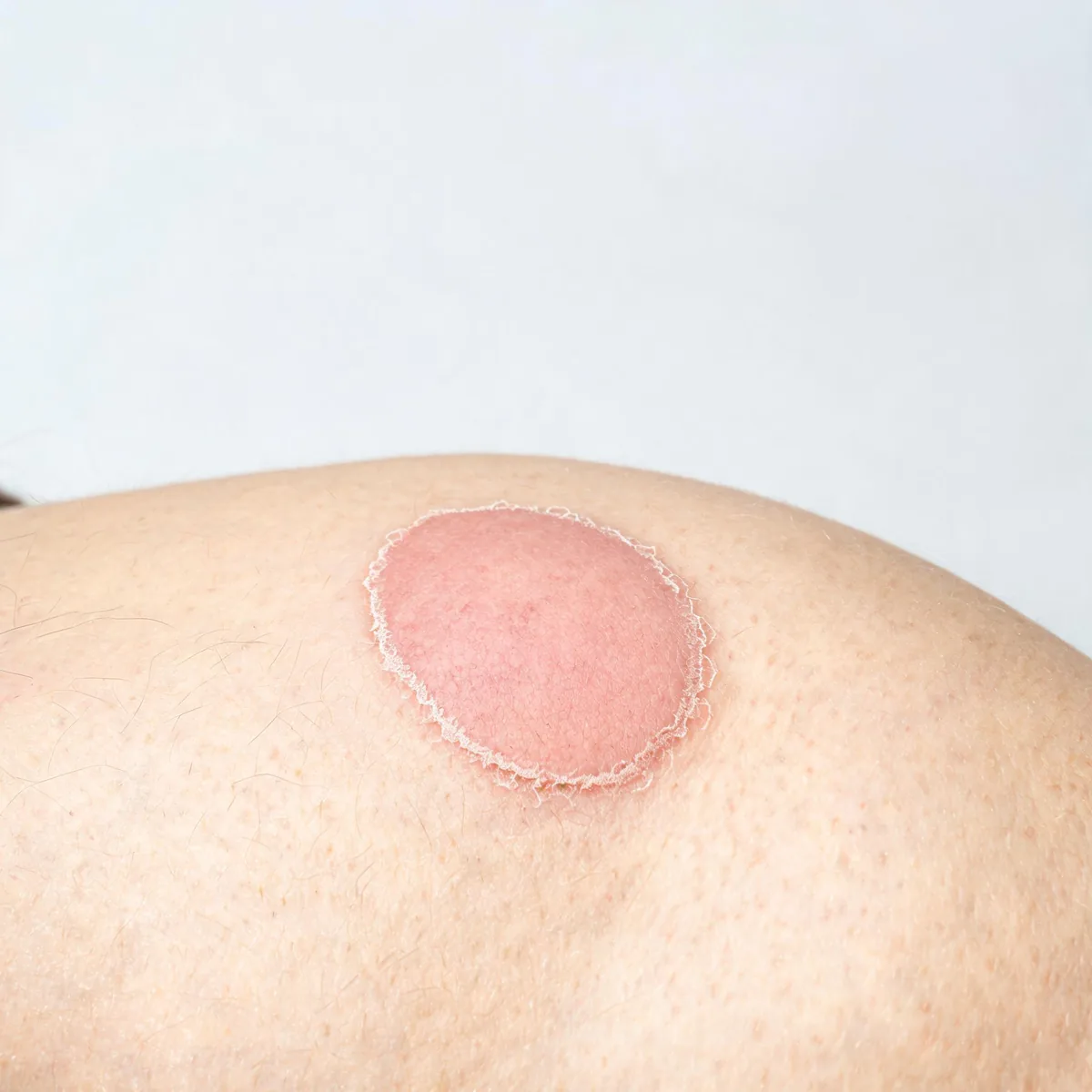
Understanding Pityriasis rosea
The tradition describes the rash through the Lungs which govern skin and hair, the Spleen which transforms fluids, and the Blood which nourishes the skin.
Wind-Heat invading the Lungs gives sudden oval rose-red patches with fine scales, skin that feels warm, mild itching, a scratchy throat or dry cough and mild fever. That is the acute pattern.
Damp-Heat gives oval patches with greasy scales, a heavy sluggish body, a sticky taste, poor appetite and loose sticky stools. The scaling texture is the distinguishing feature: greasy rather than fine.
Blood deficiency with external wind gives itch worse at night, pale dry scaly patches with scant scaling, a rash that appears and disappears, a pale complexion and an aversion to drafts. That is the pattern behind a rash that lingers and recurs.
The skin is read as an outward sign of what the Lungs, Spleen and Blood are doing. The Lungs are said to govern skin and hair, so a pathogen arriving at the exterior can surface as a rash; the Spleen transforms fluids, and when it falters the resulting Dampness combines with Heat; Blood moistens the skin, and when it is thin the surface dries and Wind finds a way in.
Pityriasis rosea is therefore never treated as one disease with one remedy. The stage of the eruption points to the pattern: a sudden bright crop of oval patches favours Wind-Heat, greasy scaling with heaviness favours Damp-Heat, and a pale lingering rash with night itch favours Blood deficiency. Naming the pattern is what allows a formula to be chosen, and the pattern can shift as the weeks pass.
Conventional view
Pityriasis rosea is a common eruption that usually announces itself with one larger patch, the herald patch, on the trunk. A week or two later a crop of smaller oval patches follows, often along the ribs and across the back in the pattern that gives it the Christmas tree name. The rash is usually only mildly itchy and clears without scarring.
No cause has been identified, although a virus is suspected, and it is regarded as benign and self-resolving. The usual course is six to eight weeks, and the main work of the consultation is to recognise it and to rule out other eruptions. A rash that reaches the palms and soles, or one that will not settle, is investigated for other diagnoses.
Treatment is aimed at comfort: an antihistamine for itch, a topical corticosteroid for inflamed patches, and emollients for dryness. A short course of oral steroid or ultraviolet therapy is reserved for severe cases. Patients are generally reassured that the rash will fade, though brown or pale marks can persist for a while afterwards.
What conventional care does not offer is an explanation for why one person clears quickly and another lingers or recurs. The wait-and-see approach can be frustrating when the itch is severe or the rash sits on visible skin, and steroids carry their own side effects. That gap is where a pattern-based approach is most often sought.
Selected PubMed records
Real PubMed records for the conventional discussion above, selected by condition name and title relevance. They are references, not a claim that any treatment is proven for this condition.
- Pityriasis Rosea: An Updated Review.. Current pediatric reviews, 2021. PMID: 32964824.
How it connects
Pityriasis rosea and atopic dermatitis often arise from the same underlying imbalances in TCM, particularly Damp-Heat and Wind-Heat lodged in the skin. The Lung governs the skin and hair, so when external Wind-Heat invades the Lung channel it can show as an acute scaly rash in one person and a flare of eczema in another, and treating the root pattern of Damp-Heat or Wind-Heat often calms both at the same time. In chronic or recurrent cases Blood deficiency may be the deeper root, leaving the skin undernourished and vulnerable to Wind, which makes a person prone to both pityriasis rosea and atopic dermatitis, seen in TCM not as separate diseases but as expressions of the same terrain. Nourishing Blood and dispelling Wind can improve the skin's resilience overall.
How it is assessed
The practitioner examines the scale, the distribution and the timing.
What a practitioner looks for
- Scale: fine scaling suggests Wind-Heat; greasy scaling suggests Damp-Heat; scant scaling with dry pale patches suggests Blood deficiency.
- Itch: mild itching fits Wind-Heat; itch worse at night fits Blood deficiency.
- Preceding illness: a recent cold or sore throat supports Wind-Heat.
- Red flags: blistering, pus, fever, or a rash that is painful rather than itchy.
The consultation starts with the story of the rash. How it began, whether one large patch came first, how quickly the crop followed and whether anything preceded it such as a sore throat all narrow the field before the skin is examined closely. The practitioner then looks at colour, shape and the texture of the scale, and asks about itch, thirst and sleep.
Scale texture is the most useful discriminator. Fine, dry scaling on warm rose-red oval patches fits Wind-Heat moving through the Lung system. Greasy scaling, a heavy body, a sticky taste and loose stools fit Damp-Heat. Patches that are pale with very little scale, an itch that wakes the person at night and a history of recurrence fit Blood deficiency with external Wind.
Tongue and pulse then confirm it. Wind-Heat shows a slightly red body with a redder tip under a thin yellow coating, and a pulse that floats and runs fast. Damp-Heat shows a red body with a greasy yellow coat and a pulse that is slippery and quick. Deficiency shows a pale thin tongue with a fine pulse. A rash that is painful or blistered rather than itchy is not this picture and is referred for medical review.
TCM patterns in Pityriasis rosea
Three patterns account for most presentations, and the differences between them are practical rather than academic. Wind-Heat invading the Lungs is the pattern of the early days: the eruption arrives suddenly, the patches feel warm, the scale is fine, and a sore throat or a mild fever is often in the background. Damp-Heat is slower and heavier, with greasy scaling, a muzzy head, a sticky taste in the mouth and loose stools; Heat makes it redder and itchier, Dampness makes it paler and more stubborn. Blood Deficiency with External Wind is the pattern of a rash that lingers or keeps returning, where the patches are pale, the scale is scanty and the itch is worst at night. The same rash can move between the three, so the pattern is reassessed as treatment goes on.
| Pattern | Key signs | The itch | Tongue | Main formula |
|---|---|---|---|---|
| Wind-Heat invading the Lungs | Sudden oval rose-red patches with fine scales; Scratchy throat or dry cough | Skin feels warm with mild itching | Body: Slightly red, with a red tipCoat: Thin yellow | Not specified |
| Damp-Heat | Oval patches with greasy scales | Not specified | Body: Red, often swollen with teeth marksCoat: Yellow, greasy and thick, usually in the middle and at the root | Not specified |
| Blood Deficiency with External Wind | Pale dry scaly patches with scant scaling; Rash appears and disappears suddenly | Itching worse at night | Body: Pale and thin, sometimes slightly dryCoat: Thin, white and a little dry | Not specified |
Wind-Heat invading the Lungs
Sudden oval rose-red patches with fine scales and a mild fever.
Wind-Heat arrives from outside and meets defensive Qi at the body's surface, so the first patches appear abruptly and feel warm to the touch. The Lungs are the organ that governs skin and hair, and their failure to diffuse Qi explains the scratchy throat or light cough and the mild fever with a slight chill. Heat dries the surface, which is where the fine scaling comes from, and the itch stays mild in this pattern.
The tongue is slightly red with a redder tip under a thin yellow coating, and the pulse floats and accelerates. Spicy food, alcohol, hot showers, sweating and exposure to wind all make it worse, while a cool room, light clothing, rest and plenty of water settle it, and chrysanthemum tea is the usual home measure. The formula recorded for this presentation is Di Huang Yin Zi, with Bai Xian Pi, Di Fu Zi and Ku Shen among its herbs. Points named are GB-20 Fengchi, LI-4 Hegu, BL-13 Feishu, LI-11 Quchi and SP-10 Xuehai.
Signs
- Sudden oval rose-red patches with fine scales
- Skin feels warm with mild itching
- Scratchy throat or dry cough
- Mild fever with slight chills
Diet and lifestyle for this pattern: Avoid spicy, greasy and fried food that generates Heat. Eat cooling food such as mung beans, cucumber and chrysanthemum tea, keep the skin cool and dry, avoid hot showers, and rest well to support defensive Qi.
Damp-Heat
Oval patches with greasy scales and a heavy body.
Damp-Heat arises when fluids are not transformed properly, which usually means a Spleen that is not coping, sometimes helped along by a hot humid climate. The turbid mixture clogs the pores and slows the movement of Qi and Blood, so the eruption takes the form of oval patches with a greasy scale. Heat and Dampness pull the picture in different directions: Heat reddens and itches, Dampness pales and weighs down, yet the greasy scaling and the heaviness stay constant.
The tongue is red with a yellow greasy coat, sometimes swollen with teeth marks, and the pulse is soggy and rapid or slippery and rapid. Hot humid weather, greasy spicy or sweet food, stress and a sedentary routine all aggravate it, while cool dry weather, a plain diet, gentle movement and rest ease it. Xiao Feng San is the formula recorded, with Ku Shen, Bai Xian Pi and Tu Fu Ling among its herbs, and the points named are LI-4 Hegu, SP-10 Xuehai, SP-9 Yinlingquan and SP-6 Sanyinjiao.
Signs
- Oval patches with greasy scales
- Body heavy and sluggish
- Sticky or greasy taste
- Poor appetite with loose sticky stools
Diet and lifestyle for this pattern: Avoid greasy, fried, sweet and dairy-heavy food that creates Dampness and Heat. Favour light, easy meals such as congee, steamed vegetables and barley water, stay in a cool dry environment, and walk gently each day to keep Qi flowing.
Blood Deficiency with External Wind
Pale dry patches with night itch and a wandering rash.
When Blood is thin the skin loses its nourishment and becomes dry, flaky and easy for Wind to enter. That is why the patches are pale with only a little scale, and why the rash can seem to come and go: Wind moves, so the eruption moves with it. Itching is worse at night, when Blood returns inward to the Liver and the surface is left even less supplied, and this is the pattern most often seen in a case that drags on or returns.
The tongue is pale and thin with a thin white coat that is slightly dry, and the pulse is fine, sometimes wiry on the left guan and floating on the right cun. Dry cold wind, overwork, lost sleep, spicy or drying food and stress all make it worse, while rest, warmth, a blood-nourishing diet, gentle moisturising and shelter from wind help. Si Wu Xiao Feng Tang is the formula recorded, with Dang Gui, Bai Shao, He Shou Wu, Jing Jie and Fang Feng among its herbs, and the points named are SP-10 Xuehai, SP-6 Sanyinjiao, LI-11 Quchi and LI-4 Hegu.
Signs
- Itching worse at night
- Pale dry scaly patches with scant scaling
- Rash appears and disappears suddenly
- Aversion to wind and drafts
- Pale complexion
Diet and lifestyle for this pattern: Eat blood-nourishing food such as dark leafy greens, black sesame, goji berries, eggs and lean meat, and avoid spicy, greasy and very dry food that can deplete Blood. Protect the skin from wind and cold, moisturise gently, and keep exercise gentle such as walking or tai chi so circulation improves without overexertion.
Treatment approach
How the tradition treats pityriasis rosea, with the herbs, formulas and points used for it.
Principles
- Dispel Wind-Heat where the rash is new, warm and finely scaling.
- Drain dampness where scaling is greasy and the body feels heavy.
- Nourish Blood where the rash is pale, dry and lingering.
- Treat itch and reassure, since the condition is described as self-limiting in both frameworks.
- The strategy differs with the stage, and the formula follows the stage rather than the diagnosis. An acute eruption is treated by dispersing Wind and clearing Heat so that the pathogen is pushed out, which is why wind-dispelling herbs feature early. A greasy lingering rash is treated by drying Dampness and cooling Blood, and a pale recurrent one by nourishing Blood and settling Wind. Because the same rash can change pattern within weeks, the formula is reviewed as it evolves rather than continued on principle.
Herbs used
Formulas
Acupoints
- GB-20 (Fengchi)
- LI-4 (Hegu)
- BL-13 (Feishu)
- LI-11 (Quchi)
- SP-10 (Xuehai)
- SP-9 (Yinlingquan)
- SP-6 (Sanyinjiao)
What to expect
- Pityriasis rosea usually resolves over a few weeks to a few months.
- The tradition describes the rash settling sooner with pattern treatment.
- Recurrence is uncommon but possible.
- Most courses begin with weekly or twice-weekly acupuncture and a daily herbal formula, and the itch usually settles before the rash does. Wind-Heat cases can fade within one to two weeks, Damp-Heat commonly takes three to four because dampness is slow to shift, and Blood deficiency cases often need four to eight weeks before the skin looks properly nourished. The rash is self-limiting in conventional terms as well, so the honest measure of success is a calmer, faster, less itchy course rather than a guaranteed shortcut.
Safety and when to get help
Seek medical help urgently for
- Rash that becomes painful, blistered or pus-filled - possible secondary bacterial infection.
- Fever above 38 C.
- A rapidly spreading rash with systemic illness.
For anything severe, sudden or spreading quickly, read when a skin problem needs urgent care.
Cautions
- Persistent or atypical rashes need dermatological review.
- Do not apply strong topical steroids without advice.
- Pregnancy requires practitioner review before internal herbs.
Using this alongside conventional care
- TCM is described as complementary to conventional care: emollients and prescribed topical treatment continue alongside herbs.
- Herbs and acupuncture are commonly used alongside antihistamines and a topical steroid, and there is no reason to stop either when the internal treatment begins. Coordination still matters, since some herbs can interact with systemic medication, so both prescribers should have the full list. If ultraviolet therapy is being used, keep herbal oils and plasters off the treated areas unless the supervising doctor agrees.
Diet and lifestyle
- Avoid spicy, greasy and fried food, alcohol and excess sugar while the rash is active.
- Food is a supporting measure rather than the treatment. Anything that generates Heat, meaning spicy, fried, greasy and sugary food along with alcohol, tends to intensify the redness and itch, and a hot humid spell will do the same from outside. Cooling bland food such as cucumber, mung beans and leafy greens suits the acute patterns, while a blood-nourishing diet of dark greens, sesame, goji berries and modest amounts of lean protein suits the dry lingering one. Shellfish and any personal allergen are worth avoiding while the rash is active.
If you're pregnant
Pregnancy tends to bring out the Blood deficiency side of this rash, since the growing fetus draws on the mother's Blood and the skin is left undernourished. That shapes both the pattern reading and the choice of herbs, and the pregnancy is treated as the first consideration rather than as an afterthought.
Herbs that strongly move Blood are avoided, which rules out Tao Ren, Hong Hua and Dan Shen. Gentler wind-dispelling herbs such as Jing Jie and Fang Feng, with small amounts of Dang Gui and Bai Shao to nourish Blood, are the usual substitutes, and only under a practitioner experienced in pregnancy care. Acupuncture at LI-11 Quchi and, cautiously and without strong stimulation, LI-4 Hegu can help with the itch and the heat.
If you're breastfeeding
The concern here is what reaches the infant through milk. The bitter, cold herbs that drain Damp-Heat, Long Dan Cao and Huang Qin among them, can reach a baby and may loosen the stools or unsettle the stomach, so they are not the first choice while feeding.
Milder surface-relieving herbs, including Chan Tui, Jing Jie and Fang Feng, are preferred, with blood-nourishing herbs added if the pattern is a deficient one. Acupuncture carries no risk to the baby and is often the main treatment. A topical wash of Ku Shen and Bai Xian Pi is another option, since nothing is swallowed.
If treating a child
This is a rash of childhood and early adulthood, and the Wind-Heat pattern is the commonest form, often following a cold or a sore throat. A child may not describe itching well, so watch for scratching, irritability and broken sleep, which tell you as much as the appearance of the patches.
Doses are reduced by age and weight, usually to somewhere between a half and two-thirds of what an adult would take, and a formula such as Xiao Feng San is adjusted by using less of the pungent herbs and none of the harshest bitters. Needling is shallow or replaced by acupressure, with points such as BL-13 Feishu and LI-11 Quchi stimulated gently.
If treating an elderly patient
The rash is uncommon at this age, and when it appears the Blood deficiency picture tends to dominate: the skin is dry, the patches are pale and the itch is often mild. Treatment is nourishing and gentle rather than dispersing, since the reserve of Qi and Blood is smaller and strong dispersing herbs would cost more than they give.
Si Wu Xiao Feng Tang at about two-thirds of the adult dose is the usual starting point, and the response is reviewed for tolerance. Older patients often take several medicines, so interactions are checked before anything is added. Acupuncture with mild stimulation is well tolerated and helps both the itch and the healing of the skin.
Urgent-sign guidance is based on standard sources: NHS anaphylaxis, NHS cellulitis, NHS Stevens-Johnson syndrome, NHS melanoma.
Evidence
Evidence status
Compiled for this page from the classical and modern literature; not a systematic review, so treat it as a pointer to sources rather than clinical guidance.
Evidence is limited to small uncontrolled Chinese series and case reports. Studies often report high effective rates above 80 percent with formulas such as Xiao Feng San and Di Huang Yin Zi, but the absence of control groups, randomisation and blinding makes firm conclusions impossible. No large randomised trials appear in English-language journals, and acupuncture for the associated itch is described only anecdotally.
The published base is thin and mostly Chinese-language. Case series report clearance rates above eighty per cent for formulas such as Di Huang Yin Zi and Xiao Feng San, but without a control arm, randomisation or blinding such figures cannot be separated from the natural course of an eruption that fades by itself inside six to eight weeks. No large randomised trial has appeared in an English-language journal, and acupuncture has been described as helpful for the itch without formal trials behind it. Recommendations therefore rest on classical theory and clinical experience, and should be read that way.
Studies often cited
Uncontrolled series report effective rates above 80 percent, without controls, randomisation or blinding. Clinical series and case reports (as recorded in the source)
Anecdotal benefit only; formal trials are absent. Anecdotal (as recorded in the source)
PubMed records for the TCM evidence
Real PubMed records for the TCM clinical evidence discussed above, selected by condition name and title relevance. They are references, not proof of benefit.
- Efficacy and Safety of Indigo Naturalis in Combination with Narrow-Band Ultraviolet B for Treatment of Pityriasis Rosea: A Meta-Analysis.. Evidence-based complementary and alternative medicine : eCAM, 2018. PMID: 29770152.
- Causal relationship between trace elements and pityriasis rosea: A Mendelian randomization analysis.. Medicine, 2026. PMID: 42700032.
Common questions
How long does pityriasis rosea last?
Usually weeks to a few months; it is described as self-limiting in both frameworks.
Is it contagious?
Conventional medicine does not treat it as readily contagious, though a viral trigger is suspected.
Can herbs speed it up?
The tradition describes clearing Wind-Heat or dampness with faster settling, but the condition resolves on its own.
When should I see a doctor?
If the rash becomes painful, blistered, pus-filled, or is accompanied by fever.
Can I use herbs alongside steroid cream?
Yes, and the two are usually used together at the start. The cream settles the visible rash while the formula works on the pattern, and the cream is then reduced gradually as the skin clears. Tell both your doctor and your practitioner what you are using, and do not stop a prescribed steroid suddenly.
Will the rash come back after treatment?
It can, though treating the pattern is intended to make that less likely. If you are constitutionally damp or blood deficient, a stretch of poor food, stress or a change of season can provoke another episode. Your practitioner can usually identify the specific trigger once the first course is complete, which makes a recurrence easier to head off.
Does acupuncture hurt on inflamed skin?
Rarely. The needles are far finer than an injection needle and are placed on the limbs and trunk rather than in the rash itself, so even tender skin is usually left alone. Most people notice a small pinch at insertion and then a heaviness or ache, and many fall asleep during the session.