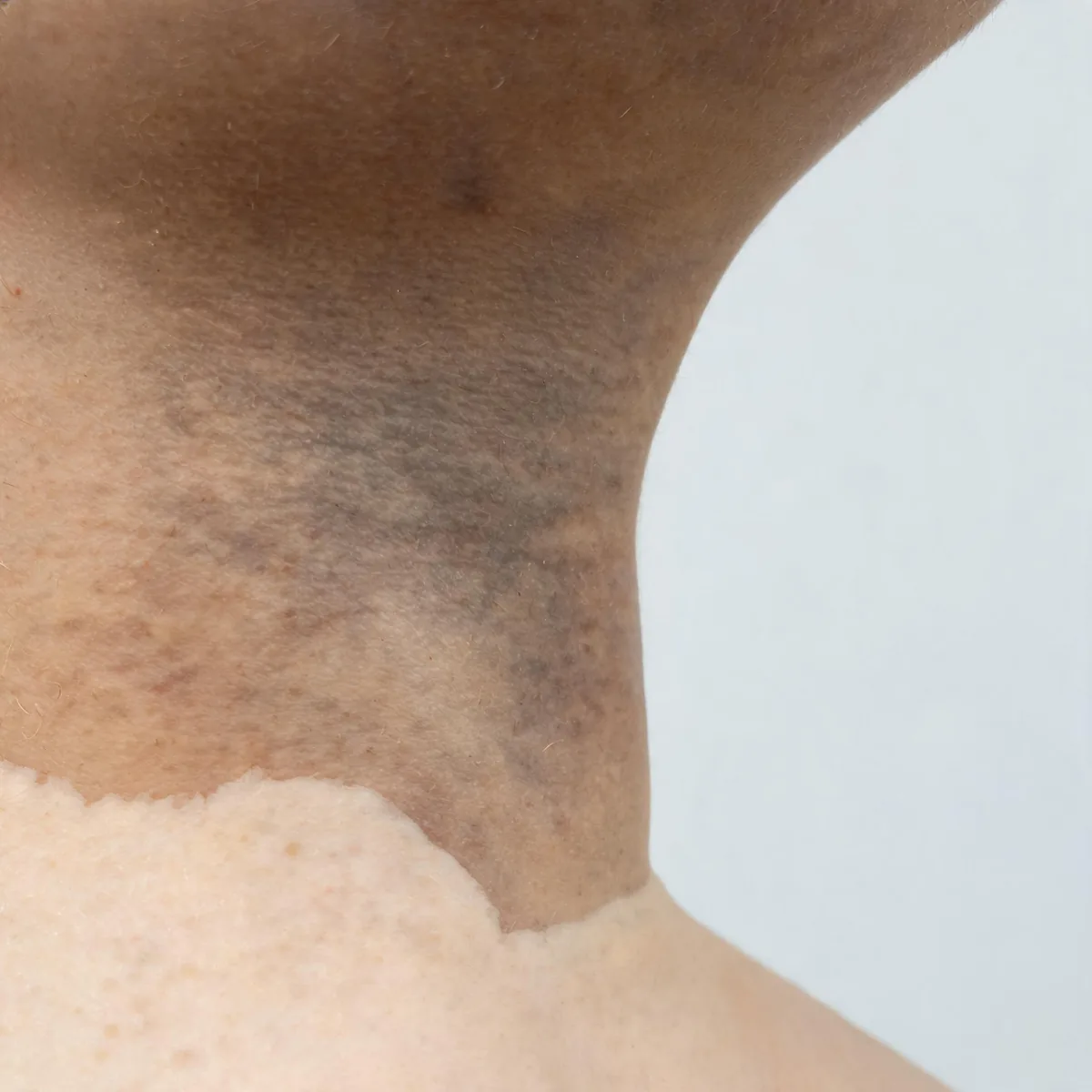
Understanding Dark skin
The tradition describes a bright complexion as depending on abundant Qi and Blood reaching the surface, produced by the Spleen and warmed by Kidney and Heart Yang.
When Blood is stagnant in the Liver, the complexion becomes dull and shadowy, with fixed stabbing rib or abdominal pain, dark menstrual blood with clots and dark lips and nails. Qi and Blood stagnation gives a similar dark purplish complexion with distending chest pain and irritability.
Spleen deficiency with dampness gives a dull sallow darkened complexion with heaviness, bloating, loose stools and poor appetite. Kidney Yang deficiency gives coldness all over, worse in the lower body, with a dark dull complexion, cold aching lower back and night urination.
Heart Yang deficiency gives a bright pale face with a dark or ashen undertone, palpitations worse on exertion, cold hands and feet and chest stuffiness. The classical literature treats that as a circulation pattern, not a cosmetic one.
In this framework the face reflects what is happening inside. A clear, lively colour needs plenty of Qi and Blood arriving at the surface, which depends on the Spleen's ability to make them and on the warming action of Kidney and Heart Yang. If any part of that arrangement falters, the face loses its lustre and takes on a shadowy cast. The Liver adds a further dimension, because it stores Blood and is responsible for keeping Qi in smooth motion, so emotional strain, frustration or a sedentary routine can check the flow, and over time the Blood congeals into a purplish darkness.
Spleen weakness produces a different look: turbid Dampness collects and drifts upwards, settling over the face like fog, so the colour turns muddy, sallow and greasy rather than bruised. Yang deficiency behaves differently again. Kidney Yang is described as the body's pilot light, and when it dims, cold narrows and congeals the vessels, leaving the face ashen, most obviously around the eyes. Weakness of Heart Yang slows circulation in much the same way, and the complexion turns pale with a duskier or bluish undertone. Because these roots are unlike one another, each calls for its own strategy rather than a general brightening approach.
Conventional view
Dermatology usually frames a dark or dull complexion as hyperpigmentation, in which melanin is laid down unevenly in the skin. Sun exposure is the commonest driver, along with hormonal change such as melasma in pregnancy or on hormonal contraception, inflammation left behind by acne or injury, and the slower cell turnover of age. Assessment is by inspection, sometimes with a Wood's lamp or dermatoscopy.
Standard treatment aims at the pigment. Topical agents include azelaic acid, kojic acid, vitamin C, retinoids and hydroquinone, used to lighten patches and even the tone, chemical peels, microdermabrasion and lasers remove surface pigment, and strict sun protection is essential if the result is to last. Oral tranexamic acid is sometimes prescribed for stubborn melasma.
The limitation is that these approaches work on the surface of the problem. Lighteners can irritate or cause rebound darkening, lasers carry a risk of post-inflammatory pigmentation especially in darker skin, and the improvement tends to fade after treatment stops, since the underlying driver has not changed. The classical literature presents TCM as a complementary lens, asking why the pigment is being produced or retained and treating the internal pattern alongside topical care.
Selected PubMed records
Real PubMed records for the conventional discussion above, selected by condition name and title relevance. They are references, not a claim that any treatment is proven for this condition.
- Skin hyperpigmentation after sclerotherapy with polidocanol: A systematic review.. Journal of the European Academy of Dermatology and Venereology : JEADV, 2023. PMID: 36196455.
- Efficacy of formulations for treating hyperpigmentation: a systematic review and meta-analysis.. Archives of dermatological research, 2025. PMID: 39921709.
How it connects
These patterns tend to arrive in company. Long-standing Spleen deficiency generates Dampness, and Dampness obstructs circulation, so a Spleen pattern can gradually produce Blood stasis. Kidney Yang deficiency creates cold, and cold congeals Blood, which is another route to a dark complexion. That is normal rather than a sign of misreading the descriptions. The practical way to narrow it down is to notice which associated symptom dominates: digestion and fatigue point to the Spleen, coldness and low back ache to the Kidney, stress and menstrual problems to the Liver. The tongue and pulse then confirm what the history suggests.
How it is assessed
The practitioner distinguishes a dull complexion from a truly darkened one, and looks for systemic signs.
What a practitioner looks for
- Distribution: facial dullness suggests stagnation; generalised darkening needs medical review.
- Pain: fixed stabbing pain suggests Blood stagnation; distending pain suggests Qi stagnation.
- Cold: coldness with dark complexion suggests Yang deficiency.
- Systemic signs: fatigue, weight loss, low blood pressure or new symptoms indicate medical assessment.
The practitioner first maps the darkness: is it a general dullness, a fixed shadow on one area, or a change around the eyes? Next comes the history, because the associated signs carry most of the information. Emotional stress that comes with tender breasts, irregular periods or dark clots suggests Liver Blood Stagnation, while fixed stabbing pain that worsens on pressure points towards Qi and Blood Stagnation. Bloating, heaviness and loose stools suggest Spleen Deficiency with Dampness, deep cold with a sore lower back and night urination suggests Kidney Yang Deficiency, and palpitations with cold hands suggests Heart Yang Deficiency.
Tongue and pulse then confirm the pattern. A dark purple tongue with stasis spots and engorged veins beneath it, together with a wiry or choppy pulse, supports Liver stagnation. A pale puffy tongue with teeth marks and a greasy white coat, with a slippery or weak pulse, supports Spleen Dampness. A pale swollen tongue with a wet white coat and a deep, slow, weak pulse, whose clearest change is at the rear position, supports Kidney Yang. A pale tongue tinged with blue, paired with a pulse that is weak, slow or irregular, puts the Heart at the centre. Sudden darkening over the whole body is not a pattern to treat but a reason to send the person for medical assessment.
TCM patterns in Dark skin
Five patterns are described, and they divide into two pairs of stagnation, one of dampness and two of failing warmth. The colour itself is the first clue. A purplish, shadowy darkness that looks bruised points to Blood that is not moving, whether the Liver is the origin or Qi and Blood are stuck together. A darkness that looks muddy and sallow, and feels heavy and greasy on the skin, points to Dampness rising from a weak Spleen. An ashen or pale darkness with a bluish tinge points to Yang too weak to warm and move the Blood, whether the Kidney or the Heart is the source. The accompanying signs settle it: fixed stabbing pain with clotty periods, bloating with loose stools, deep cold with night urination, or palpitations with cold hands. Stagnation patterns generally answer treatment faster than deficiency ones, and a person may carry more than one at a time.
| Pattern | Key signs | The itch | Tongue | Main formula |
|---|---|---|---|---|
| Liver Blood Stagnation | Fixed stabbing pain in ribs or abdomen | Not specified | Body: Purple or dark with stasis spots on the sides and distended sublingual veinsCoat: Thin white | Not specified |
| Qi And Blood Stagnation | Fixed stabbing pain worse with pressure; Distending pain in chest or ribs | Not specified | Body: Purple or dark, with stasis spots; sublingual veins dark and distendedCoat: Thin white | Not specified |
| Spleen Deficiency with Dampness | Not specified | Not specified | Body: Pale and swollen, often with teeth marks along the edgesCoat: White, greasy and moist, thick in the middle | Not specified |
| Kidney Yang Deficiency | Not specified | Not specified | Body: Pale, puffy and tender with teeth marksCoat: White and wet | Not specified |
| Heart Yang Deficiency | Chest stuffiness or mild chest pain | Not specified | Body: Pale, puffy and tender with teeth marksCoat: White and slippery | Not specified |
Liver Blood Stagnation
Dull shadowy complexion with fixed rib pain and clotty periods.
The Liver is the storehouse of Blood, and it is responsible for keeping Qi in smooth motion. When stress or frustration blocks that movement, Blood stops circulating freely and begins to settle, and the face, which relies on a steady supply of fresh Blood for its colour, loses brightness and takes on a shadowy, purplish cast. The darkness tends to deepen when the emotional strain is at its worst, and it usually arrives with stabbing pain that stays in one place in the ribs or belly, dark clots in the period, and dark lips and nails.
The tongue is dark purple with stasis spots along the sides and engorged veins beneath it, under a thin white coat. The pulse is wiry and choppy, and the classical literature likens it to a knife scraping bamboo. Emotional stress, cold raw food and iced drinks and a sedentary routine all make it worse, while gentle movement, warmth, relaxation and turmeric or ginger in food help. Xue Fu Zhu Yu Tang is the formula named for this pattern, with LR-3 (Taichong), SP-10 (Xuehai), BL-17 (Geshu) and SP-6 (Sanyinjiao).
Signs
- Fixed stabbing pain in ribs or abdomen
- Dark menstrual blood with clots
- Purple or dark lips and nails
- Dull shadowy dark complexion
- Worse with emotional stress
Diet and lifestyle for this pattern: Warm, gently spiced food such as turmeric, ginger and cinnamon helps move Blood, and dark leafy greens are worth eating often. Avoid cold raw food and iced drinks that congeal Blood, keep moving daily with walking, stretching or yoga, and make time to unwind, since emotional stress is a major trigger here.
Qi And Blood Stagnation
Dark purplish complexion with distending pain and irritability.
Qi is the motive force behind Blood, so when Qi jams, the Blood behind it congeals. The pair then fail to deliver fresh nourishment to the face, and the complexion turns dark, dull or frankly purplish. Stress, an injury or long stretches of inactivity are the usual triggers, and the darkness tends to track the pain, deepening whenever it flares.
The tongue is purple or dark with stasis spots and engorged veins beneath, under a thin white coat. The pulse is wiry and choppy, taut like a plucked string that scrapes unevenly. Stress, inactivity, cold food and iced drinks and old injuries aggravate it, while movement, warmth and calm ease it. Xue Fu Zhu Yu Tang is the formula named for this pattern, with LR-3 (Taichong), LI-4 (Hegu) and SP-10 (Xuehai).
Signs
- Fixed stabbing pain worse with pressure
- Distending pain in chest or ribs
- Dark purplish complexion and lips
- Irritability and emotional tension
Diet and lifestyle for this pattern: Gentle daily movement such as walking or stretching keeps Qi and Blood flowing. Avoid cold raw food that congeals Blood and favour warm cooked meals with dark leafy greens, black beans and a little turmeric or saffron, and manage stress through breathing or journalling, since tension drives stagnation.
Spleen Deficiency with Dampness
Dull sallow darkened complexion with heaviness and bloating.
The Spleen turns food and fluids into clear Qi and separates out what is turbid. When it is weak, that separation fails, Dampness builds up and drifts upwards, settling over the face like fog. The colour then becomes dull, sallow and muddy, and the skin feels heavy and greasy rather than bruised, which is what separates this pattern from the stagnation ones.
The tongue is pale and swollen, edged with teeth marks, and carries a greasy white coat on a moist surface. The pulse is soggy and slow, or slippery. Cold raw food and iced drinks, greasy fried food, humid weather, overeating and inactivity all worsen it, while warm cooked meals, gentle movement, rest after eating, dry warm weather and barley or adzuki beans help. Shen Ling Bai Zhu San is the formula named here, with ST-36 (Zusanli), SP-9 (Yinlingquan), SP-6 (Sanyinjiao) and ST-40 (Fenglong).
Signs
- Dull sallow darkened complexion
- Heaviness in body and limbs
- Bloating worse after eating
- Loose unformed stools with poor appetite
Diet and lifestyle for this pattern: Eat warm cooked food such as soups and stews, and avoid cold, raw and greasy food that burdens the Spleen. Damp-draining grains such as barley and adzuki beans help, and gentle daily walking helps Qi circulate and Dampness dry.
Kidney Yang Deficiency
Dark dull complexion with coldness and frequent urination.
Kidney Yang is the warming fire that lifts Blood towards the face. When it dims, cold narrows and congeals the vessels, so circulation slows and the face loses its glow, turning ashen and most noticeably so around the eyes. The same weakness shows elsewhere: coldness that is worst in the lower body, an aching lower back and knees, night urination and a deep wish to sleep.
The tongue is pale, puffy and tender with teeth marks, under a wet white coat. Its pulse is deep, slow and weak, with the clearest change at the rear position. Cold weather, drafts, overwork, excessive sexual activity and cold raw food or iced drinks all drain it further, while warmth, rest, warm cooked meals and gentle movement help. You Gui Wan is the formula named for this pattern, with REN-4 (Guanyuan), DU-4 (Mingmen), BL-23 (Shenshu) and KI-3 (Taixi).
Signs
- Feeling cold all over, worse in the lower body
- Cold aching lower back and knees
- Frequent urination, especially at night
- Low energy and sleepiness
Diet and lifestyle for this pattern: Keep the lower back and feet warm. Favour warming food such as lamb, ginger, cinnamon and walnuts, avoid raw cold food and iced drinks, and take a gentle daily walk in sunlight to help Kidney Yang rise to the face.
Heart Yang Deficiency
Bright pale face with dark undertone and palpitations.
Heart Yang provides the warmth that keeps the body heated and the force that drives Blood along the vessels. When it weakens, circulation slows and the face receives too little warm, moving Blood. The colour fades to pale first and then takes on an ashen, shadowy quality, since the Blood arriving is too slow to bring colour to the skin. Palpitations on exertion, cold hands and feet and a stuffed or mildly painful chest belong to the same picture.
The tongue is pale, puffy and tender, edged with teeth marks, under a white slippery coat. The pulse is deep and weak, most obviously at the left Cun position over the Heart. Cold weather, overwork, emotional stress and cold raw food or iced drinks aggravate it, while warmth, rest, gentle movement and warm cooked meals help. Gui Zhi Jia Long Gu Mu Li Tang is the formula named for this pattern, with HT-7 (Shenmen), PC-6 (Neiguan), BL-15 (Xinshu) and ST-36 (Zusanli).
Signs
- Palpitations worse with exertion
- Cold hands and feet
- Chest stuffiness or mild chest pain
- Fatigue with low energy
- Bright pale face with dark or ashen undertone
Diet and lifestyle for this pattern: Eat warm cooked meals such as soups and stews, and avoid cold drinks, raw food and icy treats. Keep the chest and hands warm, move gently every day so circulation is supported without exhausting you, and consider moxibustion on the lower abdomen.
Treatment approach
How the tradition treats dark skin, with the herbs, formulas and points used for it.
Principles
- Move Liver Blood where the complexion is dull with fixed pain.
- Strengthen the Spleen and drain dampness where the dullness comes with heaviness and loose stools.
- Warm Kidney and Heart Yang where coldness and palpitations accompany it.
- Investigate generalised darkening medically before treating it as a pattern.
- The root is always the organ pattern and the branch is the circulation of the face itself, so treatment does both at once: points on the face and body to bring fresh Blood and Qi to the surface, and a formula chosen for the underlying imbalance. Xue Fu Zhu Yu Tang moves Blood and clears stasis, Shen Ling Bai Zhu San is chosen to strengthen the Spleen and clear Dampness, and You Gui Wan warms Kidney Yang so that the fire reaches the face again. Diet and daily habits carry the work between sessions, because the pattern will not shift on herbs alone.
Herbs used
Formulas
Acupoints
- LR-3 (Taichong)
- SP-10 (Xuehai)
- BL-17 (Geshu)
- SP-6 (Sanyinjiao)
- LI-4 (Hegu)
- ST-36 (Zusanli)
- SP-9 (Yinlingquan)
- ST-40 (Fenglong)
- guanyuan-ren-4
- DU-4 (Mingmen)
- BL-23 (Shenshu)
- KI-3 (Taixi)
- HT-7 (Shenmen)
- PC-6 (Neiguan)
- BL-15 (Xinshu)
What to expect
- Complexion changes are described as improving slowly over months as the pattern is treated.
- Sudden whole-body darkening requires medical assessment, not herbal treatment alone.
- Stagnation patterns often respond faster than Yang deficiency.
- Change is measured in weeks rather than days. Stagnation patterns often begin to shift within four to six weeks of weekly acupuncture and daily herbs, while deficiency patterns such as Spleen Dampness or Kidney Yang Deficiency usually need two to four months before the brightening is obvious. The first signs are usually indirect: better energy, easier digestion, less irritability or warmer hands. The formula is adjusted as the pattern changes, and the gains hold only if the diet and daily routine are maintained.
Safety and when to get help
Seek medical help urgently for
- Sudden darkening of the skin over the whole body.
- Darkening with dizziness, low blood pressure, weight loss or vomiting.
- Dark patches with fever or spreading redness.
For anything severe, sudden or spreading quickly, read when a skin problem needs urgent care.
Cautions
- Generalised hyperpigmentation needs endocrine and medical assessment.
- Do not use lightening products of unknown composition.
- Medication-related darkening should be reviewed with the prescriber.
Using this alongside conventional care
- TCM is described as complementary to conventional care: endocrine and medical assessment comes first for generalised darkening, with herbs for the constitutional pattern.
- TCM sits alongside dermatological care rather than replacing it, so topical treatment and sun protection continue unchanged. If oral medication for pigmentation such as tranexamic acid is being taken, both the dermatologist and the TCM practitioner should know, since the two approaches are working on the same process from different directions. Bring a full list of medicines and supplements to the consultation, and do not stop anything prescribed without discussing it first. Lightening creams of unknown composition are best avoided entirely.
Diet and lifestyle
- Favour warm cooked food that builds Blood and Qi, and avoid raw and cold food.
- Warm, cooked food that is easy to digest is the base, because it builds Qi and Blood without burdening the Spleen. Dark leafy greens, beetroot, goji berries, black sesame and a moderate amount of good protein are worth eating often, and ginger, turmeric and cinnamon can gently move circulation. Cold drinks, raw salads and iced food weaken the Spleen, while greasy fried food, heavy sugar and a lot of dairy generate Dampness. The pattern then refines the detail: turmeric, black beans and a little saffron for stagnation, barley and adzuki beans for Dampness, and lamb, walnuts and warming spices where Yang is low.
If you're pregnant
During pregnancy a darkening across the cheeks and forehead is common and is usually melasma, sometimes called the mask of pregnancy. The classical literature reads it as disharmony between Liver and Kidney, or as stasis that the added demands of pregnancy make worse. Formulas that move Blood, Xue Fu Zhu Yu Tang among them, are contraindicated here, because Tao Ren and Hong Hua may stimulate the uterus and risk miscarriage. Gentler options nourish Kidney Yin and move Qi lightly, using herbs such as Gou Qi Zi and Bai Shao, and acupuncture is preferred to internal medicine in the first trimester. Points such as KI-3 (Taixi) and SP-6 (Sanyinjiao) are used cautiously, with SP-6 avoided early on, so work with a practitioner experienced in pregnancy care.
If treating an elderly patient
In older patients the darkness usually points to Kidney Yang Deficiency, or to Blood stasis that has been present for years. Kidney Yang declines naturally with age, so an ashen complexion commonly comes with an intolerance of cold, night-time urination and an aching lower back. Treatment is gentle and warming, with doses around two thirds of the adult amount so that the digestion is not overwhelmed. You Gui Wan is suitable but may need adjusting so that cloying herbs which cause bloating are left out. Moxibustion at points such as REN-4 (Guanyuan) and DU-4 (Mingmen) warms Yang safely, and because polypharmacy is common, interactions with conventional medicines must be checked.
Urgent-sign guidance is based on standard sources: NHS anaphylaxis, NHS cellulitis, NHS Stevens-Johnson syndrome, NHS melanoma.
Evidence
Evidence status
Compiled for this page from the classical and modern literature; not a systematic review, so treat it as a pointer to sources rather than clinical guidance.
Research centres on melasma. Randomised trials and systematic reviews suggest both Chinese herbal medicine and acupuncture can reduce pigmentation and improve complexion, with Xuefu Zhuyu Tang studied specifically for its blood-moving and stasis-resolving effects on melasma. Evidence quality is moderate: studies are often small, unblinded and published in Chinese, and acupuncture for melasma has shown promise in the same literature.
Most of the research concerns melasma rather than dark skin in general. A case series of sixty women treated with a modified Xuefu Zhuyu Decoction for three months reported clear improvement in pigmentation area and colour in roughly three quarters of them, with few side effects. A meta-analysis of twelve randomised trials found that acupuncture, whether alone or with herbs, reduced melasma area and severity more than conventional comparison treatments, with the strongest effect for body plus auricular needling. The review also noted moderate heterogeneity and risk of bias, and the wider literature is small, often unblinded and largely published in Chinese, so the evidence is best described as moderate.
Studies often cited
Studied for blood-moving and stasis-resolving effects on melasma pigmentation. Clinical studies (as recorded in the source)
Shown to reduce pigmentation in several studies, with moderate overall quality. Randomised trials and systematic reviews (as recorded in the source)
Classical record
黑如炲者死
When the face is as black as soot, the condition is grave.
Huang Di Nei Jing, Su Wen - Classical citation: from chapter 10 on the generation of the five Zang.
Common questions
Why is my complexion dull?
The classical literature reads it as Blood stagnation or Spleen dampness, or as Yang deficiency failing to warm the face.
Is dark skin always a health problem?
Not always, but sudden generalised darkening should be medically assessed for endocrine causes.
Can herbs brighten the complexion?
The tradition describes improving the underlying flow and warmth, with gradual change over months.
When should I see a doctor?
Sudden whole-body darkening, or darkening with dizziness, weight loss or low blood pressure.
How long before the complexion changes?
Subtle changes such as a less tired look often appear within three to four weeks. Clearer brightening usually takes six to eight weeks for stagnation patterns, and two to four months where a deficiency is the root.
Can I keep using my skincare products?
Yes. Topical products act on the surface and do not interfere with herbs or acupuncture. Tell your practitioner about any prescription cream so that both treatments can be planned together.